Introduction
The prevalence of irritable bowel syndrome (IBS) is between 1.1% and 45% worldwide, and between 5 and 10% for most Western countries [1]. The disease usually begins between the ages of 30 and 40 years, and two-thirds of subjects with IBS are women [2]. Most often these are patients with insistent symptoms and concurrent psychiatric disorders, primarily associated with anxiety [1]. The pathophysiology of IBS remains unclear. The disease is classified as a disorder of gut-brain interaction. It is currently believed that intestinal motility disorder, visceral hypersensitivity, central factors (stress-related psychological and psychological factors), and disorders of the intestinal microbiome play a role in the pathogenesis of the disease [1].
IBS affects young and potentially professionally productive people, which has extensive economic consequences for the patient and society. Data indicate that patients with IBS complain of worse health-related quality of life (QoL) than subjects with diabetes mellitus or even end-stage kidney disease [3]. It has been estimated that the costs of healthcare for patients with IBS in the Unites States are $2 billion per year [4].
IBS does not give morphological or biochemical markers. There are no remission periods; thus, it is difficult to assess the intensity of the disease, response to the treatment, or adverse effects of it. An attempt at objective patient evaluation can be made by assessment of the QoL, which is the most important parameter in evaluating disease severity and its impact on everyday functioning. Assessment of QoL in medicine provides information on subjective evaluation of the patient’s wellbeing, which may be very different from one based on clinical criteria [5]. It is estimated that more than half of IBS patients have psychiatric disorders that make it difficult to treat them. In addition, the recognition of mental symptoms is not easy and requires close collaboration between a family physician, gastroenterologist, psychologist, and psychiatrist [6].
Depression is one of the most prevalent mental disorders. It is among the leading causes of disability and incapacity worldwide. It affects about 300 million people annually, and nearly 800,000 die per year due to suicide caused by the disorder [7]. Detecting the co-occurrence of depression and reduced QoL will help to identify IBS patients who should receive additional care, including psychological and psychiatric treatment. Previously, our research group evaluated the association between QoL and depressive symptoms in IBS patients using an IBS-specific quality-of-life (IBS-QoL) questionnaire and the Beck Depression Inventory questionnaire (BDI) [8].
Aim
We conducted research to deepen current knowledge and precisely characterise the correlation between the severity of depression and mental health spheres in patients with IBS using an SF-36 questionnaire. Currently, we analysed QoL in patients with IBS to identify the domains of mental health most affected by IBS. Furthermore, the analysis of the correlation between the presence of depression and QoL may help assess the impact of depression on QoL in IBS patients.
Material and methods
The study was conducted on a group of 87 patients with diagnosed IBS, aged between 18 and 60 years (median: 39.22 ±11.84). The group consisted of 69 women and 18 men treated in the Department of Digestive Tract Diseases, Medical University of Lodz, Poland. Inclusion criteria for this research were as follows: age above 18 years, diagnosis based on Rome III/IV Diagnostic Criteria, and signed consent to participate in the study. The period since IBS diagnosis ranged from 1 to 31 years, on average 7.46 ±6.502 years. In the studied group, the number of patients with IBS constipation type (IBS-C) was 37 (42.53%), diarrhoea type (IBS-D) 29 (33.33%), and mixed (IBS-M) 21 (24.14%). More than half of the patients had regular body mass index (BMI) – 49 (56.31%), 22 (25.29%) were overweight, 8 (9.2%) were obese, and 8 (9.2%) were underweight. The control group consisted of 56 healthy volunteers aged from 22 to 60 years (mean: 37.05 ±12.74 years), comprising 39 women and 17 men. The research and control groups had similar age (p = 0.30) and sex (p = 0.19) composition (Table I), as well as BMI (p = 0.87), professional activity (p = 0.23), education (p = 0.16), relationship status (p = 0.19), and financial situation (p = 0.71). There were 69 (79.31%) professionally active IBS patients in the group; 39 patients had higher education (44.83%), 30 had high-school level education (34.48%), 11 (12.64%) – vocational school, and 7 (8.05%) – primary school. Forty-eight (55.17%) patients considered their financial situation satisfactory. Forty-five (51.72%) patients were married and 10 (11.49%) were in informal relationships. Seventy-eight (89.66%) patients lived with their partners or other family members. IBS incidence among families in the patient group was significantly statistically more frequent than in the control group: 22 (25.29%) vs. 6 (10.71%), respectively, p ≤ 0.05.
Table I
Comparison of the age and sex composition of both groups
| Paramater | Research group | Control group | P-value |
|---|---|---|---|
| Age (mean ± SD) | 39.22 ±11.84 | 37.05 ±12.74 | ns |
| Men | 18 (20.69%) | 17 (30.36%) | ns |
| Women | 69 (79.31%) | 39 (69.64%) | ns |
| Total | 87 | 56 |
This project was approved by the Bioethical Commission at the Medical University of Lodz, no. RNN/78/12/KE. A medical interview verifying the diagnosis of IBS based on Rome Criteria III/IV was conducted in patients qualified for the study. Patients then completed a questionnaire: the SF-36 form and the Beck Depression Inventory. Patients were advised how to fill out the forms and informed about the purpose and benefits of the study. Before completing the questionnaire, patients signed a consent form to participate in the study. Patients had unlimited time to complete the questionnaires. Screening for depressive symptoms was carried out using the Beck’s Depression Inventory (BDI) scale, which consists of 21 statements, to which one answer is given from a possible 4 variants that are scored differently. The level of depression is calculated from the score obtained after summing the number of points. The following scoring is applied: 0–11 – no depression, 12–26 – mild depression, 27–49 – moderately severe depression, 50–63 – very severe depression. The SF-36 questionnaire is most widely used for assessing QoL. It consists of 36 questions relating to eight domains of life, which are scored separately. Scoring is between 0 and 100 points for each of the eight parts of the questionnaire. QoL is directly proportional to the number of points. The questionnaire consists of eight domains: physical functioning (F), role fulfilment limited by physical health problems (Role Physical-R), bodily pain (P), general health (H), vitality (V), social functioning (S), role fulfilment limited by emotional problems (Role Emotional-E), and mental health (W). The Polish version of the questionnaire was validated in 2009 by Professor Ryszard Piotrowicz and Professor Jan Tylka.
Statistical analysis
Nominal variables are presented as percentages or fractions. Continuous variables with a normal distribution are presented as average values and standard deviations. Normality of distribution was verified with the W Shapiro-Wilk test. Ordinal variables and continuous variables with distribution deviating from normality are given as medians, lower and upper quartile values, and interquartile ranges (IQR). For comparisons of nominal variables, the χ2 test with Yates correction or Fisher’s exact two-sided test was used, depending on the size of the compared groups. For comparisons of continuous variables in two groups, Student’s t-test with independent variable estimation was used, depending on the regularity of the distribution. Comparisons of larger numbers of groups were made using analysis of variance (ANOVA) or Kruskal-Wallis nonparametric analysis of variance. The strength of correlation was assessed using Pearson’s correlation test. All comparisons were performed using the Statistica 12.0 statistical package (StatSoft, Tulsa, USA). The level of statistical significance was taken as p ≤ 0.05.
Results
Among IBS patients, depressive disorders, as assessed according to BDI, were significantly more common than in the control group: 38 (43.68%) vs. 5 (8.93%), respectively; p = 0.00001. The most common disorder was moderate depression, which occurred in 37 (42.53%) patients and 5 (8.93%) controls; p = 0.00001. The mean score from BDI questionnaires among patients was 10.780 ±6.80418, which was significantly higher than in the healthy subjects: 4.9643 ±4.65135 (p < 0.00001) (Table II).
Table II
Occurrence of depression in IBS patients according to BDI
Of the 38 patients with depression, only 4 were receiving psychiatric treatment. Depression was more common in women than in men, but the difference was not statistically significant. There was no difference in the incidence of depression according to the form of IBS. QoL was assessed according to the General Health Assessment Questionnaire - SF-36 containing 8 domains concerning various aspects of life on a 0–100-point scale. In IBS patients, the highest score was observed in two domains: social functioning (S), with 59 points, and physical functioning (F), with 58 points, while the lowest score of 41 points was found in the vitality domain (V). None of the assessed values were statistically significantly different from the average values for the Polish population (Table III).
Table III
QoL according to SF-36 scale for IBS patients
Based on the SF-36, there was also no difference in QoL between the male and female groups in any of the domains. There were also no differences in QoL scores depending on the IBS type.
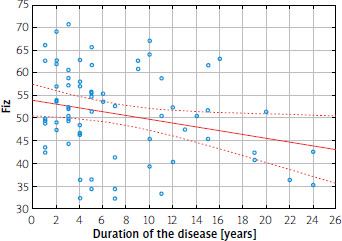
In the next part of the study, the correlations between SF-36 domain scores and BDI scores, weight, age, BMI, duration of illness, and BDI scores were evaluated. Statistically significant correlations were found between BDI scores and all domains in the SF-36 form (Figures 1–10), as well as between age and physical functioning (F) (r = –0.302, p < 0.05) and physical health (Fiz), (r = –0.295, p < 0.05). Statistically significant negative correlations were also found between the duration of the disorder and general health (H), (r = –0.290, p < 0.05), social functioning (S) (r = –0.257, p < 0.05), and physical health (Fiz) (r = –0.258, p < 0.05) (Figures 11–13).
Figure 1
Correlation between the Beck Depression Inventory and physical functioning (F) according to SF-36 (r = –0.44, p < 0.05). It was shown that as the severity of depression increased, patients rated their physical functioning as worse
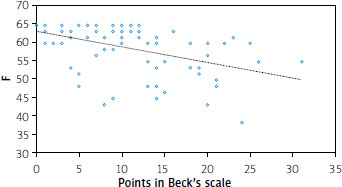
Figure 2
Correlation between the Beck Depression Inventory and role fulfilment restrictions due to physical health problems (R) according to SF-36 (r = –0.37, p < 0.05). It was shown that the greater the severity of depression, the more the patients felt restricted in fulfilling their roles due to physical functioning
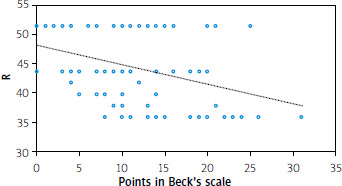
Figure 3
Correlation between the Beck Depression Inventory and bodily pain (P), according to SF-36 (r = –0.30, p < 0.05). It was shown that the higher the severity of depression, the more often patients complained about pain
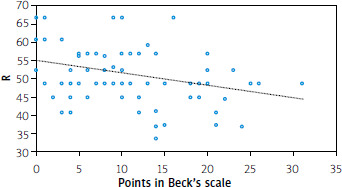
Figure 4
Correlation between the Beck Depression Inventory and general health (H), according to SF-36 (r = –0.42, p < 0.05). The findings revealed that as depression severity increased, patients gave poorer ratings for their general health
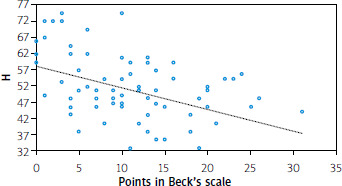
Figure 5
Correlation between the Beck Depression Inventory and vitality (V) according to SF- 36 (r = –0.58, p < 0.05). It was shown that the greater the severity of depression, the lower the patients rated their vitality
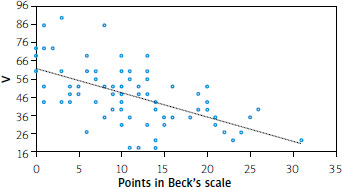
Figure 6
Correlation between the Beck Depression Inventory and social functioning (S) according to SF-36 (r = –0.42, p < 0.05). It was shown that the higher the severity of depression, the lower the patients rated their social functioning
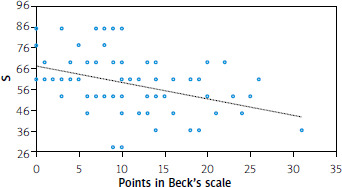
Figure 7
Correlation between the Beck Depression Inventory values and role fulfilment affected by emotional problems (E) according to SF-36 (r = –0.34, p < 0.05). It was shown that the higher the severity of depression, the more affected the role fulfilment by emotional problems
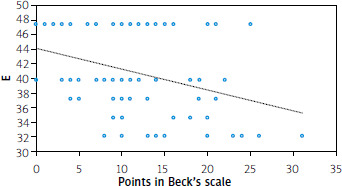
Figure 8
Correlation between Beck Depression Inventory values and mental health (W) according to SF-36 (r = –0.55, p < 0.05). It was shown that as the severity of depression increased, patients’ mental health scores worsened
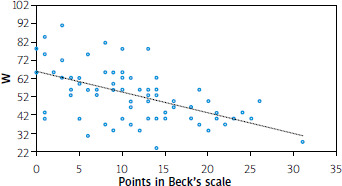
Figure 9
Correlation between the Beck Depression Inventory and physical health (Fiz) according to SF-36 (r = –0.55, p < 0.05). The findings indicated that as depression severity increased, patients rated their physical health worse
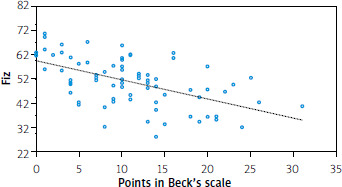
Figure 10
Correlation between the Beck Depression Inventory and psychological health (Psy) according to SF-36 (r = –0.64, p < 0.05)
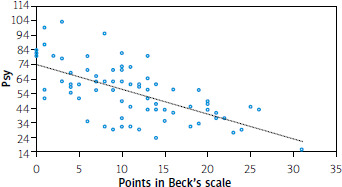
Figure 11
Correlation between duration of disease and general health according to SF-36 (H) (r = –0.290, p < 0.05). The findings indicated that as the duration of the disease increased, the evaluation of quality of life in the general health domain decreased
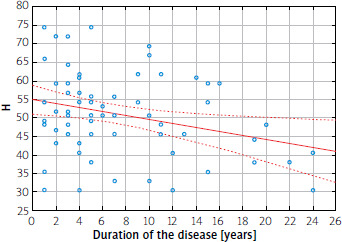
Figure 12
Correlation between duration of disease and social functioning (S) according to SF-36 (r = –0.2570, p < 0.05)
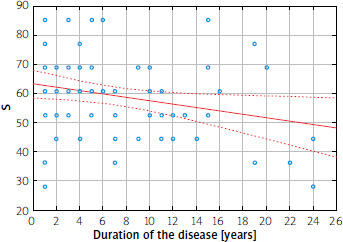
Figure 13
Correlation between duration of disease and physical health (Fiz) according to SF-36 (r = –0.258; p < 0.05)
Evidence showed that with increasing severity of depression, patients experienced a worsening of their psychological health. The strongest correlations were found between values of BDI and psychological health (Psy) (r = –0.64), vitality (V) (r = –0.596), and physical health (Fiz) (r = –0.567). The SF-36 parameters in IBS patients did not differ from the general population; however, the occurrence of depression had a strong impact on all the domains in the questionnaire. Statistically significant correlation was found between age and physical functioning (F) (r = –0.302, p < 0.05), and physical health (Fiz) (r = –0.295, p < 0.05).
Statistically significant negative correlations were found between disease duration and general health (H) (r = –0.290, p < 0.05), social functioning (S) (r = –0.257, p < 0.05), and physical health (Fiz) (r = –0.258, p < 0.05). The longer the duration of the disease, the lower the quality of life in each domain (Figures 11–13).
The findings indicated that as the disease duration increased, the evaluation of QoL in the social functioning domain decreased. It should be assumed that the duration of disorder has a negative effect on certain values of SF-36 domains in IBS patients. Also, when the disease duration time increased, QoL in the physical health area decreased.
Discussion
Despite IBS not being a life-threatening disease and having no effect on viability, it has a significant impact on the lives of patients, their families, and the entire healthcare system [9]. IBS is more often diagnosed in women than in men (patients participating in the research were also predominantly women), which might stem from women seeking medical help more often than men [10]. In this study, depression was diagnosed in 43.68% of patients with IBS, which is significantly higher than in the control group (8.93%). Anxiety and depressive disorders are strongly associated with initiation, development, and progression of IBS, exacerbating intestinal symptoms. The odds ratio for anxiety and depression in IBS subjects is estimated to be three-fold higher when compared to healthy ones. Data on the frequency of psychiatric disorders in IBS differs between the studies. However, the frequency of anxiety and depressive disorders in IBS is estimated to be about 40% and 30%, respectively [11, 12]. Discrepancies in the prevalence of depression between studies may be due to the use of different questionnaires, a focus on different mental disorders, verification of results with a standardised test, and cultural and religious differences. In the present study, a higher prevalence of depressive disorders was found in women, but this was not a statistically significant correlation. Similar results were shown in a study by Björkman et al. [13] involving 557 patients, including 152 men. The experiment used a hospital-based self-assessment scale for depression and anxiety. The obtained results did not show differences in depression, pain, stool frequency, impact on daily life, dissatisfaction with bowel habit, or extra-colonic symptoms between women and men with IBS [13].
Although previous data found that patients with IBS had a higher risk of depression compared with healthy controls under direct comparison, the difference of depression among different IBS subtypes was still not well evaluated. Moreover, understanding the comorbidity between IBS and depression may point out complex assessment and IBS management.
A relevant problem in IBS patients with psychiatric comorbidities is that they usually do not consider themselves to be suffering mentally [14]. In the present study, out of 38 patients with IBS and depression, only 4 patients with IBS were receiving treatment for depression. In our study, we did not observe differences in the occurrence of depression depending on the IBS subtype, which was also previously shown by other authors [15].
Generally, in the present study, the SF-36 parameters in IBS patients did not differ from those of the general population. There were also no differences depending on the patient’s gender. Considering the particular domains, the lowest score of 41 points was seen in the vitality domain (V), while the highest average value was in two domains: social functioning (S) – 59 points and physical functionality (F) – 58 points. The most recent data confirm lower QoL in IBS patients compared to healthy subjects based on the SF-36 questionnaire [16]. In the British population, a study by Creed et al. [5] evaluated how the severity of somatic symptoms and psychiatric symptoms affected the QoL, as measured by the SF-36. The study enrolled 257 patients with severe IBS who did not improve after standard treatment and were qualified for psychological treatment. Decreased QoL was found in every domain. The most impaired life domains were role limitations due to physical health (Fiz) and vitality (V), while the least impaired domain was physical functioning (F) [5]. The differences between the QoL results in the SF-36 questionnaire in IBS patients from different studies may reflect the general, not specific for this disease method, and the cultural differences between the populations evaluated.
We did not find differences in QoL results depending on the IBS subtypes. Similarly, Schmulson et al. revealed no differences in QoL in various types of IBS (diarrhoeal/constipated) using the SF-36. However, it was found that patients with the IBS-C type complained more often about gastrointestinal, musculoskeletal, and organic ailments. In addition, women were more likely to have IBS-C type of IBS [17]. In our study, we did not examine this correlation, but it seems that the severity of extraintestinal symptoms in women was related to more frequent constipation.
In our study, the significant correlations between BDI and all domains on the SF-36 form results were shown. Stronger depression was accompanied by a stronger reduction in QoL on the SF-36. Creed et al. [5] also found that the severity of depression was correlated with QoL as measured by the SF-36. In that study, the Hamilton Depression Rating Scale was used to assess the presence of depression. In a study by Kanuri et al. [18] that assessed the impact of sexual abuse and mood disorders on QoL with IBS using the SF-36 and BDI questionnaires, a similar relationship was obtained, and it was additionally disclosed that IBS patients were more likely to become victims of sexual abuse than healthy individuals. We also found significant negative correlations between disease duration and general health (H), social functioning (S), and physical health (Fiz). With longer disease duration, the quality of life decreased.
IBS is a condition that impacts various aspects of life, including both physical and mental health. It varies among patients, presenting different degrees of physical and mental symptoms. Despite the unthreatening character of the disease, the symptoms experienced by the patient significantly affect their functioning in every area of life. In addition, this pathology may affect the entire family and requires complex treatment. Adequate medical history taking and the identification of patients who struggle with depression would help to identify patients who require additional psychiatric and psychotherapeutic treatment alongside typical IBS management. In addition, it would be beneficial to widely introduce questionnaires used in this research, which can be easily filled out by patients and interpreted by healthcare professionals who do not have psychiatric education. An adequate and prompt diagnosis in this disease has not only a medical and ethical aspect, but also an economic one, avoiding numerous expensive diagnostic tests.
Conclusions
The presented research has some limitations stemming from the small, selected group of patients in the outpatient clinic and the diagnosis made based on BDI, and not the standard psychiatric evaluation, which might have affected the results. Despite these limitations, we have proven that depression is a significant problem in patients with IBS, which clearly lowers the patients’ QoL in every aspect. We speculate that IBS symptoms may also contribute to the low QoL in those patients, leading to depression traits in some of them. The regular assessment of depression and health-related QoL should be provided during patients’ visits to outpatient clinics. It may contribute to the IBS management, which would be more satisfactory for the patients.