Introduction
Crohn’s disease (CD) is a chronic inflammatory bowel disease that can affect the entire gastrointestinal tract, with highest prevalence rates reported in Europe and North America [1, 2]. The fistulising phenotype, which is one of the leading causes of CD-related disability, affects approximately 35% to 53% of individuals in various cohorts [3]. Perianal fistula is the predominant subtype, accounting for approximately 20% to 65% of cases. In some patients, it occurs as an initial symptom of CD [4]. The prevalence of anal fistulas amounts to 18.37 cases per 100,000 individuals in the European population [5]. Perianal fistulising disease is difficult to treat and is characterised by frequent recurrences [6, 7]. The cumulative incidence of complex perianal fistulas was estimated at 12% to 14%. Complex fistulas are associated with a worse prognosis and often lead to faecal incontinence, which worsens the patient’s quality of life [7–9]. Treatment is generally long term and determined on a case-by-case basis [10]. Tumour necrosis factor (TNF) inhibitors, particularly infliximab, are recommended as first-line biologic treatment; however, optimal treatment requires consideration of several issues, including dosage, early treatment of perianal sepsis, treatment duration, and the need to use concomitant medical therapy [6, 11].
Currently, between 60% and 90% of patients with perianal fistulas receive surgical treatment. It was reported that combined surgical and medical therapy led to better outcomes than surgery or medical therapy alone [12–15]. Effective management of perianal Crohn’s disease requires a collaborative effort involving both a gastroenterologist and a colorectal surgeon [16]. Current therapeutic strategies often follow a structured, stepwise protocol [17]. Initial management includes abscess drainage and seton insertion to facilitate ongoing drainage of the fistula tract, to prevent perianal sepsis and recurrent abscess formation and to maintain fistula patency [16, 17]. This is complemented by medical therapy, which combines antibiotics, immunosuppressants, and anti-TNF agents to target inflammation and support fistula healing [17]. In cases where these approaches are insufficient, advanced surgical options, such as reparative procedures, defunctioning stomas, or even proctectomy, may be considered [18]. Successful treatment hinges on simultaneously addressing sepsis, managing proctitis, and applying tailored medical regimens [19]. Therefore, improved diagnosis and management of this condition requires collaboration between the colorectal surgeon and the gastroenterologist, as well as shared decision-making between the patient and a multidisciplinary team [20].
Several factors negatively affect the collaboration within medical teams. In the absence of evidence from randomised controlled trials for perianal fistulising CD, there is no consensus among medical teams, and standardised measures are lacking [21]. This has led to differences in diagnostic management and treatment, which in turn results in suboptimal patient care and a marked impact on healthcare resources [22]. Cooperation between gastroenterologists and colorectal surgeons is hindered by long waiting times for diagnostic imaging procedures, such as magnetic resonance imaging (MRI) and transrectal ultrasound, as well as patient referrals to other clinics.
Aim
The aim of this study was to determine the approach of Polish gastroenterologists and surgeons to the diagnosis and treatment of complex cases of CD-related perianal fistulas during standard treatment, and treatment after failure of primary and surgical treatment.
Material and methods
This was a nationwide retrospective study conducted in Poland at centres providing treatment for patients with CD within the national drug programme B.32: Treatment of patients with Crohn’s disease (ICD-10: K50). The study began with desk research, during which centres treating adult patients for CD and CD-related perianal fistulas were identified based on the 2022 National Health Fund (NFZ) contract database for programme B.32. A total of 59 centres had contracts exceeding 5000 NFZ settlement points in programme B.32. Of these, 18 did not meet the eligibility criteria (no adult patients with CD or absence of gastroenterologists). Ultimately, 41 centres qualified for participation. The study was carried out in the planned form and consisted of two components:
Declarative component – structured online interviews (CAWI) were conducted with gastroenterologists and surgeons. Gastroenterologists were required to manage at least 20 patients with CD, including a minimum of 5 with complex perianal fistulas. Surgeons were included if they performed surgical treatment of CD-related perianal fistulas. In total, 27 gastroenterologists from 26 centres and 12 surgeons specialising in the treatment of fistulas from 11 centres, identified based on NFZ data and gastroenterologists’ recommendations, participated.
Analytical component – retrospective analysis of anonymised medical records was performed in 22 centres. Documentation from 80 patients was collected, typically covering 3–4 patients per centre.
Table I presents the numbers of participating physicians and number of evaluated patients. The survey was conducted using the computer-assisted web interview (CAWI) method. The results of the surveys were also used to assess the degree of cooperation between gastroenterologists and surgeons in providing multidisciplinary treatment for perianal fistulising disease. This cooperation was assessed on a 5-point Likert scale (1 = very poor, 2 = poor, 3 = average, 4 = good, 5 = very good). The study was conducted between February and March 2023.
Table I
Summary of physician and patient participation across surveys and retrospective analyses
The eligibility criteria for inclusion of patients in the analytical part of the study (medical record analysis) were as follows: age > 18 years, active treatment for CD, diagnosis of complex perianal fistula in the course of CD, failure of standard fistula treatment (lack of remission), and subsequent therapy lasting 1 to 5 years. A complex fistula was defined as the presence of at least 2 channels, a high tract course (inter-sphincteric, trans-sphincteric, extra-sphincteric, or supra-sphincteric), and the presence of perianal abscesses related to the fistula. The standard treatment was defined as the use of any of the following preparations: antibiotics (e.g. ciprofloxacin), metronidazole, immunosuppressive drugs (azathioprine, 6-mercaptopurine), and methotrexate. However, 64 of the patients also required surgical intervention.
Results
Frequency of perianal fistulas – surveys with gastroenterologists
The results of the survey among gastroenterologists demonstrated that 20% of patients treated for CD have perianal fistula (9% – simple fistula; 8% – complex fistula; 3% – both simple and complex fistulas), while an additional 20% reported a history of perianal fistula. In 24% of patients, the first fistula was reported before the formal diagnosis of CD. In 36% of patients, the first fistula was diagnosed within 3 years from the diagnosis of CD. However, in some patients (13%), the first fistula developed after more than 10 years from diagnosis.
Diagnostics – surveys with gastroenterologists
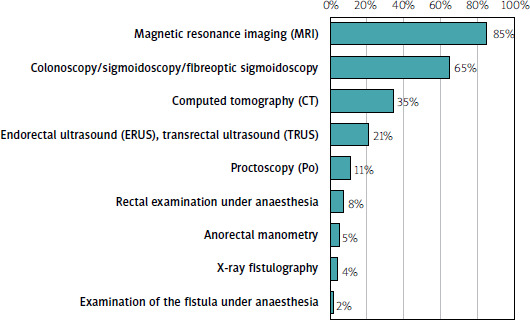
The survey showed that MRI followed by colonoscopy, sigmoidoscopy, and fibreoptic sigmoidoscopy were the most common diagnostic tools used in the identification of complex fistulas (Figure 1).
Figure 1
Diagnostic tools used in the identification of complex fistulas (source of data: survey conducted among gastroenterologist) Diagnostics – analysis of medical records
Based on the analysis of medical records, perianal fistula was diagnosed by a gastroenterologist alone in 34% (27/80) of patients, by a gastroenterologist in consultation with a surgeon in 50% (40/80) of patients, by a multidisciplinary team in 10% (8/80), and by surgeon alone in 6% (5/80). The predominance of gastroenterologists in the diagnostic process, either independently or in consultation with surgeons (84% of patients overall), was also confirmed by the survey results. Importantly, 44% of gastroenterologists declared that no patients in their centre were diagnosed by a structured multidisciplinary team, underscoring the lack of systematic, team-based diagnostic approaches in clinical practice.
Treatment
Standard therapy – analysis of the medical records
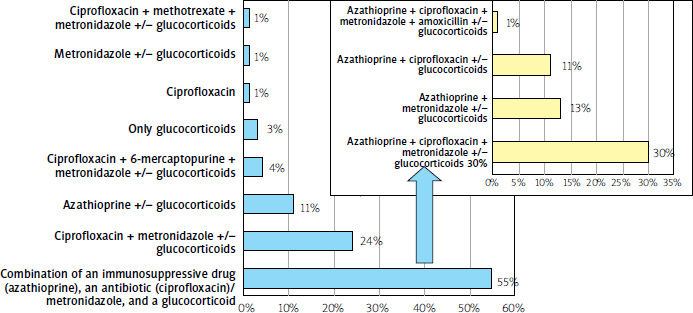
To assess the approach of physicians to fistula treatment, the medical records of 80 patients were analysed in terms of standard treatment regimens (Figure 2). The most common regimen was a combination therapy consisting of 3 or 4 drugs. Approximately 55% of patients received standard therapy with a combination of an immunosuppressive drug (azathioprine), an antibiotic (ciprofloxacin/metronidazole), and a glucocorticoid. An immunosuppressive drug (azathioprine) in combination with glucocorticoid was used in 11% of patients. Only 4% of patients received monotherapy (glucocorticoids in 3% and antibiotics in 1%). The median duration of standard treatment was 13 weeks.
Therapy after failure of standard treatment – analysis of the medical records
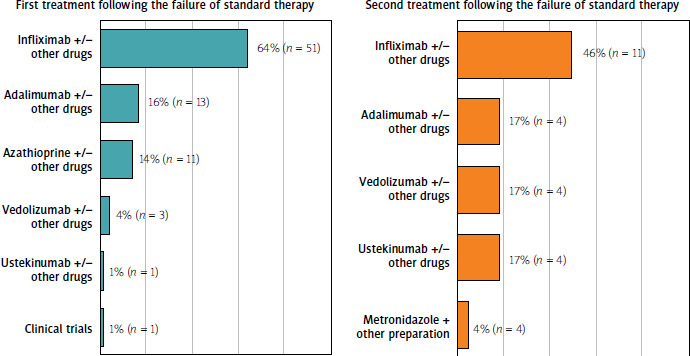
Following the failure of standard treatment, a combination of surgical and medical therapies was used in 80% of cases, while 20% of patients received medical therapy only. According to the medical records, surgical treatment of acute conditions (incision, drainage of abscess, opening of the fistula) was necessary in 51% of patients after the failure of standard treatment. In 49% of patients, setons were used, while fistulectomy was performed in 23% of patients. As part of pharmacotherapy, 91% of patients received biological treatment as the first or second treatment after failure of standard therapy. Most patients received infliximab (64% of patients) as the first treatment after the failure. Adalimumab was administered in 16% of patients, vedolizumab in 4%, and ustekinumab in 1%. In 30% of patients, second treatment was implemented before inclusion into the study. The second treatment included infliximab, adalimumab, vedolizumab, or ustekinumab. The treatment regimens are presented in Figure 3.
Surgical treatment – surveys with surgeons
The survey revealed that 29% of patients underwent the first surgical intervention before standard treatment, while 68% – within 8 to 21 weeks after the initiation of standard treatment. Almost two-thirds of patients underwent the first surgical intervention before the completion of standard treatment. Nearly half of the patients underwent surgical treatment of the fistula within 6 months from diagnosis, while 30% of patients underwent surgery within 7 months to 1 year from diagnosis, and 21% of patients waited more than a year from the diagnosis of the fistula for the first surgical intervention.
The survey revealed that patients with complex fistulas underwent a range of procedures, including surgical treatment of acute conditions (incision, drainage of abscess, opening of the fistula in 60% of patients), seton placement (57%), fistulectomy (34%), fistulotomy (29%), negative pressure therapy (19%), temporary ileostomy or colostomy (18%), fistulectomy with mucosal flap (14%), a procedure using tissue glue (6%), proctocolectomy (3%), stem cell therapy (1%), and a procedure using plugs (1%).
Cooperation between gastroenterologists and surgeons
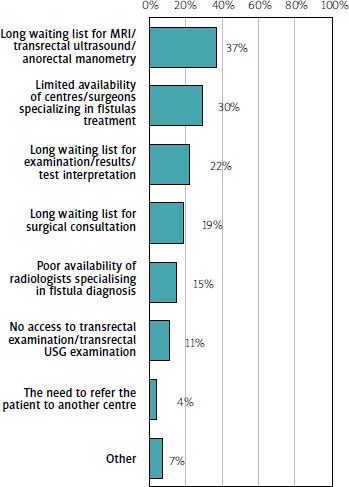
The survey highlighted challenges in the cooperation between gastroenterologists and surgeons in diagnosing and managing perianal fistula. Approximately 30% of gastroenterologists reported no issues during patient treatment. However, the majority of gastroenterologists identified barriers such as long waiting lists for specific examinations (MRI, transrectal ultrasound, anorectal manometry) and limited availability of specialised centres or surgeons (Figure 4). General issues included long waiting times for an appointment with a specialised surgeon (30%), a limited number of specialised surgeons or centres providing surgical treatment of fistulas (22%), lack of cooperation between surgeons and the referring physician (11%), delayed surgical decisions, the necessity to refer patients to another centre for surgical treatment (7%), and insufficient postoperative care (7%). At the stage of perianal fistula diagnosis, 26% of gastroenterologists rated cooperation as average (3/5) and 3% as poor (2/5), giving a total of 29% with less than good cooperation, while 71% rated it as good or very good (4–5/5). During treatment, 44% rated cooperation as average (3/5) and 7% as poor (2/5), i.e. 51% below good, while 49% rated it as good or very good (4–5/5). Opinions of surgeons concerning cooperation were rated as fairly good or good (33% of surgeons reporting no issues). Surgeons identified issues such as lack of coordination (25%), delayed referrals (17%), inadequate knowledge of surgical aspects among gastroenterologists (8%), long consultation waiting times (8%), and limited access to examinations and operating rooms.
Figure 4
Challenges in the cooperation between gastroenterologists and surgeons at the stage of fistula diagnosis (source of data: survey conducted among gastroenterologists)
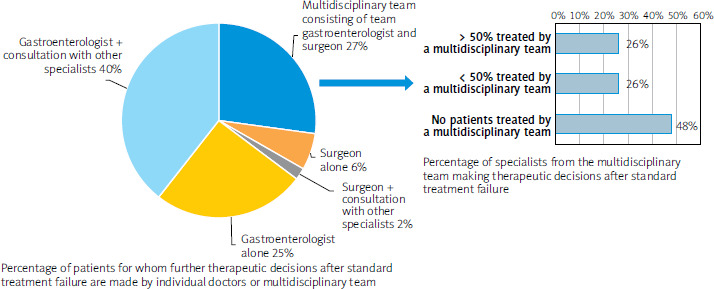
According to the results of the questionnaire, following the failure of standard treatment, the decision regarding management was primarily made by gastroenterologists (65% of cases), either alone (25%) or in consultation with other specialists, such as surgeons, radiologists, gynaecologists, or urologists (40%) (Figure 5). An interdisciplinary team was involved in this process in case of 27% of patients; however, it must be underlined that the availability of such a team differs significantly among centres. An interdisciplinary team managed patients only in half of the centres, which shows that such approach is not standard.
Discussion
To our knowledge, this study represents one of the first attempts to describe current practices in the diagnosis and management of Crohn’s disease-related perianal fistulas in Poland, combining physician surveys and retrospective chart review. While the study provides novel insights, the relatively small sample of participating gastroenterologists and surgeons should be interpreted with caution. However, it is important to note that these specialists represented more than half of all centres (63%) engaged in the B.32 programme (26 out of 41 centres with a contract > 5000 NFZ points), accounting for 89% of the total programme contracts. This strengthens the relevance of the findings, even if they remain exploratory rather than definitive. In addition, it presents real-life data from different perspectives, including those of a gastroenterologist and a surgeon.
In the management of perianal fistulas in patients with CD, a multidisciplinary approach is typically employed, involving prolonged administration of biologics, mainly TNF inhibitors, in conjunction with surgical procedures aimed at drainage of abscess or achieving definitive resolution of symptoms [9]. Despite these interventions, treatment failures are not uncommon, resulting in a repetitive cycle of therapeutic interventions without sustainable response. This study sought to investigate the strategies employed by gastroenterologists and surgeons in the management of complex perianal fistulas associated with CD across various stages of treatment, encompassing initial therapy, subsequent interventions following the failure of primary treatment, and surgical interventions.
In clinician surveys, respondents estimated that approximately 20% of their CD patients had a current fistula, while an additional 20% had a fistula in the past. Thus, around 40% of patients had ever experienced a fistula, either currently or previously. This aligns with literature reports showing that the frequency of fistulising perianal in patients with CD ranges from 17% to 43% [23, 24]. Because our medical-record cohort deliberately included only patients with complex fistulas, our study cannot provide population-level incidence or prevalence estimates. What is important, in our study cohort nearly one-fourth of patients developed a fistula before the formal diagnosis of CD, while 36% did so within 3 years after diagnosis. A comprehensive review of 12 population-based studies by Tsai et al. [25] revealed a lower prevalence of perianal fistulas, with perianal involvement reported in approximately 20% of patients with CD. The risk of perianal CD was found to increase with disease duration. Of note, about 60% of patients were diagnosed with perianal CD at the same time as luminal CD diagnosis or within the first year thereafter. The cumulative risk of perianal disease among CD patients at 1 year, 5 years, and 10 years after diagnosis was 14.3% (95% confidence interval [CI]: 7.9–24.6%), 17.6% (95% CI: 11.3–26.5%), and 18.9% (95% CI: 15.0–23.4%), respectively. Moreover, Tsai et al. [25] demonstrated that approximately 3.8% of patients developed perianal disease prior to the diagnosis of luminal CD [25].
Our study showed that MRI, colonoscopy, sigmoidoscopy, and fibreoptic sigmoidoscopy were the most common diagnostic tools used for the identification of complex fistulas in Poland. The guidelines of the Polish Expert Group on the current and future treatment of complex perianal fistulas in CD recommend MRI and/or transrectal ultrasound for lesser pelvis assessment [11]. Other published guidelines recommend visual inspection, digital examination, and imaging approaches including anoscopy, ultrasound, computed tomography, and MRI for the diagnosis of perianal fistulas [26, 27]. Additionally, transrectal ultrasound can be performed only if rectal stenosis is absent [27, 28]. Ultrasound examination of the buttocks can serve as a useful adjunctive technique. Endoscopic assessment is necessary in all patients to detect stenosis and active inflammation.
Most patients in our study received the first-line treatment consisting of 3 or 4 drugs, including the combination of an immunosuppressive drug (azathioprine), an antibiotic (ciprofloxacin), metronidazole, and a glucocorticoid. Only 1% to 3% of patients received monotherapy as standard treatment. The failure of standard treatment led to the introduction of biologic therapy (mainly infliximab, followed by adalimumab and vedolizumab) in 91% of patients. Prolonged administration of glucocorticoids at low doses or maintenance of the initial dose despite the lack of clinical remission represents an inappropriate therapeutic strategy [10]. TNF inhibitors, particularly infliximab, are the preferred treatment option in patients with severe exacerbations of CD, fistular form of the disease, or extraintestinal manifestations. All centres included in our study followed the Polish guidelines, which recommend combination treatment with an immunosuppressant and a TNF inhibitor as a more effective approach for achieving remission than monotherapy. Moreover, according to Polish guidelines, surgical intervention should be considered at every stage of disease management, particularly in cases where lesions are limited to a short bowel segment and/or complicated by fistulas, strictures, or abscesses. This is in line with other literature sources that recommend a similar therapeutic approach encompassing immunomodulators, TNF inhibitors, antibiotics, and surgical interventions [29]. An analysis of treatment strategies in Japan revealed that 23.9% to 46.5% of patients diagnosed with CD-related perianal fistulas were prescribed antibiotics, including metronidazole and ciprofloxacin [29]. Most patients received either standard treatment or biologic therapy (with or without standard treatment) before undergoing surgical treatment, while surgery was the first-choice treatment in 16% of patients.
The situation in Poland seems to be different. According to the survey among surgeons, 49% of patients are referred for surgical treatment within 6 months from the diagnosis of a fistula, while 30% of patients are referred within 7 months to 1 year from diagnosis, and 21% of patients wait more than one year. On the other hand, according to gastroenterologists, fistula is identified before CD diagnosis in up to 24% of patients. This is in line with a study by Mizushima et al. [29], in which CD was diagnosed after the identification of perianal fistula in 30.4% of cases, while in 69.6% of cases, fistulas were found during or after CD diagnosis [29].
In our study, the analysis of patients’ medical records showed that after the failure of standard treatment, numerous patients required surgical intervention for acute conditions (incision, drainage of abscess, opening of the fistula), seton placement, and fistulectomy. Our patients also underwent fistulotomy, stem cell treatment, fistulectomy with mucosal flap, a procedure using tissue glue, or a procedure using plugs. The available literature reported various surgical interventions for patients with anal fistulas. These include fistulotomy, seton placement, video-assisted anal fistula treatment, the use of autologous adipose-derived stem cells, mucosal advancement flap surgery, ligation of the inter-sphincteric fistula tract, the use of fibrin sealant, deployment of biologic or synthetic fistula plugs, and fistula tract laser closure [30–33].
Our study identified barriers to receiving surgical treatment at the time of diagnosis of perianal fistula. Gastroenterologists reported that the most common issues were long waiting lists for specific examinations (such as MRI, transrectal ultrasound, or anorectal manometry) and limited availability of centres or surgeons specialising in the treatment of fistulas. Moreover, the study demonstrated an insufficient number of interdisciplinary teams consisting of gastroenterologists and surgeons. These observations raise hypotheses about potential structural and organisational gaps in care delivery. Although these challenges are not unique to Poland, our findings highlight the need for better integration of gastroenterology and surgical care within national practice. Given the modest scale and retrospective design of this study, further prospective, multicentre investigations are required to validate these patterns and to assess their impact on patient outcomes. Increased availability of interdisciplinary teams could improve communication between gastroenterologists and surgeons, enhance patient management, and reduce the waiting time for surgery.
In general, while the basic principles for the management of perianal fistulas in CD are comparable across countries, differences in healthcare systems, resources, and practices can affect management strategies and outcomes. A review of current national and international guidelines on perianal fistulas (including guidelines issued by the British Society of Gastroenterology [BSG], the Association of Coloproctology of Great Britain and Ireland [ACPGBI], the Canadian Association of Gastroenterology [CAG], the Brazilian Study Group of Inflammatory Bowel Diseases [BSGIBD], the Danish Society of Gastroenterology [DSG], the European Crohn’s and Colitis Organisation – Special Situations [ECCO], the Italian Society of Gastroenterology [SIGE], the American College of Gastroenterology [ACG], the American Society of Colon and Rectal Surgeons [ASCRS], the Japanese Society of Gastroenterology [JSG], and the Shanghai Working Group [SWG]) revealed a consensus on most issues [34]. It is evident that multidisciplinary management involving different medical specialties is crucial for improving outcomes in patients with CD-related perianal fistulas. However, most guidelines tend to address surgical and medical treatments separately. MRI is recommended as the preferred imaging technique for diagnosis, with anorectal ultrasound also being an option due to its similar accuracy rates. Combining different imaging methods improves diagnostic accuracy. Colonoscopy is advised during the initial evaluation of patients with CD. Antibiotics are considered an effective treatment for perianal fistulas and related septic complications. Most guidelines recommend combining antibiotics with immunomodulators and/or biologics for CD-related perianal fistulas. A retrospective review of medical records from patients with CD in Belgium, France, Germany, Italy, and Spain revealed that a significant proportion of patients were treated with 5-aminosalicylic acid, TNF inhibitors, and immunosuppressants for CD or its complications [35]. Surgical interventions were frequently used for the treatment of complex perianal fistulas, with long-term seton placement and surgical drainage being the most common procedures.
First, the number of participating physicians was limited (27 gastroenterologists and 12 surgeons). The study was not designed to include all institutions in Poland but to capture a representative sample of centres with varying potential, measured by the size of their B.32 contracts. By including centres with the highest, medium, and lowest treatment volumes, and recruiting both referral gastroenterology centres and surgical units identified through NFZ data, the study provides a broad perspective on diagnostic and therapeutic practices. Nonetheless, the modest number of centres and respondents restricts generalisability, and the findings should be interpreted as descriptive and hypothesis-generating. However, this is preliminary study describing real world data concerning fistulising Crohn’s disease in Poland. Larger multicentre studies involving a broader range of institutions are needed to confirm and extend these observations.
Also, the retrospective design of the study, along with its reliance on past medical data, represents a potential limitation.
Conclusions
This exploratory study provides preliminary insights into the diagnosis and treatment of perianal fistulas in patients with CD in Poland. The findings suggest that cooperation between gastroenterologists and surgeons in the management of perianal fistulas may be suboptimal and highlight organisational barriers to multidisciplinary care. Currently, we are working on the development of a coordinated care programme for patients with inflammatory bowel disease in Poland. The introduction of such a programme could potentially improve the organisation of care for patients with perianal CD, but larger studies are needed to confirm these observations and guide its implementation.