Introduction
Inflammatory bowel disease (IBD) primarily presents in two types: ulcerative colitis (UC) and Crohn’s disease (CD). UC is distinguished by continuous inflammation confined to the mucosal layers of the colon, typically involving the rectum. In contrast, CD is marked by patchy areas of inflammation, known as skip lesions, and affects the entire thickness of the intestinal wall. The most prevalent symptom of UC is chronic, recurrent diarrhoea, which can be bloody or non-bloody and is frequently accompanied by abdominal discomfort, rectal inflammation, tenesmus, and urgency [1].
Curcumin, a polyphenol, has demonstrated numerous health benefits supported by evidence that it targets multiple signalling molecules and exhibits diverse cellular activities. Studies have shown its efficacy in alleviating pain, metabolic syndrome, inflammatory diseases, and degenerative and inflammatory eye conditions. Additionally, it has been found to benefit renal function. While most of curcumin’s therapeutic effects are attributed to its anti-inflammatory and antioxidant properties, research suggests it may have many other beneficial mechanisms [2].
Between 1990 and 2019, there was a significant increase in the prevalence of disability-adjusted life years (DALYs), years of healthy life lost due to disability (YLDs), and IBD-related anaemia. The prevalence of IBD remained elevated in high and high-middle Socio-Demographic Index (SDI) nations, while the disease burden increased in low, low-middle, and middle SDI nations. Higher SDI was associated with greater prevalence and age-standardised rates (ASR) of both YLDs and IBD-related anaemia. A decomposition analysis revealed population growth as the primary contributing factor, followed by population aging [3].
Mesalamine, administered either topically, orally, or in combination, serves as the first-line treatment for mild-to-moderate ulcerative colitis [4]. While oral monotherapy shows reduced efficacy, combined oral and topical mesalamine administration demonstrates superior therapeutic outcomes [5]. For patients with mild-to-moderate active disease who fail to respond to optimised mesalamine therapy, escalation to corticosteroids and/or immunomodulators may become necessary. However, these alternative treatments carry significant risks of serious adverse effects.
Curcumin, a natural phytochemical derived from the Indian spice turmeric [6], has been utilised for millennia in both traditional Chinese medicine and Ayurvedic practice to treat various inflammatory conditions. In vitro studies have demonstrated curcumin’s anti-inflammatory and antioxidant properties in human lymphocytes and gastrointestinal epithelial cell lines [7, 8]. Furthermore, animal studies have shown curcumin’s efficacy in reducing severity in experimental murine colitis models [9, 10].
A recent systematic review and meta-analysis of 385 patients found that adjuvant curcumin therapy demonstrated benefits for clinical remission but not for clinical improvement or disease activity in UC [11]. While these findings suggest curcumin’s potential therapeutic value for UC, conclusive recommendations await further well-designed randomised controlled trials (RCTs) with larger sample sizes to guide clinical decision-making regarding curcumin supplementation.
Turmeric, a spice renowned for its medicinal properties, has attracted significant scientific and culinary interest due to its high polyphenol curcumin content. Evidence demonstrates its therapeutic potential in managing oxidative stress, inflammatory conditions, metabolic syndrome, arthritis, anxiety, and hyperlipidaemia. Additionally, turmeric shows promise in enhancing recovery and physical performance among athletes by reducing exercise-induced inflammation and muscle soreness. Notably, even at low doses, it provides health benefits for healthy individuals, attributable to its potent antioxidant and anti-inflammatory properties [2].
Aim
Based on these findings, our study investigated the efficacy of curcumin as an adjunct therapy to optimised mesalamine treatment for achieving clinical remission and reducing disease activity in patients with UC.
Material and methods
Study design and setting
This clinical trial enrolled patients diagnosed with UC from the Internal Medicine Unit of Azadi Teaching Hospital, a tertiary care centre and the primary facility for internal medicine diagnosis and treatment in Duhok City. Potential patients underwent comprehensive medical and clinical screening to verify their UC diagnosis. The study specifically recruited patients with mild-to-moderate active UC between February 2023 and June 2024.
Inclusion and exclusion criteria
Participants who were 18 years of age or older and had been diagnosed with mild-to-moderate UC based on verified endoscopic and histologic results were included in the study. Exclusion criteria for UC patients involved several factors. Individuals with haemoglobin levels below 10 g/dl, those who had used corticosteroids within the past 12 weeks or were still undergoing corticosteroid treatment, and patients on anti-tumour necrosis factor agents or cyclosporine were excluded. Laboratory abnormalities such as leukopaenia, thrombocytopaenia, or irregular coagulation tests also led to exclusion. Patients with severe comorbidities, including liver or kidney disease, were not considered for inclusion. Additionally, those with active infections in other organs, pregnant or breastfeeding women, and individuals with stool cultures positive for enteric pathogens or Clostridium difficile were excluded. Lastly, participants using immunomodulators like 6-mercaptopurine or azathioprine were excluded unless they had maintained stable dosages for at least 12 weeks before the study. Patients who had previously received biological agents were also excluded from the study. Furthermore, all patients were under the care of the study clinician, meaning they received the same treatments, although they differed in disease duration.
Sampling technique
In this study, patients were assigned to either a control group or an experimental group (receiving curcumin therapy) based on a randomly generated sequence of digits. A total of 60 participants were randomly distributed between the two groups using statistical software. These 60 participants were then split into two groups of 30 each. Subsequently, the patients were randomly allocated to the control or curcumin therapy group through a lottery method.
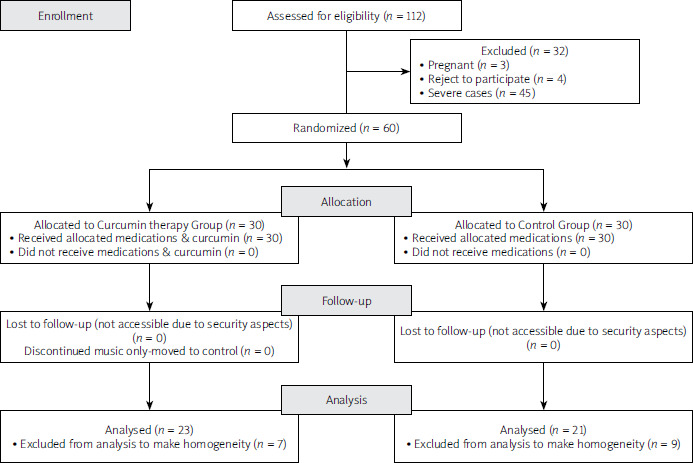
The randomisation process was carried out by the first author, while the second author managed patient enrolment based on the pre-generated random numbers. Patients who chose not to participate were not assigned any numbers. Of the 112 patients assessed for eligibility, 84 met the inclusion criteria. From the 60 patients who were randomly and evenly assigned to the two groups, 7 from the control group and 9 from the experimental group were excluded from the final analysis to adhere to the protocol analysis procedure (Figure 1).
Study groups
Patients diagnosed with mild-to-moderate active UC were randomly assigned to either the control or curcumin therapy group. Both groups continued to receive their standard medications, including mesalamine agents. The curcumin therapy group additionally received 2 g of oral curcumin daily for 2 months.
Treatment
This study is a single-centre, randomised, single-blind controlled trial involving patients with active mild-to-moderate UC who were already receiving the maximum recommended doses of both oral and topical 5-aminosalicylic acid (5-ASA) medications (e.g. 4 g/day of mesalamine along with a topical enema or suppository). For patients on standard-dose 5-ASA therapy (2–3 g/day of mesalamine) or diazo-bonded 5-ASA, the dosage was increased to either the maximum tolerable level or as clinically indicated, based on disease extent and patient tolerance.
All participants were instructed to maintain their optimal mesalamine regimen exactly as prescribed at trial initiation. They were then randomly assigned in a 1 : 1 ratio to receive either an additional 2-month treatment of 2 g curcumin daily in oral capsule form (one 1000 mg capsule taken before meals twice daily) or no additional treatment. The curcumin capsules (Puritan’s Pride® Turmeric Curcumin 1000 mg) were commercially sourced, with each bottle containing 60 capsules (Manufacturer: Puritan’s Pride, Inc., Holbrook, NY 11741, USA; Product Code: B19456 03B). All other medications were continued as prescribed throughout the trial period.
The study maintained single-blind conditions, with only the randomisation clinician aware of the treatment assignments. Clinical status was assessed at baseline and after two months using the Simple Clinical Colitis Activity Index (SCCAI) [12, 13]. A small subset of patients who demonstrated inadequate response to 5-ASAs received immunomodulators during the trial.
Clinical assessment
The SCCAI was used to assess disease activity in UC patients at baseline and after 2 months. The SCCAI evaluated six symptom domains with the following scoring criteria:
Daytime bowel frequency:
Nocturnal bowel frequency:
Defecation urgency:
Blood in stool:
General well-being:
Extracolonic manifestations:
Mild-to-moderate active UC was clinically defined as an SCCAI score > 5 but < 12 [14], while remission was defined as SCCAI ≤ 2.5 [14].
Adverse events
Adverse events reported by patients were documented in both study groups. The study clinician recorded these events during the 2-month assessment period. Throughout the trial, patients maintained regular contact with the clinician to report any complications or clinical deterioration.
Bias reduction techniques
The first author generated pre-randomised digit assignments for the study groups. The researcher responsible for patient recruitment remained blinded to group allocations throughout the study. Patients were also unaware of their treatment group assignments. Clinical assessments were performed by each patient’s regular clinician because cultural norms in our setting make patients more comfortable visiting their established physicians. Using alternative assessors would likely have led to substantial participant attrition.
Statistical analysis
Descriptive statistics are presented as mean (standard deviation) for continuous variables and as frequencies (percentages) for categorical variables. Baseline homogeneity between the curcumin and control groups was assessed using independent t-tests for continuous variables and Pearson’s χ2 tests for categorical variables. The primary efficacy analysis compared clinical improvement between groups using independent t-tests or χ2 tests as appropriate. Within-group changes in disease severity from baseline to follow-up were evaluated using paired t-tests. Treatment effect size was calculated using Cohen’s d, with effect precision expressed as mean difference (95% confidence interval). All analyses used a two-sided α level of 0.05 for statistical significance. Statistical computations were performed using JMP® software (Version 18.0; SAS Institute Inc., Cary, NC, USA; 1989–2023).
Sample size calculation
Sample size calculation was based on previously reported mean SCCAI values of 7.0 (SD = 1.8) at baseline and 5.5 (SD = 1.1) at follow-up. Using a 1 : 1 allocation ratio, we conducted a power analysis for a two-tailed test with α = 0.05 and power (1 – β) of 0.95. These parameters yielded an effect size of 1.01, indicating a required sample size of 27 patients per group. To accommodate potential attrition, we enrolled 30 patients per group.
Results
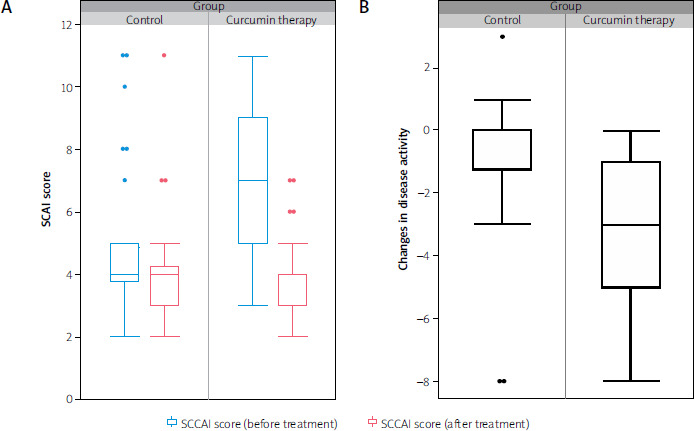
At both the intention-to-treat (ITT) and per-protocol (IPP) stages, the patients in the control and curcumin treatment groups had comparable general and medical characteristics. However, according to the ITT analysis, the curcumin treatment group had a significantly greater mean disease severity at baseline (mean: 7.10; SD =: 2.23) than the control group (mean: 4.03; SD = 0.89; p < 0.0001). After the study (2-month follow-up), the curcumin treatment and control groups had comparable mean SCCAI scores (3.47 vs. 3.63; p = 0.5155). Before and after treatment, there was a significant difference in the severity of the condition in both groups: the curcumin therapy group’s score decreased from 7.07 to 3.47 (p < 0.0001), while the control group’s score decreased from 4.03 to 3.63 (p = 0.0434). However, the curcumin treatment group showed a greater reduction than the control group (–3.4 vs. −0.5; p < 0.0001). The remission rates for the curcumin treatment and control groups did not differ significantly (10.0% vs. 20.0%; p = 0.4716; Table I; Figure 2).
Table I
Comparisons of general and medical characteristics between control and curcumin therapy groups at intention-to-treat step
Figure 2
SCCAI scores of the curcumin and control groups at baseline and follow-up steps at intention to treat step
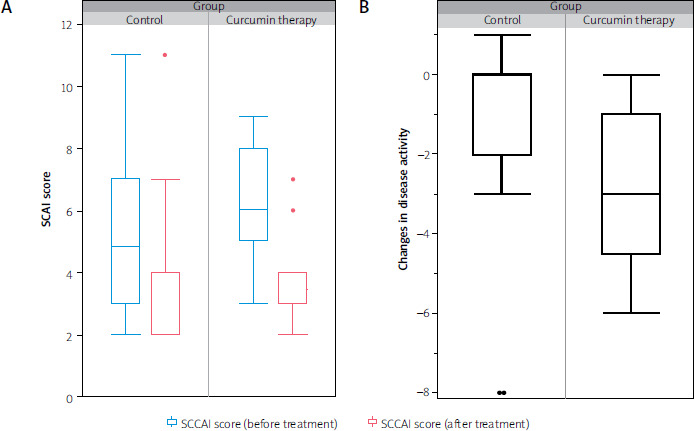
The study found that the mean SCCAI scores were comparable between the curcumin treatment and control groups both at baseline (6.29 vs. 5.13; p = 0.1101) and at the conclusion of the trial (3.29 vs. 3.65; p = 0.5509). Both the control group (from 5.13 to 3.65; p < 0.0001) and the curcumin treatment group (from 6.29 to 3.29; p = 0.0075) showed significant reductions in mean SCCAI scores. However, the curcumin treatment group experienced a greater improvement (–2.76 vs. –0.87; p = 0.0004) compared to the control group. No significant difference was observed in remission rates between the curcumin treatment and control groups (9.52% vs. 26.09%; p = 0.2451; Table II; Figure 3).
Table II
Comparisons of general and medical characteristics between control and curcumin therapy at per-protocol step
Figure 3
SCCAI scores of the curcumin and control groups at baseline and follow-up steps at per protocol step
The mean SCCAI scores were similar between the curcumin therapy and control groups in both females (3.33 vs. 3.85; p = 0.3336) and males (3.22 vs. 3.40; p = 0.6677). Similarly, the mean SCCAI scores did not differ significantly between males and females within the curcumin therapy group (3.33 vs. 3.22; p = 0.7074) or the control group (3.85 vs. 3.40; p = 0.4558; Table III). Furthermore, the study demonstrated a significant reduction in mean disease severity in both groups: from 5.13 to 3.65 in the control group (p = 0.0075) and from 6.29 to 3.29 in the curcumin therapy group (p < 0.0001; Table IV).
Table III
Comparisons of SCCAI score between control and curcumin therapy in patients with ulcerative colitis at 2 months
Table IV
Comparisons of SCCAI score before and after curcumin therapy in the control and patient groups at 2 months
| SCCAI score | Time | Mean diff (95% CI) | P-value | |
|---|---|---|---|---|
| Before treatment | After treatment | |||
| Control | 5.13 (2.72) | 3.65 (1.47) | –1.48 (–2.52 to –0.44) | 0.0075 |
| Curcumin therapy | 6.29 (1.85) | 3.29 (0.64) | –3 (–3.81 to –2.19) | < 0.0001 |
Discussion
After two months of treatment, this study found that curcumin therapy did not significantly reduce disease severity in patients with mild-to-moderate UC. However, the efficacy of curcumin as an adjunctive therapy for UC remains under debate. A comprehensive review and meta-analysis of three randomised controlled trials involving 142 patients with mild-to-moderate UC treated with both curcumin and mesalamine showed a pooled odds ratio of 6.78 (95% CI: 2.39–19.23; p = 0.042) for clinical remission associated with curcumin use. Additionally, the curcumin treatment group demonstrated superior outcomes compared to the placebo group in terms of overall improvement, endoscopic remission, and clinical response [15].
A recent systematic review and meta-analysis conducted in 2023, which included studies up to June 2021, evaluated data from six RCTs involving 385 patients. The review found that adjunctive curcumin treatment significantly increased remission rates in UC patients (RR = 2.10, 95% CI: 1.13–3.89). However, no significant effects were observed for clinical improvement (RR = 1.62, 95% CI: 1.00–2.61), endoscopic remission (RR = 4.17, 95% CI: 0.63–27.71), or endoscopic improvement (RR = 4.13, 95% CI: 0.20–87.07). Additionally, the authors suggested that the therapeutic efficacy of curcumin might be enhanced by optimising the administration route (e.g. topical delivery), treatment duration, dosage, and formulation [11].
Oral curcumin is not superior to placebo in achieving UC remission [16, 17], contrasting with findings from other studies. The plant-derived compound curcumin has been widely used in herbal medicine to treat various inflammatory conditions, including gastrointestinal tract inflammation [6]. Multiple studies have demonstrated that curcumin exhibits diverse immunomodulatory effects, including suppression of the nuclear factor kappa B pathway [9], tumour necrosis factor-α production [18], and CD4+ T-cell proliferation [8].
The precise mechanism by which curcumin affects UC patients remains unclear. However, a recent study investigating curcumin’s effect on disease activity in UC patients found that the curcumin-treated group showed significantly greater improvement compared to the placebo group (–5.9 vs. –2.1; p = 0.001). Additionally, the curcumin group demonstrated substantially lower ESR levels (–1.6 vs. –0.09 mm/h; p = 0.02) and significantly reduced serum hs-CRP concentrations (–6.3 vs. 3.7 µg/ml; p = 0.01) relative to the control group. No significant changes were observed in TNF-α levels in either group [19]. While these inflammatory markers may be associated with disease severity, the study did not specifically examine the relationship between SCCAI severity and inflammation.
The strength of this study was the absence of patient loss to follow-up. However, despite random allocation, baseline disease severity differed between groups. Existing studies have employed varying curcumin dosages, making direct comparisons challenging. In our study, patients received only 2 g of curcumin daily for two months; a longer treatment duration might yield greater benefits.