Introduction
Inflammatory bowel disease (IBD), comprising ulcerative colitis (UC) and Crohn’s disease (CD), is a chronic condition characterised by cycles of gastrointestinal inflammation, remission, and relapse. While UC primarily affects the colon and rectum, CD can involve any region of the gastrointestinal tract [1].
Dietary management plays a crucial role in IBD care, with low-fibre diets often recommended during disease relapses to mitigate symptoms [2]. However, prolonged fibre restriction may adversely affect gut microbiota and overall health, as dietary fibre with prebiotic properties is crucial for the formation of beneficial microbial metabolites, particularly short-chain fatty acids (SCFA) [2, 3].
In IBD, SCFA exerts anti-inflammatory effects by activating G-protein coupled receptors (GPCR) like GPR41, GPR43, and GPR109A, which are found in immune and intestinal epithelial cells [4]. They play a crucial role in gut health due to their immunomodulatory and anti-inflammatory properties [5–7]. The primary SCFA in the human gut are acetate, propionate, and butyrate, with butyrate serving as an energy source for intestinal epithelial cells and promoting bicarbonate secretion in the colon by activating the monocarboxylate transporter (MCT) [8, 9]. This process helps regulate luminal pH and protects the mucosal barrier, thereby supporting overall colonic health. An optimal luminal pH is also advantageous for the effectiveness of first-line therapy for IBD, 5-aminosalicylic acid (5-ASA) [10]. Additionally, SCFA inhibits histone deacetylase (HDAC), suppressing inflammation and autoimmune diseases by modulating the HDAC pathway [11].
A study using mouse and inflammatory cell models demonstrated that oat b-glucan reduces the expression of inflammatory cytokines, including TNF-a, IL-6, and IL-1b, probably through butyrate produced during dietary fibre fermentation by gut microbiota [12].
Similarly, research on IBD patients found significantly lower levels of SCFA, such as butyric, acetic, and valeric acids, in those with active disease [13]. Furthermore, an inverse correlation between butyric acid concentrations and C-reactive protein (CRP) levels suggests that enhancing SCFA formation may help regulate inflammation and reduce CRP levels [13].
A low-fibre diet may be necessary during periods of IBD relapse, intestinal stenosis, small intestinal bacterial overgrowth, or post-surgical recovery [3], but it should be limited to short durations [2]. Unfortunately, many patients lack proper guidance on reintroducing dietary fibre, leading to unnecessarily prolonged restrictions [2]. Considering the critical role of dietary fibre in gut microbiota and overall health, structured dietary strategies are crucial for the long-term management of IBD.
Oat dietary fibre, particularly b-glucan, resists digestion in the upper gastrointestinal tract due to the absence of b-D-glucanase enzymes, and undergoes fermentation by gut microbiota in the colon, exhibiting notable prebiotic properties [14]. While human faecal microbiota fully hydrolyses b-glucan, mice faecal microbiota does not completely degrade it [15]. This discrepancy suggests that animals may not fully capture the prebiotic effects of oat dietary fibre, emphasising the need for in vitro studies using human microbiota and clinical trials to explore its role in IBD management.
Recent findings by Hiengrach et al. highlight ongoing controversies regarding b-glucan’s proinflammatory and anti-inflammatory effects in IBD. In an IBD animal model, b-glucans with different structural linkages induced distinct immune responses. Pachyman, characterised by minimal (1®6)-linkages, elicited the strongest proinflammatory effect when combined with dextran sodium sulphate (DSS) or lipopolysaccharides (LPS), whereas oat b-glucan exhibited the weakest proinflammatory response. These differences may stem from variations in the downstream signalling of the Dectin-1 and TLR-4 pathways [16], suggesting that specific b-glucan structures could be selected for targeted therapeutic applications.
Despite the potential prebiotic benefits of oat dietary fibre b-glucan, research on its role in IBD remains limited. A systematic review in 2014 [17] identified only two long-term studies on oats in UC patients and none in CD. Among these, only one study reported significant clinical improvements, such as reduced relapse rates and decreased abdominal pain. Given that this review is nearly a decade old, updated research is necessary to further elucidate the therapeutic potential of oats and b-glucan in IBD management.
Aim
This systematic review aims to present the most recent evidence regarding the effects of oat dietary fibre, particularly oat b-glucan, in the context of inflammatory bowel disease.
Methodology
Search strategy
An electronic search of the PubMed, Scopus, and Web of Science databases was conducted in January 2025, to identify original studies (clinical, pre-clinical, and in vitro) published between January 2014 and December 2024.
The PubMed, Scopus, and Web of Science databases were selected as the primary databases for this systematic review due to their comprehensive coverage of high-quality, peer-reviewed literature across biomedical, nutritional, and multidisciplinary scientific fields.
The following keywords were used in the search: (oat OR oat beta glucan) AND (IBD OR UC OR Colitis OR Crohn’s).
Titles and/or abstracts were screened to identify studies that potentially met the eligibility criteria. Eligible full-text papers were systematically reviewed to address the primary research question: What is the current understanding of the effects of oat dietary fibre, including b-glucan, on the inflammatory state in IBD?
Eligibility criteria
Inclusion criteria: Original clinical studies, case-control studies, animal intervention studies, and in vitro studies published in English that analysed the effects of oat dietary fibre, specifically b-glucan, on IBD.
Exclusion criteria: Non-original research: Commentaries, letters to the editor, correspondence, editorials, duplicate publications, retractions, and reviews (including narrative, systematic, and meta-analyses).
Irrelevant focus: Studies not specifically analysing oat dietary fibre or b-glucan, or those focusing on unrelated dietary components or interventions.
Language restrictions: Studies not published in English.
Population mismatch: Studies not involving clinical populations with IBD, animal models of IBD, or relevant in vitro systems.
Duplicate publications: Studies that overlap with others already included.
Articles available only as abstracts were not excluded but were analysed based on the information provided in the abstract and mentioned with a note if the analysis was based solely on abstract data.
Results
Study selection
In total, 159 records were identified through a search of electronic databases (PubMed, Scopus, Web of Sciences). After duplicates were removed, 119 titles and abstracts were screened: 38 of these records were excluded based on their type, and then 81 papers were assessed for eligibility.
Subsequently, an additional 19 articles were excluded due to population mismatch, and 42 due to the absence of an oat dietary fibre intervention design or irrelevant focus. The flow diagram of the articles included during the selection process is provided in Figure 1.
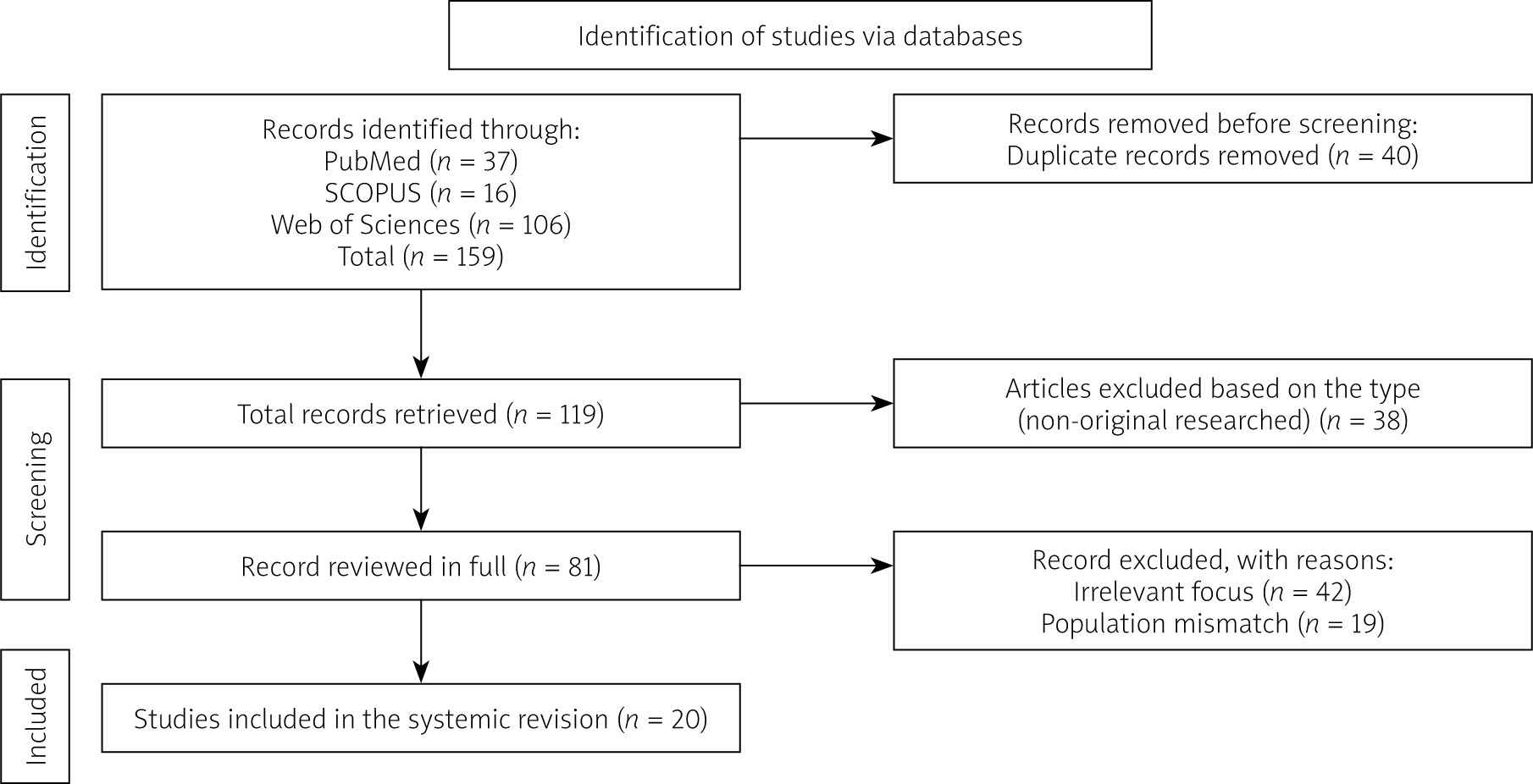
Ultimately, 20 articles met the inclusion criteria and were incorporated into this systematic review. Table I summarises the reviewed studies, detailing the authors, publication year, IBD model, study type, intervention, and observed effects.
Table I
Summary of the reviewed studies
| Authors and publication year | Intervention, dosage, duration | Type of study and origin of IBD | Effect of intervention |
|---|---|---|---|
| Liu et al. 2015 [27] | Oat β-glucan was administered at dosages of 500 mg/kg and 1000 mg/kg for a treatment period of 8 days | DSS-induced acute colitis in mice (n = 80) | Exhibited anti-inflammatory effects by inhibiting pro-inflammatory factors (TNF-α, IL-1β, IL-6, iNOS) |
| Żyła et al. 2019 [28] | Diets supplemented with 1% (w/w) oat β-glucan of either low (1.7 × 10⁶ g/mol) or high (5.9 × 10⁴ g/mol) molecular weight for 21 days | TNBS-induced colitis in Sprague–Dawley rats (n = 54) | The intervention demonstrated MW-dependent therapeutic effects: high-MW β-glucan more effectively inhibited lymphocyte infiltration in the colon mucosa and submucosa, while low-MW β-glucan more potently reduced inflammatory markers and modulated cytokine and chemokine signalling pathways |
| Kopiasz et al. 2020 [29] | 1% (w/w) oat β-glucan of either low or high molar mass for durations of 3, 7, or 21 days | TNBS-induced colitis in Sprague–Dawley rats (n = 150) | Exhibited indirect antioxidant effects on colon mucosa. Low molar mass β-glucan was more effective in reducing systemic inflammation |
| Xu et al. 2023 [12] | 10% (w/w) oat β-glucan in the diet (purity: 80%) for durations of 2 weeks | DSS-induced acute colitis in mice (n = 60) | Promoted autophagy flux and downregulated IL-1β, IL-6, and TNF-α in intestinal epithelial cells |
| Bai et al. 2021 [34] | Oat β-glucan | DSS-induced colitis in mice | Suppressed colonic inflammatory infiltration, reduced cell apoptosis, and improved colitis by modulating microbial metabolites |
| Żyła et al. 2021 [35] | Diet supplemented with 1% (w/w) oat β-glucan, either of low or high molar mass, for durations of 3 and 7 days | TNBS-induced Crohn’s disease in Sprague–Dawley rats (n = 96) | Low MW β-glucan reduced gene expression of IL-1, IL-6, IL-12, TNF-α, and CRP; high-MW β-glucan improved tissue recovery and histological outcomes |
| Kopiasz et al. 2021 [36] | Diet supplemented with 1% (w/w) low-molar-mass oat β-glucan, either of high-molar-mass oat β-glucan for durations of 3, 7, or 21 days, corresponding to different phases of inflammation and remission | TNBS-induced Crohn’s disease in Sprague–Dawley rats (n = 150) | Low-molar-mass β-glucan exhibited a stronger effect on apoptosis regulation. High-molar-mass β-glucan had a more pronounced impact on autophagy processes |
| Kopiasz et al. 2022 [37] | Diet supplemented with low- or high- molar-mass oat β-glucan administered for durations of 3 or 7 days | TNBS-induced Crohn’s disease in Sprague–Dawley rats (n = 96) | Low-molar-mass β-glucan was more effective during acute inflammation, while high-molar-mass β-glucan showed stronger effects during remission. Both reduced pro-inflammatory chemokines, suggesting improved immune regulation and mucosal healing |
| Oczkowski et al. 2024 [38] | 1% (w/w) oat β-glucan (both low- and high-molar-mass forms) administered for duration of 21 days | TNBS-induced colitis in Sprague–Dawley rats (n = 38) | Dietary oat β-glucan supplementation, especially with high molar mass, may help maintain testicular homeostasis by modulating antioxidant defence and inflammatory responses |
| Chudan et al. 2023 [39] | 5% (w/v) soluble oat fibre (including β-glucan) administered for duration of 14 days | TNBS-induced colitis in Sprague–Dawley rats (n = 30) | Soluble oat fibre supplementation may serve as a promising prebiotic treatment for the prevention of colitis by modulating gut microbiota composition and enhancing butyrate production, leading to increased regulatory T-cell populations and reduced inflammation |
| Duan et al. 2024 [40] | Oat and oat bran. 15%, 30%, and 45% oat dose groups, and 10% oat bran, 20% oat bran, and 30% bran dose groups. Administered for duration of 14 days | DSS-induced acute colitis in mice (n = 80) | Oat or oat bran can alleviate DSS-induced colitis in mice by enhancing gut barrier function, modulating the gut microbiota, and increasing SCFA production, thereby reducing inflammation |
| El Deeb et al. 2023 [41] | β-Glucan group: for 28 days, was combined with intragastric gavage administration of β-glucan at a dosage of 350 mg/kg/day (at a value of 140 mg/ml in filtered water | Oxazolone-induced UC Wistar rats were grouped into five groups (each 10 rats): control, UC, β-glucan, Fidarestat, and combined treatment groups | The combination of β-glucan and Fidarestat demonstrated distinct therapeutic effects on UC by targeting the microbiota/mitochondrial axis, suggesting a novel approach for managing this complex, multifaceted disease |
| Suchecka et al. 2015 [30] | Oat β-glucan of purity approx. 75%, with low and high MW. Administered for 6 weeks | LPS induced enteritis in Spraque-Dowley rats (n = 72) | Both β-glucan fractions significantly reduced T and B lymphocytes, granulocytes, and Tc lymphocytes. High MW β-glucan reduced lipid peroxidation more in healthy rats, while low MW β-glucan was more effective in enteritis groups, primarily by boosting antioxidant defence |
| Błaszczyk et al. 2015 [31] | Low and high MW oat β-glucan. Administered for 6 weeks | LPS induced enteritis in Sprague–Dawley rats (n = 72) | Dietary supplementation with oat β-glucan enhances antioxidant defence in the spleen, particularly in animals with gut inflammation. High MW β-glucan demonstrated greater antioxidant efficacy in LPS-induced enteritis, while low MW β-glucan was more effective in reducing oxidative stress in animals without LPS treatment |
| Hiengrach et al. 2022 [16] | Pachyman, whole-glucan particles, and oat β-glucans orally administered at a dose of 1 mg per mouse. Intervention duration was 10 days | DSS-induced acute colitis in mice | This study highlights that different forms of β-glucans have distinct immunomodulatory effects. Pachyman, a BG with minimal (1→6)-linkages, demonstrated the strongest proinflammatory response in combination with DSS or LPS, particularly by inducing high levels of cytokines (TNF-α and IL-6) and activating inflammatory genes. Selecting specific BG forms could optimize therapeutic strategies for targeted clinical applications |
| Li et al. 2024 [42] | Insoluble dietary fibre (IDF) was administered at a dosage of 500 mg/kg/day over a 56-day intervention period | DSS-induced acute colitis was modelled in mice (n = 90), which were divided into groups: wheat bran (WB), rice bran (RB), millet bran (MB), oat bran (OB), and a control groups | The four IDF (WB, RB, OB, MB) effectively alleviated DSS-induced chronic colitis by modulating gut microbiota, altering SCFA levels, reducing inflammation and oxidative stress, and restoring intestinal barrier function |
| Nyman et al. 2020 [18] | A 24-week study was conducted with 60 g of oat bran (equivalent to 6 g of β-glucan) administered | A randomized controlled trial was conducted with patients with UC in remission (n = 94) | Faecal SCFA, including butyrate, and serum propionic acid, increased without raising relapse risk. Additionally, LDL cholesterol decreased, and subjective health remained stable |
| Laatikainen et al. 2023 [19] | A 7-day study comparing carrageenan and oat fibre (placebo) was conducted | A randomized cross-over study was performed with quiescent UC patients (n = 16) | Participants experienced slightly more borborygmi during the oat fibre period compared to carrageenan. Total GI symptom scores were also higher in the oat fibre group |
| Elmalikis et al. 2019 [20] | The study investigated functional food consumption (including oats) and adherence to the Mediterranean diet 2–3 years prior to disease diagnosis | A case-control study assessed the impact of diet on UC, CD, IBS, and gastroesophageal reflux disease, involving 142 patients with these conditions and 147 gender-matched healthy controls | Patients with GI diseases consumed fewer functional foods, including oats, 2–3 years before diagnosis, particularly probiotics, prebiotics, and herbs and plant foods rich in antioxidants, compared to controls during the same period |
| Agamennone et al. 2023 [26] | Five fibres with varying composition, structure, and solubility were used: oat β-glucan (high viscosity), resistant starch, psyllium, cellulose (oat hull fibre), and pectin | Faecal samples from 16 donors (5 healthy, 11 with IBD) were incubated in an in vitro gut model with fibre (4 mg/ml) or fibre mix (4 and 12 mg/ml) for 24 h. Samples were then analysed for 16S rDNA sequencing and metabolite (SCFA and BCFA) profiles | Fiber treatment significantly impacted microbiota α-diversity in healthy individuals, but not in IBD patients, with a significant difference between the two groups (p < 0.001). The combined use of all fibres resulted in more pronounced effects on microbiota composition and metabolite production than individual fibres |
[i] IBD – inflammatory bowel disease, UC – ulcerative colitis, CD – Crohn’s disease, IBS – irritable bowel syndrome, TNBS – 2,4,6-trinitrobenzene sulfonic acid, BG – β-glucans, DSS- dextran sodium sulphate, LPS – lipopolysaccharides, IL – interleukin, TLR – Toll-like receptor, CRP – C-reactive protein, TNF-α - tumour necrosis factor, iNOS – inducible nitric oxide synthase, MW – molecular weight, SCFA – short-chain fatty acids, BCFA – branched-chain fatty acids, GI – gastrointestinal, LDL – low-density lipoproteins. *The analysis is based on data available in the abstract, because the full text was unavailable.
Clinical and case-control studies
Between 2014 and 2024, only two intervention studies on oat bran, a primary source of b-glucan, in IBD were identified [18, 19], along with 1 case-control study on functional food intake [20].
The first study, a randomised controlled trial in Sweden, found that UC patients in remission who consumed 60 g of oat bran rich in b-glucan for 24 weeks showed increased faecal SCFA, improved subjective health, and reduced LDL cholesterol, without a higher risk of disease relapse. In contrast, those consuming low-fibre wheat products experienced more gastrointestinal symptoms and no increase in SCFA levels [18].
The second study, a randomised placebo-controlled crossover trial, compared carrageenan with an oat-based b-glucan preparation (2 g/day) in patients with quiescent UC (n = 7) over 7 days [19]. Despite the short duration and small sample size, oat fibre intake led to significantly increased borborygmi compared to carrageenan (p = 0.016) and higher total GI symptom scores (p = 0.031) [19].
The third study, a case control analysis, included 142 patients with ulcerative colitis, Crohn’s disease, irritable bowel syndrome, or gastroesophageal reflux disease, alongside 147 healthy controls. Food frequency questionnaire (FFQ) analysis revealed that patients with gastrointestinal diseases had a lower intake of functional foods, including oats, probiotics, prebiotics, and antioxidant-rich plant foods, in the 2–3 years before diagnosis compared to healthy individuals [20].
These findings highlight the limited clinical research on oat dietary fibre – including b-glucan – in IBD, underscoring the need for further studies.
A notable study from 1978 [21] explored the effects of a high-fibre diet on UC relapse rates. Patients were assigned to either an intervention group (n = 24) receiving a high-fibre diet (25 g oat bran, whole-wheat bread, vegetables) alongside sulfasalazine or a control group (n = 15) receiving sulfasalazine alone. While the fibre-rich diet was well tolerated with sulfasalazine, relapse rates increased when sulfasalazine was discontinued in the fibre group. Thereby, the findings suggest that while dietary fibre may support gut health, its benefits in UC management are dependent on concurrent anti-inflammatory treatment.
A study by Hallert et al. (2003) [22], involving 22 patients with quiescent ulcerative colitis (UC), found that a daily intake of 60 g of oat bran (equivalent to 20 g of dietary fibre) over a 3-month period did not increase disease relapse. This suggests that a high-oat-bran diet is safe for UC patients and effectively increase faecal butyrate levels. Among patients with initial abdominal pain and reflux symptoms, significant improvements were reported by week 12, but these symptoms returned to baseline 3 months after ending the intervention [22].
As established in prior studies, oat bran has been employed as a dietary fibre source in clinical trials targeting patients with ulcerative colitis in remission. However, parallel investigations focusing on Crohn’s disease patients are notably absent. Recent pathological analysis indicated that a significant majority (93.5%) of H. pylori-negative Crohn’s disease patients presented signs of microscopic chronic gastritis (p < 0.00001) [23]. Findings further suggest that high-molar-mass oat b-glucan could have beneficial effects on chronic gastritis in humans, including reduced mucosal damage, favourable alterations in SCFA faecal concentrations, and improvements in peripheral blood serum glutathione metabolism and antioxidant defence parameters [24]. The tested highly purified oat b-glucan fraction demonstrated safety for human consumption, with effective results emerging after 30 days of use, offering promising insights into the nutritional management of chronic gastritis [24].
A non-interventional prospective controlled study on food hypersensitivity in IBD highlighted a significantly higher prevalence of serum immunoglobulin G4 (IgG4) positivity to oats in patients with CD (6/12) compared to healthy controls (3/36; p = 0.001). This analysis examined common food antigens among individuals with CD (n = 12), UC (n = 24), and healthy controls (n = 36) [25]. However, it remains unclear whether this immune response is specific to whole oats or extends to purified oat non-starch polysaccharide fractions, such as b-glucan.
In conclusion, while oats are a valuable dietary source of b-glucan with potential health benefits, the effects of purified b-glucan, particularly concerning its molecular weight variations, remain insufficiently explored in IBD patients. To fully understand its therapeutic potential and safety, future research should prioritise well-designed, randomised controlled trials with well-defined inclusion criteria, accounting for disease subtypes, disease activity, medication use, and dietary patterns. Additionally, studies incorporating multi-omics approaches, such as microbiome and metabolome analyses, could provide deeper insights into the mechanisms underlying b-glucan’s effects in IBD.
In vitro study
During the database search, one in vitro study examining the fermentation of various dietary fibres by faecal microbiota from IBD patients and healthy controls was identified.
In this study [26], faecal samples from healthy donors (n = 5) and individuals with IBD (n = 11) were incubated for 24 h with different fibres, including oat b-glucan (high viscosity), resistant starch, psyllium, cellulose (oat hull fibre), and pectin. The results revealed that fibre supplementation significantly influenced microbiota a-diversity in healthy individuals (p < 0.001), whereas a non-significant effect was observed in IBD patients (p = 0.0501) [26]. A notable difference in treatment effects between the two groups was observed (p < 0.001). Furthermore, the combination of all fibres produced stronger effects on microbiota composition and metabolite production compared to individual fibres. However, the small sample size of this study may introduce bias and the potential for outliers. Therefore, further research with larger sample sizes, as well as differentiation by IBD subtypes, disease activity, and other factors that may influence microbiota analysis, such as medication and diet, is necessary.
Animal studies
Research on the effects of oat dietary fibre, including b-glucan, in IBD has predominantly focused on animal models, as summarised in Table I [27–42].
Various studies have explored the different molar masses or molecular weights (MW) of oat b-glucan, its anti-inflammatory effects, and its impact on gut health. These studies offer promising findings, but they come with limitations that warrant further exploration.
Oat b-glucan, depending on its MW, has shown promising anti-inflammatory effects in animal models of IBD, as detailed in Table I. Low- and high-MW oat b-glucans exhibit anti-inflammatory effects by inhibiting pro-inflammatory factors like TNF-a, IL-1b, and IL-6, but their actions differ depending on MW. High-MW b-glucan tends to form protective mucosal layers and modulate immune responses more effectively, while low-MW b-glucan appears to influence immune cell function and may reduce systemic inflammation.
Several studies, including those by Liu et al. [27] and Żyła et al. [28], demonstrated that oat b-glucan reduced pro-inflammatory cytokines, such as TNF-a, IL-1b, and IL-6, in DSS and TNBS-induced colitis models. High-MW b-glucan was particularly noted for its ability to improve tissue recovery and reduce inflammation. Additionally, studies by Kopiasz et al. [29] and Xu et al. [12] highlighted that oat b-glucan could regulate autophagy and reduce oxidative stress, further supporting its anti-inflammatory effects.
However, while these findings are promising, many studies are limited by small sample sizes, short durations, and the use of animal models that may not fully replicate human IBD conditions. Future research, especially human clinical trials, is essential to confirm these findings and determine the optimal MW and dosing regimen for therapeutic use in IBD.
In conclusion, oat b-glucan, in both its high and low MW forms, demonstrates significant potential in reducing inflammation and promoting gut health; however, further studies are required to fully elucidate its mechanisms and efficacy in the treatment of human IBD.
Discussion
Beta-glucans derived from grains, particularly oats, exhibit notable variability in molecular weight, chemical composition, and physical properties such as viscosity, which probably contributes to their diverse biological effects. These differences are thought to significantly influence their anti-inflammatory and antioxidant activities. In particular, the molecular weight of b-glucan is closely linked to its viscosity, which may enhance its ability to form gels, interact with the intestinal mucosa, and modulate immune responses [30].
The immunomodulatory effects of oat b-glucan are probably mediated through its interaction with immune cells in the gut. One critical mechanism involves the uptake of b-glucan by M cells in Peyer’s patches, specialised cells that play a pivotal role in immune surveillance and the initiation of mucosal immunity. Upon ingestion, b-glucans are translocated via M cells into the underlying immune tissues, where they activate innate immune cells such as macrophages and dendritic cells. This interaction triggers systemic immune responses, helping to enhance the body’s ability to combat inflammation and infection. The impact of b-glucan on the spleen’s antioxidant status may thus be attributed to its efficient uptake and subsequent activation of local immune pathways [31].
In addition to b-glucan, oats are a rich source of bioactive peptides, which may further contribute to their therapeutic potential, especially in the context of inflammatory diseases such as IBD. A study conducted using DSS-induced colitis in mice found that oat peptides exhibited significant anti-inflammatory and antioxidant properties, underscoring their potential as a complementary therapy for gut inflammation [32]. Furthermore, the role of germinated oats in IBD has garnered attention, with research indicating that polyphenols, particularly avenanthramides, derived from germinated oats can modulate the expression of genes involved in tight junction regulation [33]. These compounds improve intestinal barrier integrity and reduce permeability, which are crucial factors in preventing the translocation of pathogens and the onset of inflammation in the gut. Such findings highlight the potential of germinated oats as a therapeutic strategy for IBD by improving mucosal health and mitigating inflammation [33]. The interactions between oat b-glucan and other dietary components or medications commonly used in IBD treatment represent a complex and dynamic area of research. While oat b-glucan’s anti-inflammatory and prebiotic effects may complement existing IBD therapies, care must be taken to ensure that these effects do not interfere with the pharmacological management of the disease. A personalised approach, taking into account disease severity, medication regimen, and individual dietary responses, will be crucial to harnessing the full therapeutic potential of oat b-glucan in IBD management. Further clinical studies are needed to better understand these interactions and optimise the use of b-glucan in IBD care.
Despite promising preclinical findings, the clinical application of oat b-glucan for IBD management faces challenges in translating animal study results to humans. Differences in human and animal physiology, including comorbidities, disease severity, and gut microbiota composition, can affect b-glucan’s efficacy. Human gut microbiota, which differs significantly from that of animal models, as well as interactions between gut bacteria, metabolites, and dietary components, may alter therapeutic outcomes. Additionally, while controlled animal studies minimise external variables, human trials are influenced by lifestyle, medication adherence, and genetic factors, complicating result interpretation.
Moreover, immune responses induced by b-glucan in animal models may not reflect the complexities of human IBD, where chronicity, microbial influences, and environmental exposures play significant roles. Future research should use human-relevant models, consider long-term dietary and lifestyle factors, and assess the effects of oat b-glucan in diverse patient populations. Longitudinal studies are essential to understand its sustained impact on inflammation, immune function, and gut health in IBD, leading to more personalised interventions.
While oat b-glucan holds potential for IBD treatment, further studies are necessary to fully explore its therapeutic effects in humans, incorporating human microbiota dynamics and long-term benefits for managing chronic inflammatory diseases like IBD.
In conclusion, this systematic review highlights the potential of oat b-glucan, particularly its high and low molecular weight forms, as a promising dietary intervention for IBD. Although preclinical studies have shown positive anti-inflammatory effects and improvements in gut health, translating these findings to human clinical trials remains a significant challenge due to differences in human physiology, microbiota composition, and disease complexity.
The limited number of clinical studies underscores the need for more rigorous trials to evaluate the long-term effects, safety, and optimal dosages of oat b-glucan in diverse IBD patient populations. Additionally, the interactions between b-glucan, other dietary components, and medications commonly used in IBD management warrant further investigation to optimise its therapeutic potential.
Future research should prioritise human-relevant models, multi-omics approaches, and personalised strategies to better understand oat b-glucan’s effects in IBD. Additionally, long-term clinical trials are needed to evaluate its safety, optimal dosages, and interactions with existing IBD treatments.