Several glomerular diseases have been associated with Hepatitis C virus (HCV) infection, including mixed cryoglobulinaemia syndrome (MCS), which is a systemic vasculitis. In its severe form, therapy should be started immediately. There are still questions concerning the optimum immunosuppressive regimen, the timing of administration of drugs, and the long-term efficacy of newer anti-viral drugs, especially in patients with renal involvement.
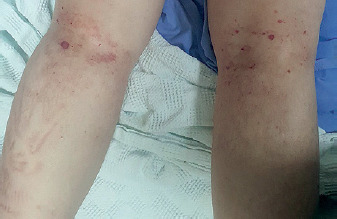
We present a case of a 51-year-old female patient who presented to the emergency department with weakness, leg oedema, palpable purpura in lower legs (Figure 1), and reduced urine output. At initial presentation, the patient was found to have significant pericardial effusion and reduced ejection fraction, peripheral neuropathy, pulmonary fibrosis, and ground glass opacities. A complete blood count showed mild anaemia: the haemoglobin level was 10 g/dl, with a white blood cell count of 6500/µl (with normal fractions) and a platelet count of 250,000/µl. The serum creatinine level was elevated (2.3 mg/dl). From her past medical history, she did not report any other conditions. Urine sediment was active and 24 h urine protein was 3.1 g. Immunological work-up for ANCA vasculitis or systemic lupus erythematosus (SLE) was negative, but the patient was found hypocomplementemic and hypoglobulinaemic with positive rheumatoid factor (RF). Immunofixation of serum and urine revealed monoclonic IgMκ. Cryoglobulins of type II (monoclonal IgM and polyclonal IgG) were positive with high burden (cryocrit 25%). Further evaluation revealed that the patient was HCV-RNA positive, genotype 4, with high viral load (4.98 × 10⁶ IU/ml). Liver function tests were normal, and liver stiffness was compatible with METAVIR score F3.
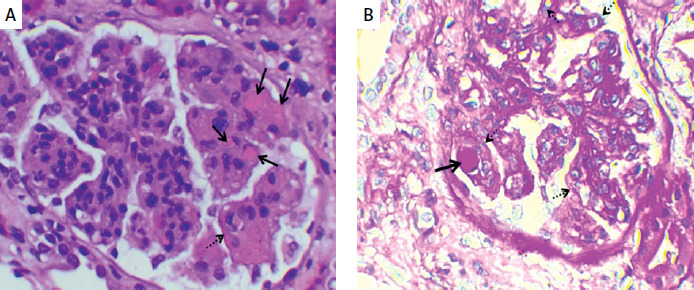
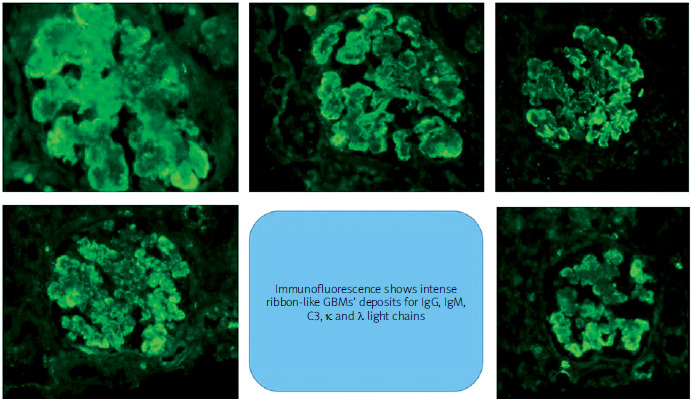
The patient underwent renal biopsy, and the results showed glomerulonephritis with membranoproliferative pattern (Figure 2). Endocapillary hyaline thrombi were depicted with hyper-microscopic features suggestive of cryoglobulins. Immunofluorescence showed positivity for IgG/IgM/C3/C1g and both light chains κ and λ (Figure 3). The work up for non-Hodgkin lymphoma or lymphoproliferative disease was negative.
Figure 2
A – Glomerulus with mesangial and endocapillary hypercellularity, subendothelial hyaline deposits (dot arrow) and endocapillary hyaline thrombi (black arrows). B – Glomerular basement membrane double contours (dot arrows) and a PAS-positive hyaline thrombus (compound arrow)
The clinical manifestations suggested a severe form of mixed cryoglobulinaemia syndrome. Immunosuppressive therapy was started immediately with high-dose methylprednisolone (1 g intravenous every day for 3 days and then tapered over a period of 6 months). Concurrently, the patient underwent multiple haemodialysis treatments. Due to the severity of the disease, the patient underwent six plasmapheresis treatments every other day. She was taken off dialysis one month after diagnosis, and she generally showed good clinical improvement. Cryoglobulins remained positive, albeit in a lower level, as well as monoclonal protein and RF.
Rituximab was started intravenously every 4 weeks (375 mg/m2), which was well tolerated, and concurrently direct acting antivirals (DAAs) were started per os. The patient received elbasvir/grazoprevir for 12 weeks without significant adverse events. Kidney function improved immediately after DAA treatment. Furthermore, cryoglobulins, monoclonal protein, and RF became negative 5 months after diagnosis. HCV infection was cured with negative HCV-RNA 12 weeks after the end of DAA treatment. During a follow-up of 3 years, there was no recurrence of the disease recorded, and all manifestations of mixed cryoglobulinemia syndrome subsided. Kidney function is currently normal, and HCV-RNA is still undetectable. Combination treatment with immunosuppressive therapy and DAAs seems to offer a sustained long-term clinical response even in patients with severe MCS.
Mixed cryoglobulinaemia syndrome is a systemic vasculitis that involves the joints, skin, kidneys, and peripheral nerves. Many disorders are associated with MCS, while HCV infection is the most frequent cause. Circulating cryoglobulins are present in 40–60% of patients with chronic hepatitis C; among those, approximately 10% have symptomatic disease [1]. Renal involvement has been shown to be the worst prognostic factor [2]. According to Terrier et al., the 1-year, 5-year, and 10-year survival rates in HCV-infected patients with MCS were 96%, 75%, and 63%, respectively [3]. Severe infections and end-stage liver disease were the main determinants of fatal events. The worst prognostic factors were Metavir fibrosis score ≥ 3, as well as heart, renal, and central nervous syndrome involvement [3].
Immunosuppression is the first-line treatment, especially if renal involvement is severe. Despite the risk of exacerbation of the HCV infection, rituximab, an anti-CD20 monoclonal antibody, has been used extensively to treat MCS. It selectively depletes the CD20 lymphocytes and therefore abolishes IgM production and cryoglobulin formation. Plasmapheresis, high-dose glucocorticoids, and cytotoxic agents are used for severe cases [4, 5]. Rituximab improves skin ulcers and renal manifestations in 75–90% of cases and peripheral neuropathy in 70% of cases [6]. A French study showed that purpura, cutaneous necrosis, and articular involvement were predictive factors of early relapse [7]. Rituximab does not usually carry an increased risk of serious adverse events and treatment discontinuation due to adverse events compared to other immunosuppressants or high-dose glucocorticoids [6].
For more than a decade, chronic HCV infection was treated with pegylated interferon (PegIFN) and ribavirin (RBV), with low eradication rates, especially in patients with genotype 1 and 4 infection [8]. The new DAAs showed significant antiviral efficacy (> 95% in naïve patients) and a good tolerance profile. These drugs target three proteins of the hepatitis C virus: NS5A and NS5B RNA polymerase, NS3 serine protease, and its cofactor NS4A. Telaprevir and boceprevir were the first agents introduced in clinical practice. Sollima et al. treated 7 patients with HCV-associated mixed cryoglobulinaemia syndrome with DAAs. Renal involvement was the most frequent manifestation. Treatment was given for 12 weeks in 5 cases and 24 weeks in 2. All patients achieved sustained virological response after treatment. Cryoglobulins were undetectable in 4 patients at the end of treatment [9]. In the multicentre study of Cacoub et al., 148 patients were recruited with active HCV infection and cryoglobulinaemic vasculitis. The primary endpoint was a complete clinical response at week 12 after DAA treatment. A complete clinical response was defined as improvement of all organs involved at baseline and the absence of clinical relapse. The clinical features at baseline were arthralgia, neuropathy, purpura, glomerulonephritis, and skin necrosis. Twelve weeks after treatment 72.6% of patients showed complete clinical response, whereas 22.6% had partial response and 4.8% did not respond to the DAAs treatment. Partial responders had improvement in some but not all organs involved at baseline. 51.5% of the partial responders and 43% of the non-responders had persistent renal impairment [10].
Although immunosuppression combined with DAA treatment is effective in HCV infected patients with cryoglobulinaemic vasculitis, some patients have relapses after treatment. Bonacci et al. reported 11% of relapses of vasculitis within 2 years after sustained virological response to DAA therapy [11], while Colantuono et al. reported 18% of relapses within 30 months [12].
Renal impairment was a significant factor for treatment decision. The combination of elbasvir and grazoprevir is an option for patients with mild, moderate, or severe renal impairment, and no dose adjustment is required. Our patient received elbasvir/grazoprevir for 12 weeks with successful eradication of the hepatitis virus with no recurrence of the mixed cryoglobulinaemia syndrome after 3 years of follow-up (undetectable cryoglobulins and normal renal function tests in several measurements).
In conclusion, although symptomatic mixed cryoglobulinaemia syndrome is rare in HCV-infected patients (4.9%), this case illustrates the importance of identifying MCS in HCV infection [13]. Treatment with combined immunosuppression and antiviral treatment can quickly resolve the disease.