Introduction
Ulcerative colitis (UC) is a lifelong immune-mediated disorder of the gastrointestinal tract, confined to the colon and rectum, in which chronic mucosal inflammation follows an unpredictable course of flares and remission [1–4]. Over time, this disease trajectory may result in cumulative bowel damage, extraintestinal manifestations, and a substantial deterioration in health-related quality of life [1–3]. Despite major advances in therapeutic options over the past two decades, durable disease control remains elusive for a considerable proportion of patients. Approximately one third of individuals fail to respond to initial advanced therapy, and up to half subsequently experience loss of response during treatment with advanced therapy (biologic agents or small-molecule drugs) [5–9].
Improved insight into the immunological networks driving intestinal inflammation has catalysed the development of increasingly selective therapeutic strategies [9]. Among these, the interleukin 23 (IL-23) signalling pathway has been identified as a central regulator of chronic intestinal inflammation through its role in maintaining pathogenic T helper 17-driven immune responses [10–12]. Accumulating experimental and clinical data suggest that selective blockade of the IL-23 p19 subunit may provide therapeutic advantages over agents targeting both IL-12 and IL-23, such as ustekinumab (UST) [12–16]. Importantly, selective inhibition of IL-23 may also mitigate potential safety concerns related to interference with IL-12-dependent immune functions [13, 14].
Mirikizumab (MIRI) is a humanised immunoglobulin G4 monoclonal antibody designed to specifically neutralise the p19 subunit of IL-23 while sparing IL-12 signalling [15, 16]. Based on robust evidence from phase III randomised controlled trials, MIRI became the first approved selective IL-23 p19 inhibitor for the treatment of adults with moderate to severe UC [17, 18]. In the pivotal LUCENT program, MIRI demonstrated clear superiority over placebo, with 63% of patients achieving clinical response and 24% achieving clinical remission after 12 weeks of induction therapy, followed by maintained benefit during continued treatment [18, 19].
Nevertheless, randomised trials are conducted in highly selected populations and may underrepresent patients encountered in routine clinical practice, particularly those with extensive treatment exposure and prior therapeutic failures. Consequently, the generalisability of trial results to real-world settings remains an important unresolved question. To date, evidence describing the effectiveness and safety of MIRI outside controlled trial environments is limited. Against this background, real-world data are essential to define the position of selective IL-23 inhibition within contemporary treatment algorithms for UC.
Aim
The present multicentre study was therefore designed to assess the real-world effectiveness and safety of MIRI in patients with UC treated across 21 inflammatory bowel disease (IBD) centres, aiming to bridge the gap between clinical trials and everyday practice and to inform future therapeutic decision-making.
Material and methods
Study design
This was a retrospective, observational, multicentre study conducted in 21 IBD centres in Poland. The study evaluated the effectiveness and safety of MIRI in adult patients with moderate to severe UC treated in routine clinical practice. All data were derived from medical records and institutional databases, reflecting standard-of-care management. All therapeutic interventions were conducted in accordance with the Polish National Health Fund Drug Program B.55: “Treatment of patients with moderate to severe UC”. Initiation of MIRI was based strictly on the eligibility criteria defined by this national advanced therapy program. According to the program regulations, patients must have a confirmed diagnosis of UC with moderate to severe disease activity, typically defined by a Total Mayo Score (TMS) ≥ 6, and documented inadequate response, loss of response, or intolerance to conventional therapy, including systemic corticosteroids and/or immunosuppressive agents (azathioprine or 6-mercaptopurine). In addition, patients previously exposed to biologic or small-molecule therapy were eligible in cases of primary non-response, secondary loss of response, or intolerance. Patients were included if MIRI was initiated because of clinically active disease requiring treatment escalation within routine practice.
Population
A total of 257 adult patients 18 years of age or older initiating MIRI treatment for UC before 31 January 2026 were included in the study. Patients with Crohn’s disease or unclassified IBD were excluded. Participants received standard induction therapy with MIRI administered intravenously at a dose of 300 mg at weeks 0, 4, and 8. In patients with an insufficient clinical response at week 12, the induction phase could be extended by an additional 12 weeks with continued intravenous administration according to the induction regimen, allowing a maximum induction duration of 24 weeks. Extended induction was defined as continuation of intravenous MIRI beyond week 12 up to week 24 in patients with insufficient early clinical improvement, in accordance with the Polish National Health Fund Drug Program B.55 and local routine practice. Subgroup analyses were prespecified according to previous exposure to advanced therapy. Patients were categorised as advanced therapy naïve or advanced therapy experienced, defined as prior exposure to at least one biologic or small-molecule therapy used for UC. Additional analyses were performed in selected previously exposed subgroups, including patients with prior infliximab (IFX) and UST treatment. Efficacy and safety endpoints were evaluated separately within each subgroup at weeks 12 and 24 using the same outcome definitions and statistical methods as those applied to the total study population.
Definitions
Clinical response was defined as a decrease from baseline in the TMS by at least 3 points and at least 30%, together with a decrease in the rectal bleeding subscore by at least 1 point or an absolute rectal bleeding subscore of 0 or 1. Clinical remission was defined using the Partial Mayo Score (PMS) as a value of 2 points or less, with no individual subscore greater than 1. Endoscopic response was defined as a decrease in the endoscopic Mayo (eMayo) subscore by at least 1 point from baseline. Endoscopic remission, also referred to as mucosal healing, was defined as an eMayo subscore of 0. Biochemical remission was defined as normalisation of inflammatory markers with faecal calprotectin (FC) less than or equal to 250 µg/g and C-reactive protein (CRP) less than or equal to 5 mg/l. Corticosteroid (CS)-free clinical remission was defined as clinical remission in the absence of systemic CS use at the evaluated time point.
Data collection
Data were collected using a standardised case report form. Baseline data included demographic characteristics, smoking status, comorbidities, year of UC diagnosis, disease extent according to the Montreal classification, and the presence of EIM. Information on current and prior UC therapies, including conventional treatments, biologics, small molecules, and advanced combination therapy (ACT), was systematically recorded. Clinical, endoscopic, and laboratory disease activity were assessed at baseline, after 12 weeks of MIRI therapy, and, when applicable, after 24 weeks in patients undergoing extended induction phase. Disease activity was evaluated using the PMS, eMayo, and TMS, along with faecal calprotectin (FC), C-reactive protein (CRP), and haemoglobin (Hgb) levels. Safety was monitored throughout the study by recording adverse events (AE), comprising non-serious adverse events and serious adverse events (SAE). The use of extended induction was also recorded. Steroid tapering was performed according to local clinical practice. Treatment discontinuation, when applicable, and the reason for discontinuation were recorded whenever available in the medical records. Because this was a retrospective real-world study, not all patients had complete evaluable data for every endpoint at each time point; therefore, denominators varied across analyses.
Statistical analysis
Statistical analyses were performed using R statistical software (version 4.4.2). Continuous variables were summarised as mean and standard deviation (SD) or as median and interquartile range (IQR), depending on the distribution of the data. Categorical variables were presented as absolute counts and percentages within the respective groups. Comparisons between follow-up measurements of clinical parameters and corresponding baseline values were conducted using the paired Student’s t-test or the Wilcoxon signed-rank test, as appropriate, based on the normality of the distribution of differences. Normality was assessed using the Shapiro–Wilk test, as well as by evaluating skewness and kurtosis. Two-sided 95% confidence intervals for proportions of predefined endpoints were calculated using the Clopper–Pearson exact method. For non-normally distributed continuous variables, paired comparisons were performed using the Wilcoxon signed rank test, and the reported difference corresponds to the median paired difference. All statistical tests were two-tailed, and a significance level of a = 0.05 was applied throughout.
Results
The study group consisted of 257 patients and was predominantly composed of middle-aged individuals (43.7 ±15.6 years; 43.2% male) with a normal body mass index (24.7 ±4.6 kg/m2) and established disease (median duration: 8 years). Comorbidities were frequent (70.8%), mainly cardiovascular (34.6%) and endocrine-metabolic (25.3%). Extensive colitis (E3) predominated (58.0%). Baseline disease activity was moderate to severe (PMS 6.25 ±1.96; TMS 8.95 ±2.08; median eMayo 3), with elevated FC (935.5 µg/g) and CRP (6.39 mg/l). Most patients had prior exposure to advanced therapy (87.5%), and 54.1% underwent an extended induction phase to week 24 (Table I).
Table I
Demographic and clinical baseline characteristics of the total study group
[i] ADA – adalimumab, AZA – azathioprine, BMI – body mass index, CRP – C-reactive protein, E1 – ulcerative proctitis (Montreal classification), E2 – left-sided colitis (Montreal classification), E3 – extensive colitis (Montreal classification), EIM – extraintestinal manifestations, FC – faecal calprotectin, FILGO – filgotinib, GUS – guselkumab, Hgb – haemoglobin, IFX – infliximab, IQR – interquartile range, M – mean, Me – median, MMX – multimatrix formulation, MP – mercaptopurine, n – number, OZA – ozanimod, PMS – Partial Mayo Score, RYSA – risankizumab, SD – standard deviation, SpA – spondyloarthritis, TMS – Total Mayo Score, TOFA – tofacitinib, UC – ulcerative colitis, UPA – upadacitinib, UST – ustekinumab, VDZ – vedolizumab, 5-ASA – 5-aminosalicylic acid. *Includes 6 patients with ADA + MIRI (added during extended induction phase), and with the history of ACT: 2 patients with ADA + FILGO, 1 patient with VDZ + IFX, and 1 patient with ADA + UPA.
Significant improvement was observed at weeks 12 and 24 across all parameters: PMS, eMayo, and TMS decreased, FC and CRP declined, and Hgb increased (all p < 0.001) (Table II). Figures 1 and 2 demonstrate the progressive reduction of TMS and key clinical and laboratory markers over time.
Figure 1
Boxplot presenting distribution of TMS in the total study group through the qualification (baseline) and treatment process
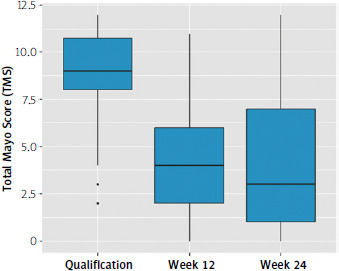
Figure 2
Boxplot presenting distribution of clinical parameters in the total study group through the qualification (baseline) and treatment process
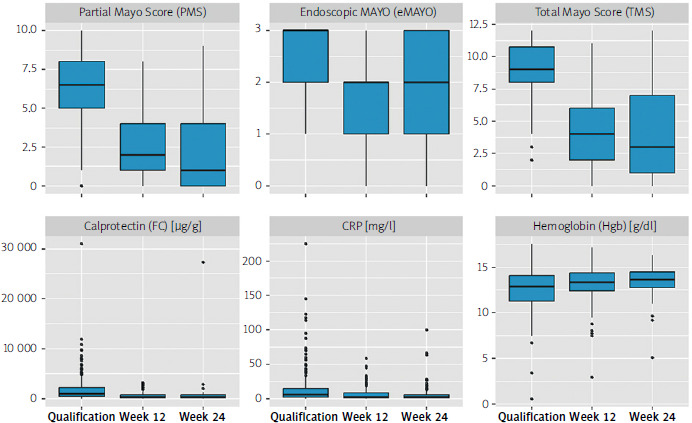
Table II
Evolution of clinical parameters during the treatment process in week 12 and week 24 in the total study group
[i] CI – confidence interval, CRP – C-reactive protein, eMayo – Endoscopic Mayo score, FC – faecal calprotectin, Hgb – haemoglobin, IQR – interquartile range, M – mean, MD – mean difference, Me – median, n – number, PMS – Partial Mayo Score, SD – standard deviation, TMS – Total Mayo Score. Data are presented as mean plus minus standard deviation or median with interquartile range, as appropriate. Changes between baseline and follow-up were assessed using the paired Student’s t test or the Wilcoxon signed rank test according to the distribution of paired differences. Difference denotes the mean paired difference for normally distributed variables or the median paired difference for non-normally distributed variables. Confidence intervals are presented as 95% confidence intervals.
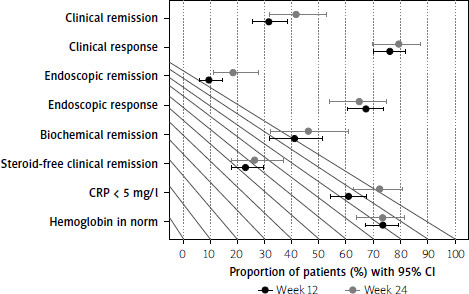
In the overall group, clinical remission was observed in 31.7% of evaluable patients at week 12 and in 41.8% of evaluable patients at week 24, while clinical response was observed in 76.2% and 79.3%, respectively. Endoscopic remission was 9.5% at week 12 and 18.5% at week 24, while biochemical remission was 41.1% and 46.0%, respectively. CS-free clinical remission was achieved in 23.1% of patients at week 12 and 26.4% at week 24. Endoscopic response was 67.1% at week 12 and 64.8% at week 24, and CRP normalisation reached 72.4% at week 24. AE occurred in 9.1% and 14.1% of patients at weeks 12 and 24, respectively, while SAE occurred in 2.6% and 6.6%, respectively (Table III). Figure 3 presents the proportions achieving predefined efficacy endpoints.
Table III
Treatment efficacy and safety parameters in the total study group in week 12 and week 24
[i] CI – confidence interval, CRP – C-reactive protein, n – number. Data are presented as number of patients achieving the outcome (events) over the number of evaluable patients (N), with corresponding proportions and exact 95% confidence intervals. Confidence intervals were calculated using the exact Clopper-Pearson method. Differences in denominators across endpoints reflect availability of evaluable data for each specific outcome at each time point. Endoscopic response required paired baseline and follow-up endoscopic assessment, whereas endoscopic remission was based on the absolute follow-up endoscopic Mayo subscore among patients with available endoscopic evaluation.
Figure 3
Proportions of patients achieving defined endpoints at week 12 and week 24 in the total study Group
CRP – C-reactive protein.
Among advanced therapy-naïve patients (N = 32), the highest early clinical remission was observed at week 12. However, week 24 estimates in this subgroup should be interpreted with caution because of the very small number of evaluable patients. Clinical remission was 60.7% at week 12 and 50.0% at week 24, while biochemical remission exceeded 80% at both time points. Endoscopic remission remained limited (10.7%®16.7%), and CS-free remission decreased over time (42.9%®16.7%). Endoscopic response decreased from 75.0% to 66.7%. AEs were reported in 16.6% and 20.0%, with serious events up to 10.0%. Confidence intervals were wide due to the small sample size (Table IV).
Table IV
Treatment efficacy and safety parameters among patients without advanced therapy in the past (naïve), in week 12 and week 24
[i] CI – confidence interval, CRP – C-reactive protein, n – number. Data are presented as number of patients achieving the outcome (events) over the number of evaluable patients (N), with corresponding proportions and exact 95% confidence intervals. Confidence intervals were calculated using the exact Clopper-Pearson method. Differences in denominators across endpoints reflect availability of evaluable data for each specific outcome at each time point. Endoscopic response required paired baseline and follow-up endoscopic assessment, whereas endoscopic remission was based on the absolute follow-up endoscopic Mayo subscore among patients with available endoscopic evaluation.
In the subgroup with prior IFX exposure (N = 162), clinical remission increased from 30.2% at week 12 to 43.6% at week 24, while clinical response grew from 75.9% to 84.6%. Endoscopic remission improved from 10.8% to 19.6%, and biochemical remission from 37.5% to 50.0%. Endoscopic response remained stable at 67.9%. CS-free remission rose modestly (21.6%®23.6%), and CRP normalisation reached 79.0% at week 24. AEs were reported in 6.3% and 15.8% of patients at weeks 12 and 24, respectively, with serious events in 2.1% and 7.9% (Table V).
Table V
Treatment efficacy and safety parameters among patients with IFX in the past, in week 12 and week 24
[i] CI – confidence interval, CRP – C-reactive protein, n – number. Data are presented as number of patients achieving the outcome (events) over the number of evaluable patients (N), with corresponding proportions and exact 95% confidence intervals. Confidence intervals were calculated using the exact Clopper-Pearson method. Differences in denominators across endpoints reflect availability of evaluable data for each specific outcome at each time point. Endoscopic response required paired baseline and follow-up endoscopic assessment, whereas endoscopic remission was based on the absolute follow-up endoscopic Mayo subscore among patients with available endoscopic evaluation.
In the subgroup with prior UST exposure, clinical remission increased from 20.6% to 33.3% and clinical response from 73.8% to 83.3%, accompanied by a doubling of biochemical remission. Endoscopic remission rose from 4.4% to 11.8%, and biochemical remission from 20.7% to 42.9%. Endoscopic response decreased from 66.1% to 61.3%. CS-free remission remained relatively stable (17.6%®18.2%), while CRP normalisation increased to 75.0% at week 24. AE occurred in 11.4% and 13.5%, and serious adverse events in 7.1% and 8.1% (Table VI).
Table VI
Treatment efficacy and safety parameters among patients with UST in the past, in week 12 and week 24
[i] CI – confidence interval, CRP – C-reactive protein, n – number. Data are presented as number of patients achieving the outcome (events) over the number of evaluable patients (N), with corresponding proportions and exact 95% confidence intervals. Confidence intervals were calculated using the exact Clopper-Pearson method. Differences in denominators across endpoints reflect availability of evaluable data for each specific outcome at each time point. Endoscopic response required paired baseline and follow-up endoscopic assessment, whereas endoscopic remission was based on the absolute follow-up endoscopic Mayo subscore among patients with available endoscopic evaluation.
In the subgroup (N = 225) previously exposed to any advanced therapy, clinical remission increased from 27.5% to 41.2%, with clinical response growing from 74.2% to 80%. Endoscopic remission improved from 9.3% to 18.6%, biochemical remission from 36.5% to 42.2%, and CS-free remission from 20.2% to 27.1%. Endoscopic response remained relatively stable (65.9% to 64.4%). The safety profile was comparable to that observed in the overall study group (Table VII).
Table VII
Treatment efficacy and safety parameters among patients exposed to any advanced therapy in the past, in week 12 and week 24
[i] CI – confidence interval, CRP – C-reactive protein, n – number. Data are presented as number of patients achieving the outcome (events) over the number of evaluable patients (N), with corresponding proportions and exact 95% confidence intervals. Confidence intervals were calculated using the exact Clopper-Pearson method. Differences in denominators across endpoints reflect availability of evaluable data for each specific outcome at each time point. Endoscopic response required paired baseline and follow-up endoscopic assessment, whereas endoscopic remission was based on the absolute follow-up endoscopic Mayo subscore among patients with available endoscopic evaluation.
AEs were infrequent and mostly mild at both time points. At week 12, the most common AEs were skin rash (1.7%) and nausea (1.3%), with all others ≤ 0.9%. At week 24, abdominal pain and leukopaenia were most frequent (1.9%), while remaining AEs occurred in 0.9% of patients. SAEs were rare at week 12 (≤ 0.9%), whereas at week 24 UC flares were more common (5.6%), with other SAEs remaining infrequent (0.9%). Overall, no new safety signals were observed. All data are presented in Table VIII.
Table VIII
Adverse events in the total study group, in week 12 and 24
[i] COVID-19 – Coronavirus disease 2019, UC – ulcerative colitis. Data are presented as number of patients achieving the outcome (events) over the number of evaluable patients (N), with corresponding proportions and exact 95% confidence intervals. Confidence intervals were calculated using the exact Clopper-Pearson method.
Discussion
In this retrospective, multicentre real-world study, we demonstrated that treatment with MIRI was associated with significant improvement in patients with moderately to severely active UC, the majority of whom had prior exposure to advanced therapies and long-standing disease. The study population reflects a difficult-to-treat group, characterised by extensive colitis (E3 predominance), high inflammatory burden (median FC > 900 µg/g; elevated CRP), and previous advanced therapy failure in nearly 90% of patients. Such characteristics are representative of contemporary tertiary-care UC populations and enhance the external validity of our findings [3, 11].
We observed significant reductions in clinical (PMS, TMS, eMayo), biochemical (FC, CRP), and haematological (Hgb) parameters at both week 12 and week 24 (all p < 0.001), indicating rapid induction of disease control. Clinical and endoscopic outcomes observed at week 24 among evaluable patients suggest that benefit may be maintained and, in some patients, may further improve with continued treatment beyond week 12 [18–20]. However, these findings should be interpreted cautiously because the week 24 analysis was based on a smaller subset of patients, many of whom underwent extended induction.
Our remission and response rates are broadly consistent with available real-world evidence on MIRI in UC [21–24]. In the international two-centre retrospective study by Levartovsky et al., which included 74 patients (93% previously exposed to biologics or small molecules; 52.7% on corticosteroids at baseline), week-12 clinical response and remission rates were 70.3% and 17.6%, respectively, with CS remission in 16% (24). Notably, 8.1% discontinued therapy during induction due to lack of efficacy or AE. These remission rates at week 12 are comparable to those observed in our group, particularly considering the heavily pretreated population. Importantly, similar week-12 response and remission rates were reported across patients previously exposed to IFX, UST, vedolizumab, and Janus kinase inhibitors, supporting the effectiveness of IL-23 inhibition across different prior treatment lines [24].
Other multicentre European and Asian real-world studies have reported week-12 clinical remission rates ranging from approximately 15% to 30%, increasing by week 24, with biochemical remission frequently exceeding 40–60% [21, 22]. In our group, biochemical remission reached 46.0% and CRP normalisation 72.4% at week 24, which aligns with these data. The magnitude of CRP normalisation may reflect both effective inflammatory control and the high baseline inflammatory burden.
Endoscopic remission rates in real-world settings generally remain lower than clinical remission rates, particularly in heavily pretreated populations [21, 22, 24]. Our endoscopic remission of 18.5% at week 24 is comparable to other observational studies, in which rates typically range between 15% and 25% at 6 months. This discrepancy between symptomatic and endoscopic improvement underscores the well-recognised dissociation between patient-reported outcomes and mucosal healing and supports the need for objective monitoring in routine clinical practice. The numerically lower endoscopic response at week 24 compared with week 12 should not be interpreted as definite loss of efficacy. More likely, it reflects the smaller week-24 sample, selection of patients requiring extended induction because of slower or more refractory disease, and the retrospective design without central endoscopic reading. Importantly, endoscopic remission increased over the same period, suggesting ongoing mucosal improvement rather than worsening.
Subgroup analyses provide additional clinically relevant insights. In biologic-naïve patients, we observed the highest early clinical remission (60.7% at week 12), with biochemical remission exceeding 80% at both time points. Although confidence intervals were wide due to small numbers, this pattern is consistent with phase 3 analyses demonstrating higher response rates in less heavily pretreated patients [18, 19] and with emerging real-world data [24]. In patients previously exposed to infliximab (IFX), remission rates improved over time (30.2% to 43.6%), with an increase in clinical response (from 75.9% to 84.6%) and meaningful gains in endoscopic and biochemical endpoints. These findings are consistent with observational data indicating that selective IL-23 inhibition retains efficacy after IFX failure [21, 22]. In the subgroup with prior UST exposure, clinical remission and response increased from 20.6% to 33.3% and from 73.8% to 83.3%, respectively, and with a doubling of biochemical remission. Although outcomes were numerically lower than in IFX-exposed patients, they remain clinically relevant and support the concept that switching within the IL-23 pathway, from p40 blockade to selective p19 inhibition, may confer additional benefit in selected patients [12, 14, 24].
The safety profile in our group was acceptable and comparable to previously published real-world and clinical trial data [18–20, 24]. AE and SAE rates remained low through week 24, with no unexpected safety signals. Levartovsky et al. reported treatment discontinuation in 8.1% during induction, which is consistent with the low early discontinuation rates observed in our group [24]. Overall, these findings reinforce the favourable safety profile of IL-23 p19 blockers (including MIRI) in routine clinical practice [25, 26]. No deaths and no unexpected treatment-related safety signals were recorded during follow-up.
Several limitations should be acknowledged. First, the retrospective design introduces potential selection bias and missing data; however, the structured requirements of the national drug program impose mandatory clinical, laboratory, and endoscopic assessments within predefined time windows, thereby reducing variability in follow-up and ensuring a standardised evaluation of treatment response. Second, endoscopic assessments were not centrally read. Third, week-24 analyses were based on a reduced number of evaluable patients and should not be interpreted as direct within-cohort longitudinal comparisons with week-12 outcomes. Fourth, some outcome denominators differed across endpoints because not all patients had complete clinical, laboratory, and endoscopic data available at each time point. Nonetheless, the multicentre design, inclusion of heavily pretreated patients, and comprehensive assessment of clinical, biochemical, and endoscopic outcomes strengthen the generalisability of our results and position them within the growing body of international real-world evidence [21–24].
Overall, our data complement phase 3 trial evidence [18–20] and contemporary real-world studies, reinforcing the effectiveness of MIRI in routine practice, particularly in advanced-therapy–experienced UC populations [21–24]. The outcomes observed at week 24 among evaluable patients suggest that therapeutic benefit may be maintained and may further improve in some patients with sustained IL-23 inhibition. Prospective, longer-term real-world studies and comparative effectiveness analyses are warranted to better define optimal positioning within the therapeutic algorithm [11, 14].
Conclusions
In this multicentre retrospective real-world study, MIRI demonstrated significant and sustained clinical, biochemical, and endoscopic effectiveness in patients with moderately to severely active UC, including those with prior exposure to advanced therapies. Clinical, biochemical, and endoscopic outcomes observed during follow-up were consistent with those reported in other international real-world studies. The safety profile was favourable and aligned with both phase 3 trials and post-marketing observational data. These findings support MIRI as an effective therapeutic option in both biologic-naïve and biologic-experienced UC populations in routine clinical practice.