Introduction
Gastric cancer (GC), ranked fifth in incidence rate and fourth in cancer-associated mortality, remains an important global health challenge [1]. This incidence rate is two-fold higher in men, and approximately one out of every 13 cancer-related deaths was globally related to GC in 2020. However, a remarkable diversity has been reported for GC incidence and mortality rates across populations. It is well documented that south central Asian countries, including Iran, Afghanistan, Turkmenistan, and Kyrgyzstan are considered as high-incidence areas [1, 2].
Despite all tangible advances in the treatment of gastric cancer and subsequent global changing trends in incidence and mortality rates, the disease remains a significant ongoing health problem responsible for a major portion of cancer-specific deaths, particularly in high-incidence regions including Iran [3]. Besides the high prevalence, patients with GC are often diagnosed at advanced stages, when conventional surgery and radio- and chemotherapy treatments do not lead to beneficial therapeutic effects and consequently result in chemotherapy resistance, distant metastasis, tumour recurrence, and reduced 5-year survival rates [4]. Considering that endoscopy, as a gold standard method, is both expensive and invasive, identifying the novel diagnostic or prognostic markers for early diagnosis, or even preventing the disease progression at the very beginning form, is essential to establish more efficient and cost-effective strategies against GC.
A wide range of variables including environmental factors and genetic abnormalities have been proven to be involved in GC development. There has been an ongoing effort to elucidate if these factors may be powerful clinical diagnostic and prognostic biomarkers of GC. Up to now, a considerable number of protein-based biomarkers with different applications and efficiencies such as fibroblast growth factor receptor 2 (FGFR2) [5], E-cadherin [6], human epidermal growth factor receptor-2 (HER2) [7], vascular endothelial growth factor (VEGF) [8], the phosphoinositide 3-kinases (PI3K) signalling axis [9], and tumour protein p53 [10] have been identified for GC. However, recent advancements in the genomic era have prompted researchers to explore the potential utility of new nucleic acid-based molecules as novel biomarkers for GC management [11–15]. It has been proposed that specific expression patterns of various genome-based markers may be optimal biomarkers for the development of genome-based therapeutic targeting. Hence, further research on the underlying genetic susceptibilities, pathological consequences of gene dysregulation, and ethnic background of GC is helpful to identify more powerful biomarkers for clinical practice, especially in risk stratifying and customising the therapeutic strategies [16].
Tripartite motif (TRIM) family proteins are a group of ubiquitin E3 ligases with broad functions in various physiological or pathological conditions [17]. The TRIM family consists of 76 members, all sharing a tripartite motif composed of a RING finger, two B-Box motifs, and a coiled-coin (CC) region, and they are involved in a variety of cellular processes including proliferation, apoptosis, autophagy, immunity, and carcinogenesis [18, 19]. A growing body of evidence demonstrates that several TRIM family proteins are expressed diversely in various human cancers and act as regulators in cancer development and progression. TRIM24, also known as transcriptional intermediary factor 1 (TIF1a), has been reported to be expressed in a wide variety of cancers including hepatocellular carcinomas as well as head and neck, breast, and lung cancers. Evidence shows that TRIM24 contributes to cancer development through interaction with various tumour-suppressive or oncogenic pathways such as PI3K/AKT signalling pathway in prostate cancer and glioma [20, 21], Wnt/b-catenin signalling pathway in colorectal and gastric cancer [22, 23], epithelial-mesenchymal transition pathway in hepatocellular and renal cell carcinoma [24], suppressing Forkhead box protein M1 (FOXM1) in ovarian cancer [25], and Hippo-Yes-associated protein (YAP) signalling in colorectal cancer [26]. These multiple regulatory mechanisms have led to a dual oncogenic or tumour suppressor roles for TRIM24. Some studies have reported an oncogenic role for TRIM24 and subsequent significant association between the TRIM24 upregulation and poor clinical outcomes in cancer patients [21, 23, 25–35]. Conversely, other studies have shown decreased levels of TRIM24 expression, which is characteristic of a tumour suppressor gene [36, 37].
Despite all these studies around the role of TRIM24 in different human cancers, there is still uncertainty regarding the TRIM24 expression pattern in different cancers. To address this dichotomy, studying the TRIM24 function based on the cancer type and ethnic background seems necessary. Considering the importance of genetics and ethnicity in GC incidence and mortality burden, in this study the expression pattern of TRIM24 in Iranian GC patients, its potential association with overall survival, and correlation with b-catenin, cyclin D1, and B-cell lymphoma 2 (BCL2), as representative genes for biological pathways engaged with Wnt signalling, cell cycle, and apoptosis, was analysed. Additionally, a meta-analysis of all published studies was conducted to address the existing controversy regarding the potential TRIM24 tumour suppressor or oncogenic role and to clarify the prognostic value of TRIM24 expression in various malignancies.
Material and methods
Patients and tissues
A total of 40 GC tissues and paired noncancerous tissues were obtained from the Ghaem and Imam Reza hospitals of Mashhad University of Medical Sciences, Mashhad, Iran, between November 2015 and 20 February 2018. All patients were newly diagnosed cases with no history of chemotherapy or radiotherapy before biopsy. More detailed criteria for patient selection are presented in our previous study [38]. All patients signed a consent form, and the study protocol was approved by the Ethics Committee of Mashhad University of Medical Sciences (IR.MUMS.MEDICAL.REC.1399.094). Fresh endoscopic biopsy specimens from GC tissues and their adjacent noncancerous tissues (located at least > 5 cm away from the cancerous site) were immediately immersed in RNAlater (Thermo Fisher Scientific, Waltham, MA, USA) and then stored at –80°C until RNA extraction. Pathologic data regarding the tumour size, tumour type (intestinal vs. diffuse-type), and T and N stage was obtained using patients’ records in the pathology ward.
RNA extraction and quantitative reverse-transcriptase PCR
The total RNA from GC tissues and the paired noncancerous samples were extracted Using Trizol Reagent (Sangon Biotech Co., Ltd., Shanghai, China) as described in the manufacturer’s instructions.
The quality and quantity of extracted RNA samples were evaluated using a NanoDropTM 2000 spectrophotometer (ThermoFisher Scientific, Waltham, MA, USA). RNA samples with an optical density (OD) 260/280 nm ratio > 1.8 were selected for further analysis. Briefly, 2 µg of total RNA was reverse transcribed into cDNA using the cDNA synthesis kit (Wizbiosolutions, Seongnam, Gyeonggi, Korea). Quantitative real-time PCR was performed on a light cycler instrument (Roche LightCycler® 96 System) in a total reaction volume of 20 µl consisting of SYBR Green master mix (10 µl), cDNA template (2 µl), reverse (0.3 µl) and forward (0.3 µl) primers, and nuclease-free water (7.4 µl). Forward and reverse primer sequences for each gene were as follows:
TRIM24: 5’-GGAGTCATTCGTTGCCCAGT-3’ and 5’- TTCTGCGTTGTCCTCACAGC-3’, b-catenin: 5’-TCTGAGGACAAGCCACAAGATTACA-3’ and 5’-TGGGCACCAATATCAAGTCCAA-3’, Cyclin D1: 5’-TGGAGGTCTGCGAGGAACA-3’ and 5’-TCATCTTAGAGGCCACGAACAT-3’, BCL2: 5’-ACGGTGGTGGAGGAGCTCTT-3’ and 5’-CGGTTGACGCTCTCCACAC-3’, and b-actin: 5’-CACGAAACTACCTTCAACTCC-3’ and 5’-CATACTCCTGCTTGCTGATC-3’.
The real-time PCR protocol was as follows: preincubation (94°C for 600 s), 40 cycles of amplification (95°C for 15 s, 59°C for 30 s, and 72°C for 40 s), followed by a dissociation stage (95°C for 10 s, 65°C for 60 s, and 97°C for 10 s). Each experiment was independently repeated in triplicate. Finally, the relative levels of TRIM24, b-catenin, cyclin D1, and BCL2 mRNA against the reference gene (b-actin) were calculated by the comparative CT method (2–DDCT).
Search strategy, literature selection, and data collection for the meta-analysis
An electronic search of the PubMed, Web of science, Scopus, and Google Scholar databases were performed to identify all relevant studies up to August 2022. The following search terms including “TRIM24”, “tripartite motif-containing 24 protein”, “Transcriptional Intermediary Factor1”, “TIF1a”, “cancer”, “carcinoma”, “tumor”, “neoplasm”, “malignancy”, “prognosis”, and “survival analysis” were used individually and/or in various combinations to retrieve the relevant literature. In addition, the reference lists of all identified literature were manually screened to find additional relevant articles. This study was conducted according to the standards for reporting meta-analyses of observational studies (PRISMA guidelines).
All articles were independently reviewed by two authors at different levels of titles, abstracts, and bodies for relevance and any disagreements were resolved by consensus. Studies were considered eligible if they met the following criteria: (a) dealing with human solid tumours, (b) tissue expression of TRIM24 was determined, and (c) provided sufficient data regarding the associations between different expression level of TRIM24 and clinical outcomes in the forms of hazard ratios, (HRs)/odd ratios (ORs), and 95% confidence intervals (CIs). Studies with lack of sufficient data to calculate the HRs/ORs with 95% CI and those that were not original were excluded. In the case of duplicate studies, the most recent or informative study was included.
The quality of the included studies was independently assessed according to the Newcastle-Ottawa Scale (NOS), and any disagreements were resolved by consensus. Briefly, the following data were retrieved independently by two reviewers from each study: the first author’s surname, year of publication, country, tumour type, age, gender, sample size, number of low and high TRIM24 expression patients, clinical stage, tumour size, the source of specimen, methods of detection, tumour-node metastasis (TNM), distance metastasis (DM), disease-free survival (DFS), overall survival (OS) and HR, and 95% confidence interval (CI). For studies only provided Kaplan-Meier curves, HRs, and 95% CIs were indirectly estimated from the data extracted by Engauge Digitizer software using specific methods.
Statistical analysis
All statistical analyses were performed using IBM SPSS version 22 (SPSS Inc., Chicago, IL, USA). Based on the normal distribution of TRIM24 expression levels, the paired-samples t-test was used to compare the mRNA expression levels of TRIM24, b-catenin, cyclin D1, and BCL2 between GC tissues and corresponding noncancerous tissues. Patients were divided into two categories of high and low expression based on the median TRIM24 expression levels. The independent t, c2, and Fisher’s exact tests were applied to evaluate whether the TRIM24 expression level was associated with the clinicopathological parameters of the patients. Patients’ overall survival (OS) in different levels of TRIM24 was assessed using Kaplan-Meier plot and log rank (Mantel-Cox) test. Overall survival was defined as the duration from the date of diagnosis to either death or the most recent follow-up, without any limitation on the cause of death. Cox proportional hazards regression in univariate and multivariate models was also applied to identify independent predictive factors for survival. A p-value less than 0.05 was considered as statistically significant.
Regarding the meta-analysis, pooled HR/OR and 95% CI were used to measure the impact of TRIM24 expression on patients’ survival and clinicopathological features, respectively. Between-study heterogeneity was measured using the inconsistency index (I2) and Q statistics. Significant heterogeneity was defined as an I2 > 50%, and p < 0.05. If there was no significant heterogeneity among the studies, a fixed-effect model was utilised, otherwise a random-effects model was applied. Moreover, subgroup and sensitivity analyses were performed to explore the source of heterogeneity. Publication bias was tested by a funnel plot and Begg’s rank correlation method. All analyses were performed using Comprehensive Meta-Analysis software. A p-value < 0.05 was considered as statistically significant.
Results
Overexpression of TRIM24, b-catenin, cyclin D1, and BCL2 in gastric cancer
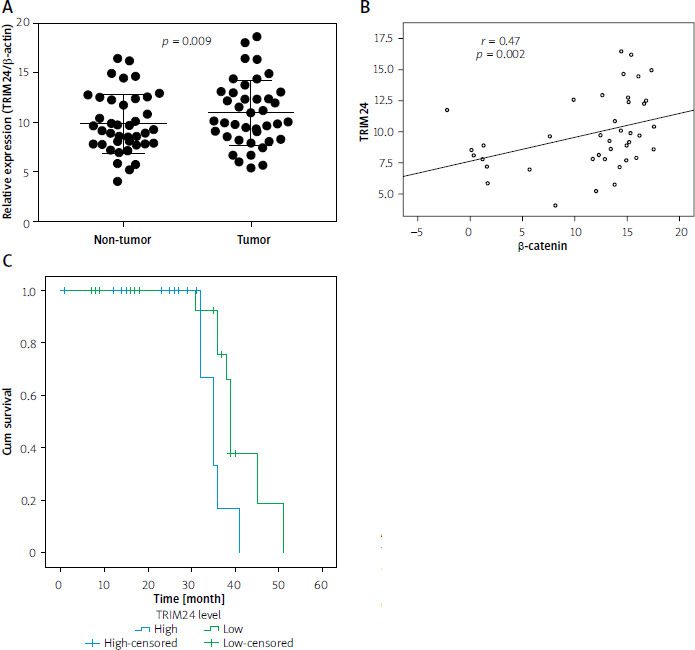
To determine whether the expression of TRIM44 is altered in gastric cancer, a real-time quantitative PCR of the corresponding mRNA was performed on 40 cancerous tissues and their adjacent non-cancerous tissues. As shown in Figure 1, the TRIM24 mRNA levels were significantly higher in the tumour tissue (fold change = 2.69, 95% CI: 2.24–3.60, p = 0.009) (Figure 1 A). The data regarding to the expression levels of b-catenin, cyclin D1, and BCL2 were retrieved from our previous study [38], and their potential correlation with TRIM24 expression was analysed. It was found that all these genes were upregulated, and their expression ratios were as follows: b-catenin (FC = 2.53, 95% CI: 1.91–3.15); cyclin D1 (FC = 2.39, 95% CI: 1.60–3.28); and Bcl2 (FC = 2.42, 95% CI: 1.60–3.28). TRIM24 overexpression was also correlated with high b-catenin (r = 0.47, p = 0.002) (Figure 1 B), while no statistical significant correlation were found for cyclin D1 and BCL2.
Figure 1
TRIM24 expression in GC tissue and its relationship with patients’ overall survival. A – TRIM24 mRNA expression levels in 40 GC tissues and their corresponding noncancerous tissues. B – Correlation between TRIM24 and β-catenin expression (r = 0.47, p = 0.002). C – Kaplan-Meier survival curves of GC patients stratified by high and low TRIM24 expression levels (p = 0.019)
Correlation between TRIM24 expression and clinicopathological features in GC patients
To investigate the association between the TRIM24 overexpression and some clinicopathological features of GC, patients were classified into two groups based on the median level of TRIM24 expression as high (n = 20) and low (n = 20) groups (Table I). As shown in Table I, no significant differences were observed regarding in the pathological parameters, including tumour type (p = 0.144), tumour size (p = 0.519), T stage (p = 0.127), and N stage (p = 0.185), between the two study groups. Additionally, patients in the high group showed a higher frequency for anaemia (80% vs. 55%), bleeding (40% vs. 35%), dysphagia (75% vs. 65%), smoking (55% vs. 35%), stomach ache (80% vs. 65%), reflux (65% vs. 40%), and anorexia (80% vs. 55%), compared to the low group. However, these differences were not statistically significant.
Table I
Correlation between TRIM24 expression and clinicopathological features in GC patients
TRIM24 expression and the prognosis of GC patients
Kaplan-Meier analysis was performed to examine whether TRIM24 expression level is associated with patients’ overall survival (OS), and if it could act as a valuable prognostic factor in GC patients. A lower OS rate was observed in patients with high TRIM24 levels (median = 35 months, 95% CI: 31.61–38.40) compared to those with low levels (median = 40 months, 95% CI: 36.34–41.66) (p = 0.019; Figure 1 C). Interestingly, Cox proportional hazards regression in univariate (HR = 3.37, 95% CI: 1.09–10.46, p = 0.035) and multivariate (HR = 3.94, 95% CI: 1.06–14.60, p = 0.041) models identified TRIM24 mRNA level as an independent prognostic factor for OS in GC patients (Table II). Altogether, these data indicated that TRIM24 expression may increase during GC progression, and that this marker appears to be clearly associated with a more malignant phenotype and worse prognosis.
Table II
Univariate and multivariate analyses for variables associated with the overall survival of GC patients
Meta-results
Literature retrieval and analysis
Following a comprehensive literature search based on the predefined criteria, a total of 24 published articles (26 studies) were finally found to be eligible for enrollment in the current meta-analysis (Figure 2) [20–23, 25–36, 39–45]. The main characteristics of these eligible studies with 3639 patients and sample sizes ranging from ranging from 31 to 341 are summarised in Table III. All studies were published between 2010 and 2022. A total of 14 different types of cancer including gastric cancer (n = 3), hepatocellular carcinoma (n = 1), colorectal cancer (n = 3), oesophageal squamous cell cancer (n = 1), breast cancer (n = 5), prostate cancer (n = 2), glioblastoma multiform (n = 1), bladder cancer (n = 2), non-small-cell lung cancer (n = 1), head and neck squamous cell carcinoma (n = 3), cervical cancer (n = 1), and ovarian cancer (n = 2) were analysed in this study. Of these, 17 studies provided data regarding the OS, and 10 studies reported data for PFS/DFS/RFS and TRIM24 expression.
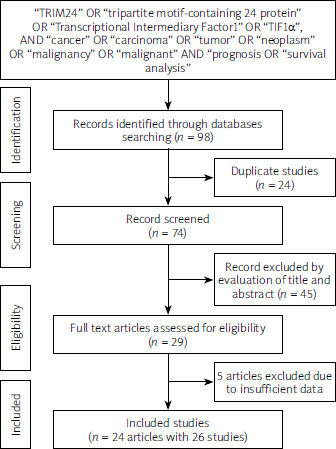
Table III
Characteristics of eligible included studies
[i] GC – gastric cancer, EOC – epithelial ovarian cancer, OC – ovarian cancer, CRC – colorectal cancer, ESCC – oesophageal squamous cell cancer, PC – prostate cancer, BC – breast cancer, GBM – glioblastoma multiform, Bld – bladder cancer, HNSCC – head and neck squamous cell carcinoma, CC – cervical cancer, OS – overall survival, DFS – disease-free survival, PFS – progression-free survival, RFS – recurrence-free survival, TFS – tumour-free survival, NR – not reported.
Association between TRIM24 expression and patients’ OS
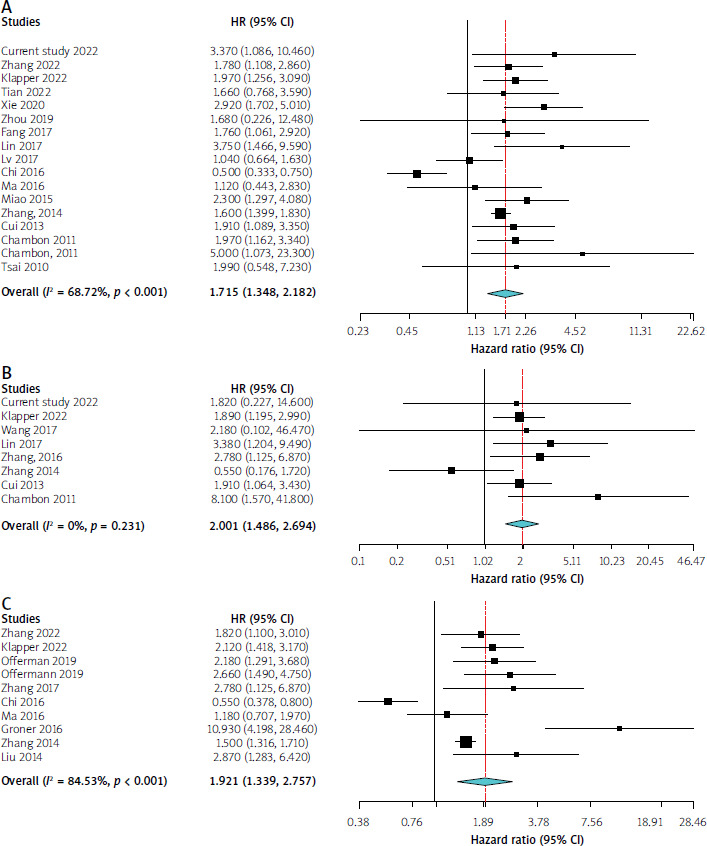
Seventeen studies by univariate model and eight studies by multivariate model were pooled separately to measure the impact of TRIM24 expression on patients’ overall survival. Due to the significant heterogeneity in univariate analysis (p < 0.001, I2 = 68.72%) and lack of heterogeneity in multivariate analysis (p = 0.231, I2 = 24.81%), random and fixed effect models were applied respectively. Both univariate and multivariate analysis showed that high expression of TRIM24 was significantly correlated with poorer OS rates (HR = 1.72, 95% CI: 1.35–2.18, p < 0.001 and HR = 2.00, 95% CI: 1.49–2.69, p < 0.001, respectively) (Figures 3 A, B). Pooled data from 10 studies with a total of 2011 patients, conducted on the effect of TRIM24 expression and PFS/DFS/RFS, also demonstrated that high expression of TRIM24 predicted worse outcome (HR = 1.92, 95% CI: 1.34–2.75, p < 0.001) (Figure 3 C).
Figure 3
Forest plot analyses for patient survival associated with TRIM24 expression. A – In univariate analysis, B – in multivariate analysis, C – in univariate analysis for PFS/DFS/RFS
CI = confidence interval, HR = hazard ratio, OS = overall survival. D – in subgroup based on cancer types
Moreover, subgroup analysis by patient ethnicity and cancer type was also performed (Table IV). In stratified analyses by cancer type, elevated level of TRIM24 was associated with worse OS in patients with different kinds of digestive system carcinomas with no heterogeneity (HR = 2.22; 95% CI: 1.68–2.93; p < 0.001) or other cancers (HR = 1.55; 95% CI: 1.14–2.09; p = 0.005) (Figure 3 D). Subgroup analysis stratified by ethnicity also revealed that high TRIM24 expression was significantly associated with poor OS both in Caucasian with no heterogeneity (HR = 2.14; 95% CI: 1.55–2.95; p < 0.001) and Asian with subsequent heterogeneity (HR = 1.59; 95% CI: 1.20–2.11; p = 0.001) (Table IV). This suggested that the heterogeneity of analyses was probably due to the tumour type and ethnicity. In addition, subgroup analyses for ethnicity was also performed in multivariate analyses of OS. Consistent with univariate analyses, both Caucasian and Asian groups exhibited significant worse OS (HR = 2.09; 95% CI: 1.36–3.22, p < 0.001 and HR = 1.93; 95% CI: 1.28–2.69, p = 0.002, respectively). A similar trend was also found for subgroup analysis regarding PFS/DFS/RFS and TRIM24 expression (Table IV).
Figure 3
Cont. D – in subgroup based on cancer types
CI = confidence interval, HR = hazard ratio, OS = overall survival.
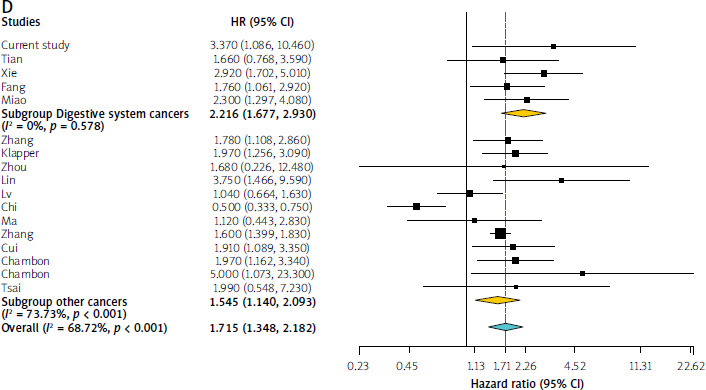
Table IV
Meta-analysis of the association between TRIM24 expression and patients’ survival and clinicopathological characteristics
Association between TRIM24 expression and clinicopathological characteristics
To investigate the association of TRIM24 expression with clinicopathological features of patients with different types of cancers, further meta-analysis was performed on studies that provided data for LMN, DM, tumour size, tumour stage, as well as age and gender distribution. The strength of any association between TRIM24 expression and clinicopathological parameters was assessed by calculating pooled ORs with corresponding 95% CIs. Meta-results showed that high TRIM24 level was associated with LNM (OR = 1.70; 95% CI: 1.04–2.78, p = 0.036), advanced tumour stage (OR = 2.46; 95% CI: 1.74–3.47, p < 0.001), and marginally with larger tumour size (OR = 1.27; 95% CI: 0.096–1.69, p = 0.096). However, no significant association was found for DM (OR = 4.28; 95% CI: 0.90–20.43, p = 0.680), age (OR = 0.98; 95% CI: 0.82–1.19, p = 0.883), and gender distribution (OR = 1.07, 95% CI: 0.84–1.37, p = 0.560) (Table IV).
Sensitivity analysis and publication bias
To examine the stability of pooled results, sensitivity analysis by consecutively omitting each study was performed in both univariate and multivariate analysis of OS studies, PFS/DFS/RFS, as well as other association’s studies. The results showed that no single study significantly affected the overall pooled HRs or ORs, indicating that pooled results were statistically robust (Figure 4 A).
Figure 4
Sensitivity analysis (A) and Begg’s funnel plots of the publication bias (B) for OS in univariate analysis
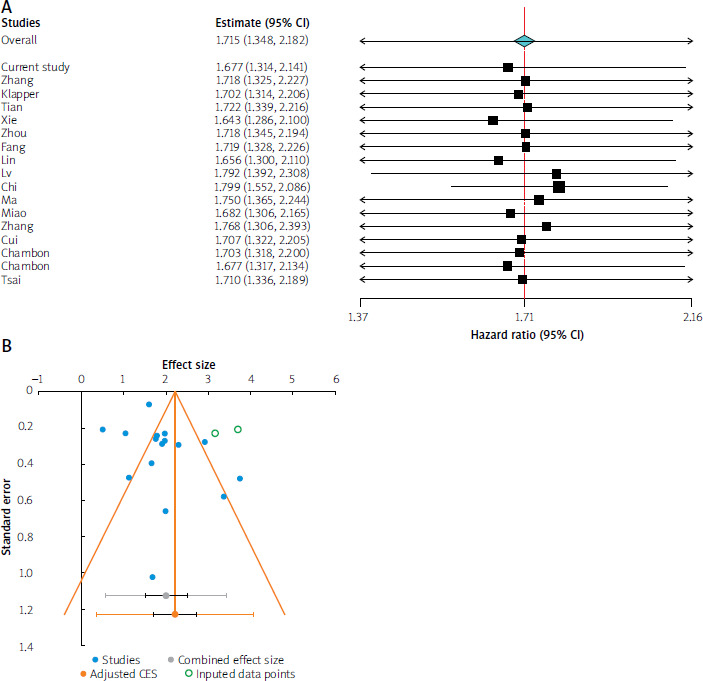
Begg’s funnel plot and Egger’s regression asymmetry test were also used to assess the publication bias of the meta-analysis. Both visual inspection of funnel plot and Egger test results revealed no evidence of publication bias in the 17 studies by univariate analysis (Egger’s test, p = 0.413, Figure 4 B), and 8 studies by multivariate analysis (Egger’s test, p = 0.690) for OS, 10 studies by univariate analysis for PFS/DFS/RFS (Egger’s test, p = 0.274), 14 studies for tumour stage (p = 0.258), 7 studies for tumour size (Egger’s test, p = 0.426), 15 studies for age (Egger’s test, p = 0.637), and 12 studies for gender (p = 0.524). However, a significant publication bias was found across the 13 included studies for LNM (Egger’s test, p = 0.007), suggestive of potential risk for publication bias.
Discussion
The existing research on the TRIM family suggests that some of TRIM members are involved in various types of malignancies. It has been reported that TRIM24 plays a dual oncogenic or tumour suppressor role in the pathogenesis of a wide range of cancers. The present study was designed to assess the expression pattern of TRIM24 in GC patients. Our results showed that TRIM24 expression was remarkably higher is tumour tissues compared to their normal adjacent tissues. Furthermore, our findings indicated that high expression of TRIM24 predicts shorter OS/DFS, and worse prognosis in patients affected with GC. However, some studies have reported a significant association between decreased levels of TRIM24 and poor outcomes, indicating a tumour suppressor role in cancer patients [36, 37, 46]. Also, our meta-results confirmed that TRIM24 overexpression was significantly associated with poor OS and PFS/DFS/RFS both in univariate and multivariate models. Furthermore, the pooled data demonstrated that TRIM24 overexpression was also remarkably correlated with worse clinicopathological outcomes including LNM, tumour stage, and tumour size. These findings support the oncogenic role of TRIM24 in the development, invasion, and metastasis of various tumours.
Previous studies have indicated a regulatory role for TRIM proteins in Wnt/b-catenin signalling. It is well-established that the Wnt/b-catenin signalling pathway is involved in oncogenesis and contributes to the initiation and progression of different cancers such as ovarian cancer [47], lung adenocarcinoma [48], breast cancer [49], and colorectal carcinoma [50]. In the present study, b-catenin expression level was higher in GC tissues than in the controls. The positive significant correlation between the b-catenin expression levels and TRIM24 in GC patients was also interesting. These findings reasonably confirm other studies on the critical contribution of TRIM proteins in the development and progression of different types of cancer through the Wnt/b-catenin signalling axis [51]. In addition to b-catenin, the overexpression of BCL2 and cyclin D1, two other major downstream genes of the Wnt pathway, were also observed in the present study. Previous studies revealed that TRIM24 knockdown in human cancer cells resulted in downregulation of b-catenin and cyclin D1, as well as a significant reduction in BCL2 mRNA and protein levels, indicating that TRIM24 is engaged in GC tumour progression through Wnt/b-catenin, cyclin D1, and BCL2 signalling axes. A rational explanation for these observations is that TRIM24 plays an oncogenic role in GC, and its overexpression could result in the enhancement of cell proliferation and inhibition of apoptosis due to the upregulation of genes encoding b-catenin, cyclin D1, and BCL2. Taken together, a direct link between TRIM24 upregulation and GC progression could conceivably be hypothesised. However, the precise function(s) of TRIM24 in the molecular mechanisms of GC development are yet to be explored.
Our meta-results showed that TRIM24 overexpression was an indicator for worse outcomes and poor prognosis in patients with various tumours. Pooled HRs from Cox uni-/multivariate analyses also demonstrated shorter OS and PFS/DFS/RFS in patients with high TRIM24 levels compared to those with low TRIM24 level, indicating that TRIM24 overexpression is likely to serve as an unfavourable prognostic factor for affected patients. Moreover, the pooled ORs indicated that TRIM24 expression was also remarkably correlated with LNM, tumour stage, and tumour size in these patients. In general, TRIM24 overexpression represents an independent predicting factor for the prognosis of cancer patients. Consistent with these results, two previous meta-analyses with 10 and 14 studies, respectively, have also evaluated the prognostic value of TRIM24 expression in various solid tumours [52, 53]. However, the former study failed to find a significant relationship between OS and TRIM24 expression due to fewer included articles, but the later one showed that TRIM24 overexpression predicted poor OS significantly. In line with their results, a significant correlation was also found in subgroup analyses based on various factors such as ethnicity and type of cancer. This result strongly supports the clinical significance of TRIM24 expression as a novel prognostic biomarker in different malignancies and suggests that TRIM24 may be a promising target for cancer therapy.
Because heterogeneity is a significant issue in meta-analyses, its sources have been evaluated through predefined methods, including stratified analyses in which a considerable reduction was observed for heterogeneity among Caucasian patients as well as those with digestive system cancers. However, some limitations in this meta-analysis should be pointed out when interpreting the results. First, no exact cut-off value was reported for the expression levels of TRIM24 in different studies. Moreover, the difference in protocols for post-surgery treatments in different studies may have had an impact on survival outcomes and thus might have resulted in some heterogeneity.
Conclusions
Our results support that TRIM24 overexpression could predict worse prognosis and promote tumour progression in a concerted fashion with the Wnt/b-catenin axis in GC patients as well as other solid tumours. More multicentre studies are needed to confirm the value of TRIM24 expression as a potential prognostic marker.