Introduction
The Crohn’s Disease Exclusion Diet (CDED) combined with partial enteral nutrition (PEN) is a dietary therapy developed to induce and maintain remission in patients with Crohn’s disease (CD), particularly in children and adolescents, but increasingly studied in adults as well. The CDED + PEN is a standardised diet consisting of 3 phases. The first phase (0–6 weeks) is highly restrictive, excluding all potential triggering ingredients, while emphasising consumption of high-quality protein sources and microbiome-enhancing ingredients. For the next 6 weeks (phase 2) the diet is liberalised, enabling a gradual introduction of previously restricted components. The maintenance phase starts from week 13. This phased approach facilitates ease of adherence for patients, making the CDED more manageable and allowing for better long-term compliance. Adherence may be difficult without proper education and support, and it requires supervision from a dietitian.
There are many studies available to support the usefulness and effectiveness of CDED + PEN in induction of remission in mild to moderate CD [1–5], but published evidence of maintenance therapy for IBD is limited. Additionally, most of the available data are trials based on small groups of patients.
Table I
Presentation of analysed group
Aim
We designed this retrospective study with a 12-month follow-up period to evaluate the duration of clinical remission in paediatric patients with mild to moderately active Crohn’s disease undergoing CDED + PEN, stratified by degree of dietary adherence.
Material and methods
It is a retrospective, single-centre observational study with the participation of paediatric patients with CD who underwent CDED + PEN (Modulen IBD®) treatment between June 2019, and June 2025 at the Department of Gastroenterology, Hepatology, Feeding Disorders, and Paediatrics, The Children’s Memorial Health Institute in Warsaw, Poland. A complete enteral formula recommended for exclusive and partial enteral nutrition in patients with CD is Modulen IBD®. The daily intake of Modulen IBD® and the mandatory products in the first 2 stages of CDED + PEN were calculated by a dietitian for each patient individually (unit dose) depending on age, gender, and nutritional status using the Harris-Benedict formula. The principles of each of the 3 stages of the diet were discussed in detail by the dietitian with the patient and caregiver.
Clinical remission was defined as Pediatric Crohn’s Disease Activity Index (PCDAI) < 10. The adopted relapse criteria were as follows: any increase in PCDAI > 10 or escalation of medical therapy. The following parameters were assessed: nutritional status of patients using the BMI-SDS index (group 6–17 years), inflammatory markers: erythrocyte sedimentation rate (ESR), C-reactive protein (CRP), and faecal calprotectin level. Disease severity was assessed by PCDAI index. High adherence was defined as adherence ≥ 80%. All data were analysed after 1.5, 3, 6, 9, and 12 months from baseline (the introduction of the nutritional intervention). The time to relapse was analysed.
Statistical analysis
Statistical analysis involved a preliminary assessment of data distribution using descriptive statistics (mean, standard deviation, quartiles, and IQR). The F-test was used to verify the assumption of variance homogeneity. Due to the demonstrated differences in variance, Welch’s t-test, which is robust to unequal variances and different sample sizes, was used to compare means between two independent groups.
Results
Fifty-four patients aged 6–17 years were qualified for the study. The analysed group is presented in Table I. Mean longevity of disease before CDED + PEN was 1.44 years. In 32 of 54 patients, CDED + PEN treatment was initiated within 6 months of diagnosis. Mean baseline PCDAI was 15.47 ±12.44 points. Clinical remission was achieved in 69% of children (37/54, 5 lack of data) by week 6 and in 77% by week 12 (40/52, 7 lack of data). Mean week-6 PCDAI was 6.12 ±8.03 points, mean week-12 PCDAI was 4.63 ±5.69 points. Improvement of nutritional status was observed post CDED. Mean baseline BMI-SDS was 18.18 ±4.67 vs. month-12 mean BMI-SDS 18.95 ±3.22.
Twelve-month clinical follow-up was available in 41 subjects. Relapse 12 months post nutritional intervention was documented in 12/41 patients. The median time to relapse was 8.2 months. A statistically significant factor influencing the duration of remission was identified. In patients with adherence ≥ 80% (n = 17), the median remission time was 11.97 months (IQR: 7.60–25.98; mean: 18.75 ±16.18 months). In those with adherence < 80% (n = 10), the median remission time was 5.63 months (IQR: 4.97–8.03; mean: 6.88 ±4.02 months). The mean difference between groups was 11.9 months (95% CI: 3.3–20.5); Welch’s test p = 0.009. An F-test confirmed unequal variances (p = 0.0002) (Tables I, II, Figure 1).
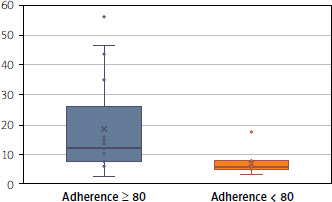
Table II
Evaluation of inflammatory parameters during CDED + PEN induction and maintenance therapy
Discussion
There are single publications available assessing the effectiveness of CDED in maintaining remission. The limitations in the available studies were the small groups of patients and short observation periods. Effectiveness of partial enteral nutrition for the maintenance of remission in Crohn’s disease was proven in meta-analysis [6]. The study conducted by Yanai et al. supports the use of CDED as sole maintenance therapy in adults, but the observation period lasted only 24 weeks [2]. Twenty-four-week follow-up was also conducted in a study from Israel designed to assess the CDED in adults with Crohn’s disease. At week 6, 13 (68%) of 19 patients in the CDED plus partial enteral nutrition group and 12 (57%) of 21 patients in the CDED group had achieved clinical remission (p = 0.4618). Among the 25 patients in remission at week 6, 20 (80%) were in sustained remission at week 24 [2]. A case series (n = 4) by Levine et al. provided data showing that CDED plus PEN was effective as monotherapy in uncomplicated mild–moderate CD disease, with > 1 year sustained remission recorded [7]. A group of researchers from Italy, based on the assessment of 5 cases, suggested that CDED with or without PEN presented a safe and effective therapeutic option as both induction and maintenance monotherapy.
There are no studies assessing adherence and its influence on the length of remission. The DELECTABLE program aimed to assess satisfaction, adherence, and efficacy of dietary therapies (CDED, EEN) as part of IBD care. Patient- and dietitian-rated adherence was high at baseline and did not significantly decrease on any diet arm (p > 0.349) [8]. The study was underpowered to show whether CDED was superior to EEN in sustaining remission. However, 2 weeks of EEN followed by CDED was effective in inducing remission in CD, with most CDED patients maintaining remission up to 24 weeks [9].
Authors from Greece presented the results of their study concluding that adherence to the Mediterranean diet (MD) was associated with disease activity and QoL in patients with CD. They recommended future research focusing on MD intervention studies on IBD patients to assess its effect on modulating disease activity/course and related inflammatory biomarkers [10]. According to our results, sub-optimal adherence is the chief modifiable predictor of relapse. CDED + PEN rapidly induces remission in children with CD and, when adherence is ≥ 80%, prolongs it by about 1 year. During the first 6 months, a decrease in inflammatory parameters (FCP, CRP, ESR) was observed in the analysed group, followed by a gradual increase in the mean values. The results are consistent with those previously presented [11].The median time to relapse was 8.2 months. The presented results support wider adoption of CDED + PEN for paediatric mild-to-moderate Crohn’s disease and underscore the dietitian’s key role in sustaining adherence. The findings of our study can help guide personalised treatment plans, optimise dietary protocols, and improve long-term outcomes for CD patients. The importance of adherence to dietary recommendations and its impact on the course of CD was presented by researchers in their work where they examined the correlation between elemental diet (ED), adherence, and the postoperative recurrence of CD. Patients who did not adhere to the ED were allocated to the non-ED group. Symptomatic and endoscopic recurrence-free durations were longer in the ED group than in the non-ED group (p = 0.003 and p = 0.021, respectively), and ED adherence was a prognostic factor for endoscopic recurrence (HR = 2.777, 95% CI = 1.036–8.767, p = 0.042) [12]. Ali Alsarhan et al. used a questionnaire to identify the difficulties CD patients faced while using the special diet. The following factors were reported to cause non-compliance by patients: intolerance/difficulty to follow (40%), cost (19%), poor clinical response (19%), and others. They emphasised (as did we) that a multidisciplinary approach, including dietary interventions, is crucial. Addressing barriers and prioritising the dietitians’ role is essential for improved patient outcomes in inflammatory bowel disease management.
Conclusions
CDED + PEN therapy is a promising approach for inducing and maintaining remission in paediatric patients with mild to moderate Crohn’s disease. The duration of remission achieved with these therapies can range from several months to over a year or longer, depending on the patient’s adherence to the prescribed diet. Follow-up visits every 3–6 months to assess dietary adherence and monitor for potential relapses, particularly during the first year of therapy, are recommended. As confirmed by the results of our study, high adherence to CDED and PEN significantly improves remission duration, often extending beyond a year.