Introduction
Endoscopic retrograde cholangiopancreatography (ERCP) with biliary stenting is a widely recognised management and standard of care in patients with malignant biliary obstruction (MBO). Apart from tissue acquisition, this method is believed to be sufficiently effective in relieving jaundice before applying chemotherapy. Other benefits of stenting are prevention of bacterial infections of the bile duct, the maintenance of liver function, and improvement of the patients’ quality of life [1]. Moreover, in selected centres, the transpapillary endoscopic approach may serve to deliver drugs, radioisotopes, or photodynamic therapy. Apart from these advantages, ERCP with biliary stenting carries the risk of acute pancreatitis, bleeding, cholecystitis and in case of separated intrahepatic ducts also the risk of acute cholangitis with formation of liver abscesses [2]. In certain patients, these complications may blunt expected advantages of stenting.
The final target of palliative biliary drainage in patients with jaundice due to unresectable MBO is to prolong survival by providing access to chemotherapy. For this reason, drainage of more than 50% of the total liver volume is recommended, requiring stenting of at least 2 biliary sectors, and infrequently necessitating several endoscopic interventions [3]. Self-expandable metal stents (SEMS) offer longer bile duct patency than plastic stents, which was confirmed in our recently published study [4].
The clinical spectrum of patients with MBO is wide, according to variable degree of local extension and systemic dissemination of cancer. In advanced stages of cancer, the decision on biliary stenting may be intricate due to challenging assessment of short-term life expectancy, excessive expectations from patients’ families or specialists in different areas of medicine, and the impact of economically oriented hospital policies.
Aim
The purpose of this study was to investigate the clinical efficacy of biliary stenting in patients with jaundice and unresectable MBO with regard to access to chemotherapy.
Material and methods
Study design
This was a retrospective study conducted in patients with MBO hospitalised in a tertiary gastroenterology centre from July 2018 to March 2023. In all patients the malignant character of biliary obstruction was confirmed by histopathology, and due to the origin and site of biliary stricture the patients were diagnosed as perihilar (pCCA) or distal (dCCA) cholangiocarcinoma, ampullary cancer (aCA), gallbladder cancer (gCA), and pancreatic cancer (pCA). All patients were found to be non-eligible for radical surgical treatment based on contrast imaging examinations. Inclusion criteria were as follows: age > 18 years and hyperbilirubinaemia equal to or greater than 2.5 mg/dl with or without elevated activity of liver enzymes. On the other hand, all patients who scored 0–2 in the Eastern Cooperative Oncology Group (ECOG) scale were potential candidates for systemic chemotherapy if bilirubin levels could be significantly reduced by endoscopic biliary stenting. The exclusion criteria were as follows: co-existence of an extrabiliary or extrapancreatic neoplasm, external or internal bile drainage done before admission to hospital, and intrahepatic cholangiocarcinoma. The end of the follow-up was the decision on further treatment made by the oncological council.
The study was conducted in accordance with the ethical guidelines of the Declaration of Helsinki (9th Revision, Poland, 2013).
Data collection
Based on imaging techniques (ultrasound, computed tomography, magnetic resonance) the collected data included local lymph node and vascular invasion by cancer, distant metastases, and ascites. The pCCA was categorised according to Bismuth-Corlette classification (BCC) [5]. Laboratory data were collected before, and 7–10 days and 28–35 days after endoscopic biliary drainage. The source data such as medical history, physical examination, reports of imaging techniques, pharmacological therapies, results of histopathologic or cytologic examinations, and oncology council decisions were extracted from the hospital electronic information system. Pain severity (from no pain [0] to strong pain [10]) was assessed by numerous ratio scale (NRS). General physical condition was assessed by Zubrod scale [6] modified by ECOG (1982), where grade 0 means full ability to carry on all pre-disease performances, grade 1 means restrictions in physically strenuous activity with preserved ability to carry out work of a light or sedentary nature, grade 2 means capability of all selfcare but failure to carry out any work activities taking more than 50% of waking hours, grade 3 means capability of limited selfcare, confinement to bed or chair taking more than 50% of waking hours, and grade 4 complete means disability to carry on any selfcare.
Statistical analysis
Baseline demographics were summarised using descriptive statistics. The qualitative variables were presented as number (%). The distribution of quantitative variables was tested using the Shapiro-Wilk test and assessed graphically based on histograms. One-way ANOVA (analysis of variance) was applied to verify the differences between the means of the studied groups. In the case of variables that did not meet the required assumptions, the Kruskal-Wallis one-way ANOVA was used.
The p level less than 0.05 was considered statistically significant. All statistical analyses were performed with TIBCO Software Inc. (2017) Statistica (data analysis software system), version 13 (http://statistica.io).
Results
General characteristics of patients
Seventy-eight patients with unresectable biliary or pancreatic cancers were allocated into one of three groups based on their bilirubin level: 2.5 mg/dl – < 6.0 mg/dl (group 1), 6.0 mg/dl – 15.0 mg/dl (group 2), and > 15 mg/dl (group 3). Twenty-one patients were diagnosed with pCCA, 14 with dCCA, 10 with gCA, 15 with aCA, and 18 with pCA. The participation of different cancers in the study according to initial bilirubin level is shown in Table I, and the demographic and biochemical characteristics of the patients are shown in Table II.
Table I
Representation of different cancers obstructing extrahepatic biliary ducts in the 3 bilirubin-dependent groups of patients
| Group | Type of cancer | ||||
|---|---|---|---|---|---|
| pCCA (n = 21) BCC (1-2/3-4) | dCCA (n = 14) | gCA (n = 10) | aCA (n = 15) | pCA (n = 18) | |
| 1 | 32.0% (25%/75%) | 24.0% | 0% | 28.0% | 16.0% |
| 2 | 19.0% (50%/50%) | 4.8% | 14.3% | 33.3% | 28.6% |
| 3 | 28.2% (22%/78%) | 21.8% | 21.8% | 3.2% | 25.0% |
Table II
Demographic and laboratory characteristics of patients (mean ± SD) with malignant biliary obstruction according to initial bilirubin level (groups 1–3)
[i] NS – not significant, BMI – body mass index, NRS – Numerous Ratio Scale, ECOG – Eastern Cooperative Oncology Group, ALP – alkaline phosphatase, GGT – gamma–glutamyl transferase, CRP – C–reactive protein, RBC – red blood count, WBC – white blood count, PLT – platelet count, Ca19.9 – cancer antigen 19.9.
On imaging methods, regional lymph node invasion was detected in 68%, 80.1%, and 62.5% of cases in groups 1, 2, and 3, respectively. In these groups, metastases were found in the peritoneum in 16.0%, 33.3%, and 31.2% of cases, respectively. The mean duration of symptoms reported by patients before hospitalisation (jaundice, abdominal pain, weight loss) was 7.3 ±6.4 weeks and did not differ significantly between the various cancer types. No patient showed signs of circulatory or respiratory failure during hospitalisation, and the largest number of patients with good physical performance (grade 0 in ECOG scale) was found in group 1 (48%). The prevalence rates of overweight/obesity, diabetes, hyperlipidaemia, chronic kidney disease, and liver cirrhosis were not significantly different between patients with various types of cancers.
Biliary stenting
The selection of biliary stent (plastic vs. SEMS), its size, and number were at the discretion of operator and depended on the site, length, and stiffness of the biliary stricture. At initial presentation, plastic stents were used in 48 (61.5%) patients (7 in group 1, 11 in group 2, 20 in group 3) and fully covered SEMS in the remaining. There was no significant effect of stent type on access to chemotherapy. The mean time from the first implantation of the stent to the decision on further management made by the oncological council was 36.3 ±6.4 days (in respective bilirubin level-based groups 39.2 ±13.7 days, 41.3 ±18.9 days, and 29.9 ±8.8 days, p < 0.01). During this time, stents were exchanged in 20 (25.6%) patients (1 to 4 times) due to stent dysfunction (n = 12), which was associated with clinical signs of cholangitis in 2 patients in each group (not statistically significant). In all cases cholangitis was controlled with antibiotic therapy without the development of sepsis. Another need for repeated tissue sampling was indeterminate histopathological diagnosis in the first sample (n = 8). More than one biliary stenting was required in 12%, 9.6%, and 3.2% of patients in 3 bilirubin level-based groups.
Clinical outcomes of endoscopic biliary drainage
The results of the liver function tests, which were conducted before and after biliary drainage at two time intervals (7–10 days and 28–35 days), are shown in Figure 1. In group 1, the bilirubin level fell by 1.19 mg/dl at the first measurement after stenting (7–10 days) and fell by 1.61 mg/dl 3 weeks later. In patients with an initial value of 6–15 mg/dl, the bilirubin level fell by 3.77 mg/dl and 5.69 mg/dl 7–10 days and 28–35 days after biliary drainage, respectively. In group 3, the bilirubin level fell by 7.1 mg/dl at the first measurement after stenting (7–10 days) and by 13.0 mg/dl 3 weeks later (Table III). In total, the palliative chemotherapy (monotherapy with gemcitabine or oxaliplatin, irinotecan, 5-fluorouracyl, or capecitabine) was applied in 28 (35.8%) patients: 44.0%, 38.1%, and 31.2% in groups 1, 2, and 3, respectively. The remaining patients were ineligible for chemotherapy due to unsatisfactory liver function tests, including bilirubin level or high aminotransferases and/or deteriorating general condition (ECOG > 2). The clinical outcomes in terms of securing access to chemotherapy and survival time according to the initial bilirubin level are shown in Table IV. The mean survival time in MBO patients was 4.8 ±2.8 months: 5.4 ±2.7 months, 6.2 ±3.9 months, and 3.8 ±2.0 months in groups 1, 2, and 3, respectively. The survival analysis based on the Kaplan-Meier curve in the three study groups is shown in Figure 2.
Figure 1
Bilirubin serum levels on days 7–10 (A) and 28–35 (B) after biliary stenting depending on baseline bilirubinaemia
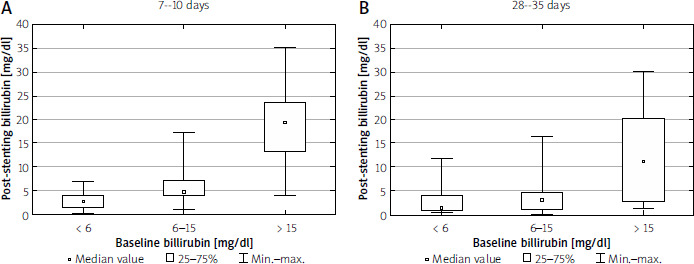
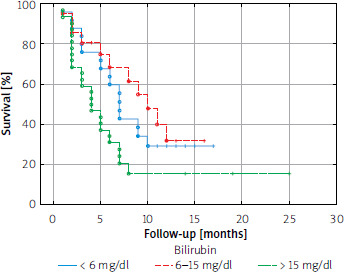
Table III
Bilirubin and aminotransferase serum levels before and after endoscopic transpapillary biliary drainage according to initial bilirubin level (groups 1–3)
Table IV
Access to chemotherapy and survival time of patients with malignant biliary obstruction undergoing biliary drainage according to initial bilirubin level (groups 1–3)
| Clinical outcome | Group 1 | Group 2 | Group 3 | P-value |
|---|---|---|---|---|
| Access to chemotherapy* | 44.0% | 38.1% | 31.2% | < 0.1 |
| Survival time [months], mean ± SD | 5.4 ±2.7a | 6.2 ±3.9a | 3.8 ±2.0 | < 0.05 |
Discussion
Studies published in recent years on endoscopic treatment of MBO have mostly focused on new techniques of biliary drainage in different anatomical circumstances. Our study addresses the real-world benefits of transpapillary biliary stenting in unresectable MBO in terms of securing access to chemotherapy. In patients with MBO, the biliary drainage can be a purely palliative treatment in the case of cholangitis or symptomatic jaundice (pain, pruritus), but its main purpose in the majority of patients with unresectable tumours is providing access to safe chemotherapy [5, 7]. In our study, all patients at initial presentation were excluded from radical surgery owing to expansion of cancer, but they were found to be eligible for systemic chemotherapy after restoration of biliary outflow – this kind of treatment requires significant improvement in liver function tests [8, 9]. This target may be achieved by biliary drainage under condition of unremitting bile outflow from more than 50% of hepatic volume without significant liver injury or development of serious procedure-related adverse events. Abnormal liver function tests, in particular hyperbilirubinaemia, are the main obstacles to starting systemic chemotherapy. The primary endpoint in this study was the accessibility of systemic chemotherapy with or without radiotherapy following endoscopic biliary drainage. The reasons for denial of chemotherapy by the oncological council were a suboptimal decrease of bilirubin level and progression of the cancer with significant deterioration in physical status. In patients with mild hyperbilirubinaemia (group 1), biliary drainage had a significant, although minor, effect on bilirubin level without its normalisation, and in 12% of patients endoscopic reinterventions were necessary due to stent dysfunction delaying access to chemotherapy. Therefore, in patients with an initial bilirubin level of less than 6 mg/dl, the decision on the need for biliary drainage should be taken on a personal basis because any delays in access to treatment may downgrade the benefits of bilirubin level reduction. According to the Tokyo Guidelines, assessment of eligibility to chemotherapy should be made no later than 2 weeks after biliary drainage because longer periods may be associated with cancer progression [10].
In patients with most severe jaundice (group 3) the decline of bilirubin level following biliary drainage was almost linear, but also relatively slow. Only a few patients from this group received chemotherapy, because the liver function tests did not improve satisfactorily and/or the cancer progressed. The decline of aminotransferases in patients with a bilirubin level of more than 15 mg/dl was insignificant after 4 weeks, suggesting an intrahepatic component of jaundice or inadequate deficient biliary drainage. In patients with a baseline bilirubin level in the range 6–15 mg/dl, the access to chemotherapy and survival time were better than in more jaundiced patients; therefore, this bilirubin selection may define the target population for endoscopic stenting. Moreover, in this population, improvements in serum aminotransferases effectively followed the decline of bilirubin level.
In our study, the mean survival time of patients with different cancers obstructing extrahepatic biliary ducts was about 5 months. The 5-year survival rate in patients with MBO is only 5%, and up to 75% of them die within the first year after diagnosis [11, 12]. Patients with gallbladder cancer and perihilar cholangiocarcinoma have an even worse prognosis [13, 14]. Better prognosis is linked to ampullary cancer, which in our study was diagnosed only in 1 patient classified in group 3. Owing to recent progress in anti-cancer therapies, the survival rate of patients with MBO is slowly improving. The phase III trial of the BILCAP study demonstrated a significant improvement in overall survival for patients receiving eight cycles of capecitabine compared to the control group [15]. Therefore, access to chemotherapy is key in the management of patients with MBO.
A limitation of this study was the retrospective nature of the analysis, including several cancer types responsible for MBO and relatively low number of patients enrolled. The heterogeneity of cancer types could significantly affect survival time, but not the dynamics of bilirubin change following biliary stenting. The retrospective nature of the study precludes stratification of patients according to advancement of cancer. In contrast, the strength of the study is a practical aspect, showing genuine profits and unmet outcomes of biliary stenting in the real-world setting.
Conclusions
Although biliary drainage is mandatory in MBO to preserve liver function for subsequent chemotherapy, only one-third of patients reach access to oncological treatment. In terms of bilirubin reduction and access to chemotherapy, transpapillary endoscopic biliary drainage was most effective in patients with a baseline bilirubin level of 6 mg/dl to 15 mg/dl. In patients with a higher bilirubin level the clinical outcome was less favourable owing to unsatisfactory alleviation of jaundice. In the case of mild hyperbilirubinaemia, the effect of biliary drainage was clinically insignificant, with a concomitant delay in access to chemotherapy and cancer progression.