

INTRODUCTION
The developments observed in the diagnosis and treatment of diseases, which started in the middle of the twentieth century, have also led to an increase in the use of complementary and alternative therapies e.g. black radish (Raphanus sativus L. var niger) cure for chronic cough. Alternative medicine, health care that replaces medical treatments, is not accepted by modern biomedicine. Complementary medicine is a system of treatment and care applied in addition to medical treatment [1]. The terms complementary and alternative medicine (CAM) are often used under the same heading. Parents turn to CAM applications due to their fear of the side effects of traditional medical treatments and many other reasons.
Food allergies are an important problem that occurs as a result of the immune system’s response to dietary proteins and affects the quality of life of patients and their families. While the most common food allergens in children are cow’s milk and eggs; hazelnut, peanut, walnut, and wheat are among the common allergens [2]. In food allergies, there may be findings such as urticaria, angioedema, and anaphylaxis as a result of immunoglobulin E (IgE)-mediated type 1 reaction, as well as findings such as atopic dermatitis and eosinophilic gastroenteropathy in mixed type and non-IgE-mediated forms [3]. Among the findings, anaphylaxis is a life-threatening clinical picture and food allergies are the most common cause of anaphylaxis in childhood [2].
Black radish is a root crop/vegetable consumed in winter. There are few adult cases of radish allergy described in the literature. Anaphylaxis with black radish has been reported in one adult case so far [4–6]. We present a patient who consumed black radish cure due to chronic cough and then had anaphylaxis due to black radish allergy.
CASE REPORT
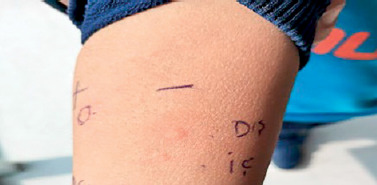
A 5-year-old male patient presented with complaints of urticaria, persistent vomiting, and coughing after consuming a black radish cure about 2 months ago. He had a history of runny nose, sneezing in the spring, and coughing that increased especially at night after he started school. Postnasal discharge was detected in the examinations and the cough was constantly recurring. In addition to medical drugs, the mother sought alternative treatment and applied the black radish cure including honey she heard about from her neighbor. The patient had previously been able to consume honey without any problems. He took a teaspoon of the mixture (black radish plus honey) in the morning, at noon, and in the evening. Approximately 4 h after the evening dose, red, itchy, raised urticarial lesions developed on the face and trunk, and the patient began to vomit repeatedly and cough. His complaints, which lasted for 0.5 h, disappeared over time and the family did not go to the emergency service. In our patient, the onset of recurrent vomiting and cough with urticarial lesions on the face and trunk indicated the development of at least 2–3 systemic manifestations and suggested that anaphylaxis developed as a generalized systemic reaction, albeit somewhat delayed. To confirm the diagnosis of the patient who did not have active complaints during the examination, a skin prick test was performed with inhaled allergens, and a prick-to-prick test was performed with the extracts inside and outside of the black radish. Negative control: 0 mm, histamine 4 mm, meadow grasses 4 mm, and black radish 4 mm induration (Figure 1). Since there was no routine approach previously described with radish, we applied the prick-to-prick test ourselves, to 3 individuals, with the same radish for avoiding irritant reaction, and induration did not occur on them. The patient’s allergic rhinitis symptoms were attributed to grass pollen allergy. Since the patient did not have any problems when he ate honey after anaphylaxis, a prick test was not performed with honey. In the blood tests, the total IgE was 1,060 IU/ml and there was no eosinophilia. The patient was found to be allergic to grass pollen and radish. The patient was able to consume the same group of root crops/vegetables e.g., carrots and celery without any problem. The patient was instructed to avoid eating radish and an adrenaline autoinjector was prescribed. The patient was still advised to be careful while consuming root crops since we were not able to perform food challenges with all of them. The fact that the patient was able to consume the same group of root crops/vegetables, such as carrots and celery, without any problems reduced the possibility of developing cross-reactions between these groups of vegetables in our patient. Although we asked for testing with honey or other vegetables that might cross-react, the family was non-compliant and would not allow further testing. (Informed consent was obtained from the patient’s relatives for this presentation.)
DISCUSSION
United Nations National Institute of Health defines CAM practices as a broad field of health that encompasses all health services, methods, practices, and accompanying theories and beliefs, outside the dominant health system, in a particular society or culture in a particular period [7]. The positive factors that incline parents towards complementary and alternative treatments for their children are as follows: parents’ opinion that complementary and alternative treatment methods are effective and safe, the patient can take an active role in such treatments, and parents create a sense of control, most of the treatment methods are non-invasive and easy to accept [8].
Modern medicine used today accepts the evidence-based approach. CAM practices are often based on unproven assumptions. These methods can be harmful both directly due to their side effects and indirectly due to their ineffectiveness or delay in medical treatment. Direct side effects vary according to the type of treatment used. Side effects are most common with herbal therapies. In herbal products, there is not enough information about the active components and metabolites of the plant, its pharmacokinetic properties, toxicology and antidote, frequency of side effects, interaction with other herbs or drugs, and use in special patient groups [9]. Our patient, who was able to consume honey without any problems before and after, had anaphylaxis due to a black radish-honey cure. Our pediatric case is the first patient having anaphylaxis described with a black radish cure in the literature. In our patient, the onset of recurrent vomiting and cough with urticarial lesions on the face and trunk indicated the development of at least 2–3 systemic manifestations and suggested that anaphylaxis developed as a generalized systemic reaction, albeit somewhat delayed [10–12].
Food allergy is more common in children than adults. In addition, the prevalence of food allergies is increasing in developed countries [13–15]. Despite the increasing prevalence of food allergy cases and the risk of serious allergic reactions, there is no definitive cure. The main solution is symptomatic treatment and removal of allergen-containing food from the diet [16]. In a multicenter study by Aydogan et al. in Türkiye, cow’s milk was found to be the most common cause of anaphylaxis in children with food allergies, followed by nuts and chicken eggs [2]. Black radish allergy, which we detected in our case, is a very rare condition. There are very few adult cases of radish allergy reported in the literature. Even though anaphylaxis caused by black radish was reported in an adult, there have been no pediatric cases described so far.
Black radish (Raphanus sativus L. var. niger) is a root vegetable of the Brassicaceae family and a variety of winter radishes [17]. Black radish allergy is rare. Sousa et al. reported a case report of anaphylaxis with black radish in a 56-year-old female patient. The patient presented to the emergency department with generalized urticaria, facial angioedema, and severe bronchospasm (O2 saturation in room air, 88%) 10 min after ingesting a dietary supplement, also known as Hepatocomplex® (Biocol Laboratórios, Alcoitão, Portugal). The patient was administered adrenaline intramuscularly, corticosteroid, and H1 antihistamine intravenously. A skin prick test was performed with Hepatocomplex®. The skin test was positive (mean swelling of 5 mm in diameter), however, a dry cough occurred during the test, which immediately returned with inhaled salbutamol. The composition of the dietary supplement was analyzed to find the culprit food ingredient. It has been observed that it contains rosemary (Rosmarinus officinalis), artichoke (Cynara cardunculus), and black radish (Raphanus niger), including sorbitol, glycerin, lecithin, choline, arginine, vitamin E, and several oligo-elements. Prick-to-prick tests were performed with the first three fresh foodstuffs. It was just positive for black radish (10.5 mm mean diameter swelling); the rest were negative [5]. Our patient also took a cough cure containing black radish for food supplementation and had anaphylaxis with black radish.
The radish-specific antigen triggering the allergy is currently unknown. Immunoblotting analysis in a previous case report demonstrated IgE reactivity to 65-kDa or 18-kDa proteins in radish. There are some significant protein families of plant food allergens, containing pathogenesis-related (PR)-10 and profilin. PR-10 and profilin have molecular weights of about 17-18 kDa and 12-15 kDa, respectively, and are not thermostable and susceptible to gastric ingestion [18, 19]. The fact that our patient was able to consume the same group of root crops/vegetables, such as carrots and celery, without any problems reduced the possibility of developing cross-reactions between these groups of vegetables.
Oral allergy syndrome (OAS) is defined as the symptoms of IgE-mediated immediate allergy localized in the oral and pharyngeal region and caused by contact with the acid and heat-labile antigen of raw fruits and vegetables such as profiling and PR-10. There is cross-reactivity between food and aeroallergens, roughly 60% of food allergies, and the rate of OAS in cases with pollen allergy is 5–8% [20]. Cases with an allergy to pollens are detected to have pollen food allergy syndrome (PFAS) which is clinically described by OAS symptoms immediately after food ingestion and is considered to happen when anti-pollen allergen IgE antibodies cross-react with the plant food allergens. Although our patient is allergic to the pollens of meadow grasses, it is not known whether there is cross-reactivity between meadow grasses and black radishes.
CONCLUSIONS
This case is presented to draw attention to the allergic, anaphylactic, life-threatening side effects that may develop due to CAM practices, which are frequently used in children and seen as quite innocent. In addition, although it is rare, anaphylaxis can be seen induced by black radish consumption.