


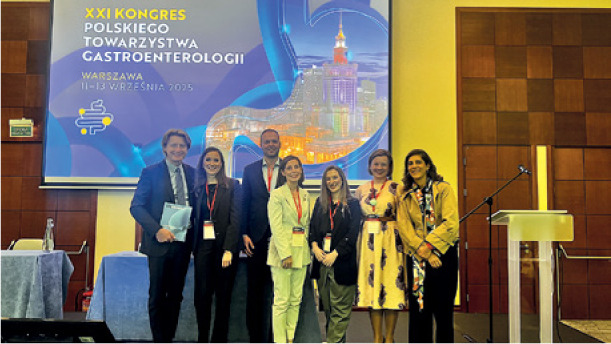
As the first signs of autumn appeared over Central Europe, we experienced Warsaw becoming, once again, the vibrant centre of gastroenterology. From 11 to 13a September 2025, we had the privilege of welcoming more than a thousand colleagues – clinicians, researchers, and students – to the Hilton Warsaw City Hotel for the XXI Congress of the Polish Society of Gastroenterology (PTG-E).
For us, this Congress also carried a sense of historical continuity. Founded in 1909, the Polish Society of Gastroenterology stands among the world’s earliest gastroenterological organisations, emerging shortly after the American and Japanese societies. Throughout its long history, Polish physicians have helped drive progress in digestive medicine, and we feel deeply connected to this legacy of innovation and leadership.
Under Grazyna Rydzewska’s scientific direction, this year’s meeting was organised in close collaboration with major academic centres, professional partners, and industry contributors. The Congress was held under the honorary patronage of the Polish Ministry of Health, the Rome Foundation, HpEuReg, and the World Gastroenterology Organisation (WGO). During the 3 days, we witnessed a vibrant exchange in which clinical practice and scientific discovery naturally came together, and the dialogue between Polish and international gastroenterology gained new strength.
Bridging science and clinical practice
From the very first morning, we watched the Congress unfold as a true meeting point between practical medicine and scientific reflection. The opening day was devoted to hands-on workshops and masterclasses, and it was gratifying for us to see young physicians eagerly signing up for the endoscopy and ultrasound courses. At the same time, seasoned gastroenterologists led live demonstrations on intestinal ultrasound, pancreatic imaging, and advanced therapeutic procedure sessions that vividly illustrated how technical skill and clinical intuition continue to evolve together.
Among the parallel sessions, one was particularly meaningful to us because of its novelty and international reach: the Psychogastroenterology session organised under the auspices of the Rome Foundation. Its inclusion in the program signalled a broader shift in our field. Disorders of gut–brain interaction (DGBIs) simply cannot be fully understood, let alone effectively treated, without taking into account psychological, behavioural, and emotional factors that influence digestive health.
The session was anchored by a keynote lecture delivered by Professor Laurie Keefer of the Mount Sinai Gastroenterology Centre in New York, a Rome Foundation Board member and one of the world’s foremost authorities in psychogastroenterology. Her presentation on skills-based medicine, resilience, and psychological adaptability offered a transformative lens for viewing patient care. We observed firsthand how strongly her message resonated with Polish clinicians, prompting discussions about how behavioural interventions might be integrated into routine gastroenterology practice. After Professor Keefer’s presentation, a 3-hour practical workshop by the faculty of psychogastroenterology further deepened participants’ understanding and provided direct clinical application.
For us, this session held additional symbolic weight. The Polish Society of Gastroenterology has recently formed a national Psychogastroenterology Section – only the second such section worldwide after the United States. This development reflects a clear commitment within Polish gastroenterology to embrace the psychosocial dimensions of digestive diseases and to align our national priorities with the global direction set by the Rome Foundation and the WGO.
The session was richly complemented by contributions from Polish experts, who addressed stress management, dietary factors, and effective communication with patients. Their presentations underscored a message we deeply believe in: psychogastroenterology is no longer an abstract concept confined to academic discourse, but an emerging clinical reality that is reshaping daily practice in Poland.
Opening ceremony and honors
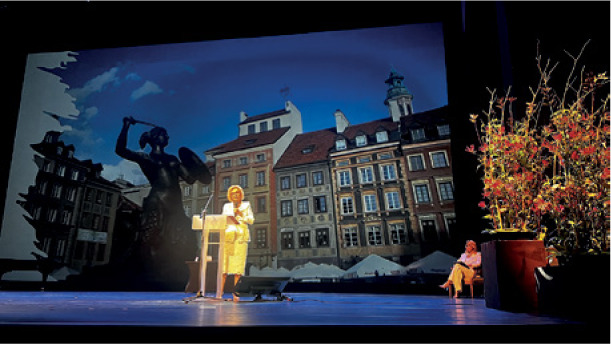
The Opening Ceremony of the Congress was both solemn and inspiring, setting the tone for 3 days of scientific exchange and collegial celebration. The ceremony was gracefully moderated by Agata Młynarska, a distinguished Polish journalist and media personality, whose thoughtful introductions and elegant moderation added warmth and professionalism to the event. In her welcome address, Professor Grażyna Rydzewska, Vice-President of the Polish Society of Gastroenterology, emphasised the Congress theme “One Patient” as a call for unity across disciplines and borders, reminding participants that “we all share the same patient, the same mission, and the same responsibility”.
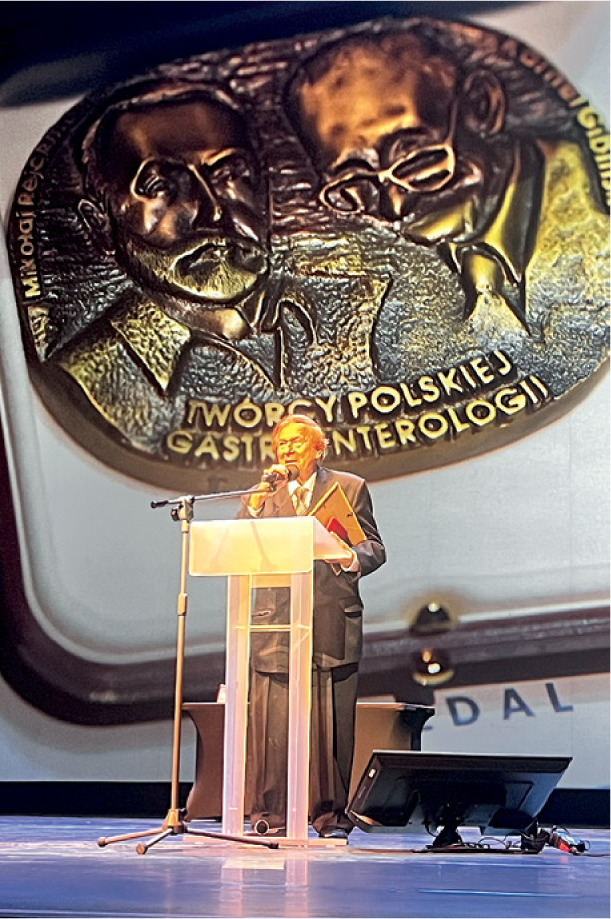
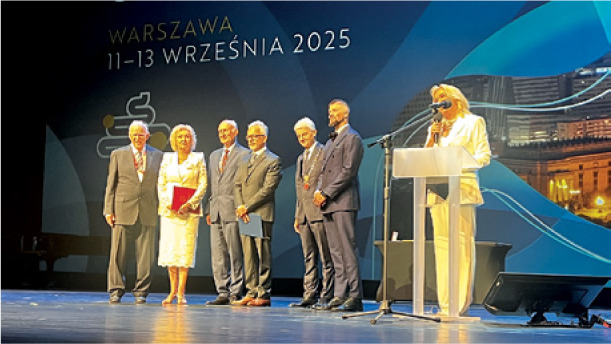
During the ceremony, Medals of Honour of the Polish Society of Gastroenterology were presented to distinguished figures whose achievements have profoundly influenced the development of gastroenterology in Poland and beyond. Among the recipients were Professors Jan Długosz and Maciej Gonciarz, whose distinguished academic career and mentorship have left an enduring mark on Polish clinical medicine.
The Society also conferred the title of Honorary Member of the Polish Society of Gastroenterology (PTG-E) upon two eminent scientists: Professor Jean Morisset (Canada), a long-time friend of Polish gastroenterology and an internationally recognised expert in gastrointestinal and pancreatic research, and Professor Tomasz Brzozowski (Poland), a world-renowned authority in gastrointestinal physiology and experimental gastroenterology.
Their recognition reflected not only individual excellence but also the spirit of international collaboration that defines the Society’s activities, a bridge between Polish and global gastroenterology. The cultural part of the opening ceremony featured the outstanding Polish pianist Paweł Kowalski, one of the most versatile Polish musicians, performing more than forty works for piano and orchestra as well as recitals, chamber, film, and jazz music. His performance brought both emotion and artistic depth to the evening, perfectly complementing the spirit of unity and excellence that defined the Congress.
Scientific highlights of the Congress
The following days were devoted to plenary sessions and focused symposia covering topics from the molecular mechanisms of inflammatory bowel disease (IBD) and the role of the microbiome in disease prevention to new therapeutic horizons in metabolic dysfunction-associated steatotic liver disease (MASLD).
Each presentation carried a sense of momentum: gastroenterology today is not only about organs but also about systems, neural, immune, and microbial, and about understanding the patient as a whole. The IBD sessions, always a highlight of the Congress, brought together leading European experts. Professor Joana Torres (Portugal) discussed prevention and early detection strategies in IBD, while Polish researchers presented new clinical data and registry findings. In another hall, Professor Maura Corsetti (UK) explored the clinical overlaps between cyclic vomiting syndrome and cannabinoid hyperemesis, topics once considered rare but now increasingly relevant.
Elsewhere, Professor Jan Tack (Belgium) challenged the audience to rethink the overuse of proton pump inhibitors, presenting evidence-based deprescribing protocols, while Professor Mariangela Alloca (Italy) demonstrated state-of-the-art intestinal ultrasound scoring in IBD, showing how imaging can replace invasive diagnostics in many cases.
Between sessions, corridors buzzed with conversation, not only about endoscopy or biomarkers but also about teamwork. As one participant noted, “Our specialty is no longer defined by the scope of the endoscope, but by the scope of our collaboration”.
Bringing global voices to Warsaw
This year’s Congress was distinguished by its truly international faculty. In addition to outstanding Polish experts, the program featured guests from the UK, Italy, Spain, Norway, Germany, Portugal, Canada, the USA, and the Czech Republic.
Among them were Prof. Laurie Keefer (USA), Prof. Anastasios Koulaouzidis, and Prof. Peter Konturek (Germany), both long-standing friends of Polish gastroenterology, as well as Prof. Martina Müller-Schilling (Germany), who spoke on UEG collaborative initiatives and the evolving landscape of hepatology. Prof. Lucia Guilabert (Spain) and Dr. Paula Sousa (Portugal) contributed to interactive, case-based sessions on intestinal disorders and diagnostic innovation.
Their presence not only enriched the scientific program but also reaffirmed the long-standing partnerships between Polish and international societies. Many of the invited guests maintain close collaborations with Polish research teams, sharing data, mentoring PhD students, and participating in joint studies.
Emerging scholars and advancing frontiers
Equally inspiring was the enthusiasm of young investigators who presented their research during oral and poster sessions. Many explored new frontiers such as the gut–brain axis, microbiome modulation, artificial intelligence in gastroenterology, and telemedicine. These voices illustrated the vitality of the field and the continuity between generations, with senior experts mentoring early-career clinicians just as others once mentored them. As in previous years, the sessions were accompanied by a lively exhibition area and vibrant evening discussions, a testament to the energy of Polish gastroenterology and its openness to innovation.
The road ahead
When the Congress concluded, participants left Warsaw with new insights, connections, and a renewed sense of purpose. In her closing remarks, Professor Grażyna Rydzewska reminded the audience that gastroenterology, in Poland and globally, is evolving toward integration:
“The patient does not belong to one specialty. The patient belongs to us all”.
That statement captured the essence of the Congress, a field not fragmented but united, where gastroenterologists, surgeons, dietitians, psychologists, and scientists work together in the service of 1 patient. For the World Gastroenterology Organisation, the Congress once again underscored the importance of global partnership. It demonstrated how a national society, deeply rooted in tradition yet open to innovation, can serve as a hub for collaboration, education, and clinical excellence in Poland, in Europe, and beyond.