


Introduction
In recent years, there has been a trend towards deterioration of the quality of drinking water both in Ukraine and in all countries of the world as a result of nitrates entering the underground water table. Today, there is no region in Ukraine where they would not be detected in wells in excess of standard quantities [1,2].
Nitrates and nitrites are very common substances in the environment. The annual increase in their content in water, air and food products leads to an increase in their intake in the human body. Drinking water from decentralized sources of water supply is an important source of nitrates entering the human body. There is no doubt that nitrates and nitrites have a wide range of toxic effects. The most dangerous of them is the occurrence of methemoglobinemia in young children, which poses a threat to their health and life [3,4].
Many scientific works are devoted to the study of nitrate pollution of the environment and its impact on the living organism [5-7]. However, there are a number of aspects left without proper attention, in particular the effect of nitrates on metabolic processes in the age aspect. During the introduction of xenobiotics into the body of mammals, we can assess the state of the organism in general and the state of individual organs and systems both by non-specific (integral) and specific indicators. Specific include metabolic processes and changes that occur under the influence of certain substances and make it possible to establish early manifestations of pathological changes. Non-specific data include body weight, morphological composition of blood, morphological changes in organs, and the relative weight of internal organs. According to some scientists, the latter are biologically more important [8]. The dynamics of changes in the body weight of animals during exposure to a chemical substance reflects the general state of the organism and the general (non-specific) reaction to intoxication. And the organ that is one of the first to react to the toxic effects of chemicals is the liver [9]. Therefore, taking into account the ever-growing problem of nitrate contamination of groundwater, which is used for the drinking needs of the population both in Ukraine and in other countries of the world, the study of the impact of consuming water with an exceedingly high concentration of nitrates on the body of mammals, especially in the age aspect, always remains relevant.
Aim of the work
The aim of the work was to evaluate the age-specific changes in certain non-specific (such as body weight and liver mass ratio) and specific indicators (transaminases) in the body of white rats when consuming water with an above-normal concentration of nitrates.
Material and methods
The study was conducted on 60 outbred white female rats, divided into two age categories: 30 sexually mature individuals with an initial body weight of 180-200 g and 30 sexually immature individuals with an initial body weight of 60-80 g. Each age category was divided into 5 groups: white rats in the 1st group consumed drinking water with a nitrate content of 50 mg/l, the 2nd group – 150.0 mg/l, the 3rd group – 250.0 mg/l, and the 4th group – 500.0 mg/l. The control group used drinking water from the city water supply (Ternopil city, Ukraine). Access to water was free and could be consumed without restrictions. To create model water solutions, drinking water from the city water supply was used, to which, taking into account the background level (presence of nitrates in the amount of 11.3 mg/l), sodium nitrate (NaNO3) was added in the necessary dose to achieve the concentration in drinking water for consumption by rats in corresponding concentrations of 50, 150, 250, 500 mg per liter. The groups were formed by the method of randomization, and the average body weight in each group was statistically unreliable (p>0.05) among themselves. The duration of the experiment was 30 days. Female white rats were kept on a standard ration of the vivarium of the Ivan Horbachevsky Ternopil National Medical University, at a temperature of 18-22 °C, which met the established requirements. Animals were removed from the experiment by bloodletting under thiopental-sodium anaesthesia. Experiments were conducted in accordance with the European Convention for the Protection of Vertebrate Animals Used for Research Purposes (Strasbourg, 1986) [10] and the norms of biomedical ethics and ‘General ethical principles of animal experiments’ adopted by the First National Congress on Bioethics (Kyiv, 2001).
To study the influence of different concentrations of nitrates under the conditions of their intake with drinking water on the condition of the liver of white rats, the relative weight of the liver (RMW) was calculated according to the formula [11]:
RMW = ML/MW x 100%,
where ML is the weight of the liver of a white rat, g, MW is the body weight of a white rat, g.
To assess the hepatotoxic effect of nitrates, the activity of the enzymes alanine aminotransferase (ALT) and aspartate aminotransferase (AST) in blood serum was determined using a semi-automatic biochemical analyzer, the Humalyzer 2000 (Human, Germany) using a standard set of reagents and expressed in U/L.
Statistical processing of digital data was carried out using the software Excel (Microsoft, USA) and STATISTICA 10.0 (Statsoft, USA) using parametric and non-parametric methods of evaluating the obtained data. Further pairwise comparison of groups was performed using the Mann-Whitney U-test when assessing the level of statistical significance at p<0.05 [12].
Results
During the study of the effect of nitrates of different concentrations in drinking water on the body of rats of different age categories, body weight changes were detected in all the studied groups during the 30-day experiment. In sexually mature rats of the control group, which drank water from the city waterworks, body weight increased by 19.1% (p<0.05) during the experimental period (Table 1). In white female rats that consumed drinking water with different nitrate content, body weight growth depended on their concentration. With nitrate content at the level of standard indicators (50 mg/l), body weight increased by 16.7% (p<0.05) compared to their initial weight. In rats of the 2nd group, which consumed drinking water with a nitrate content of 150 mg/l body weight increased by 14.3% (p<0.05). In white rats of the 3rd and 4th groups, which consumed drinking water with a nitrate content of 250 and 500 mg/l, the weight increased by only 9.2% and 6.2%, respectively, compared to the initial data.
Table 1
Changes in the body weight of sexually mature rats while consuming water with different concentrations of nitrates, M±m
In sexually immature female white rats of the control group, body weight increased by 84.6% (p<0.05). When consuming drinking water with a nitrate concentration of 50 mg/l, the body weight of rats increased by 79.6% (p<0.05), with a nitrate concentration of 150 mg/l it increased by 67.3% (p<0.05), with a nitrate concentration of 250 mg/l it increased by 60.4% (p<0.05) and with a nitrate concentration of 500 mg/l it increased by 54.6% (p<0.05) (Table 2).
Table 2
Changes in the body weight of sexually immature rats during consumption of drinking water with different concentrations of nitrates, M±m
Thus, a 30-day exposure to nitrates when supplied with drinking water had a negative effect on the body of white female rats and led to a delay in body weight gain in both age groups, especially in those who consumed drinking water with a nitrate content of 250 and 500 mg/l.
The liver is the first organ in the body of mammals to react to the toxic effects of chemicals. With the toxic effect of various chemicals on the liver, its increase can be noted as a result of an inflammatory reaction and its fullness [13]. Therefore, during the study of the influence of drinking water with different concentrations of nitrates, we evaluated not only the body weight of the animals, but also the absolute and relative weight (organ weight/body weight x 100) of the liver.
When calculating the relative weight of the liver, we found that in sexually mature rats it increased statistically significantly in the rats that consumed drinking water with nitrates in concentrations of 250 and 500 mg/l by 19.8% (p<0.05) and by 24 .8% (p<0.05), respectively (Table 3).
Table 3
Absolute and relative weight of the liver in sexually mature rats that consumed drinking water with different concentrations of nitrates, M±m
In sexually immature rats, on the contrary, the relative weight of the liver was statistically significantly reduced in rats that consumed drinking water with a nitrate content of 250 and 500 mg/l by 19.7% (p<0.05) and 24.4% (p<0.05) respectively (Table 4).
Table 4
Absolute and relative weight of the liver in sexually immature animals that consumed drinking water with different concentrations of nitrates, M±m
When assessing the impact of xenobiotics on the body of mammals, it is of great importance to determine the activity of the enzymes that play a key role in the exchange of the main metabolites of the cell, namely AST and ALT. Their activity increases in response to even minor cell damage and indicates the presence of cytolysis.
The consumption of water with excessive nitrate content was found to have a negative effect on the body of the rats. There was a significant increase in the activity of ALT in sexually mature white female rats during the consumption of drinking water with nitrate content at the level of 250 and 500 mg/l – by 8.2% (p <0.05) and by 13.2% (p<0.05) respectively (Figure 1).
Figure 1
Comparison of the content of alanine aminotransferase in the blood serum of rats during the consumption of drinking water with different concentrations of nitrates, (%), M±m
Notes: * – reliability of differences between control and experimental groups (p<0.05).

In the blood serum of sexually immature white rats, the increase in ALT activity when consuming such water was more pronounced and amounted to 17.5% (p<0.05) and 27.3% (p<0.05), respectively. In terms of age, the intensity of changes in ALT activity in blood serum in sexually immature rats exceeded the indicators of sexually mature rats in the 3rd and 4th groups by 210%.
AST activity increased by 20.1% (p<0.05) in white female rats of both age groups that consumed drinking water with a nitrate concentration of 250 mg/l, and with a nitrate amount of 500 mg/l it increased by 21.8% (p <0.05) (Figure 2). In the blood serum of sexually immature rats, AST activity increased in the respective groups by 21.9% (p<0.01) and by 28.8% (p<0.05). In terms of age, the intensity of changes in AST activity in blood serum in sexually immature animals differed little from the indicators of the sexually mature rats.
Figure 2
Comparison of the content of aspartate aminotransferase in the blood serum of rats when consuming drinking water with different concentrations of nitrates, (%), M±m Notes: * – reliability of differences between control and experimental groups (p<0.05); ** – reliability of differences between the control and experimental groups (p<0.01).
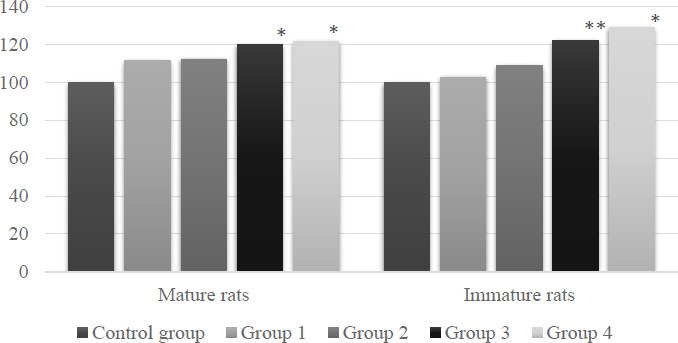
The ratio of AST/ALT did not differ significantly between the control group and the studied groups, and in turn was not statistically significant.
Discussion
According to literature sources [14], the body weight of animals and the relative weight of individual organs are non-specific indicators that reflect the general state of the body during the intake of xenobiotics with drinking water. The dynamics of the body weight of experiment-subject animals reflects the general reaction of the body to the influence of a chemical compound. The obtained results indicate that nitrates, when supplied with drinking water in excess amounts, had an adverse effect on the body of both sexually mature and sexually immature white female rats and caused a decrease in the rate of body weight gain in both age categories compared to rats of the control group. At the same time, in the control group of sexually immature rats, which were in the period of growth and puberty and did not have the adverse effect of nitrates, there is a more significant increase in body weight than in sexually mature rats, i.e., 84.6% versus 19.1%, respectively. The results of animals that consumed drinking water with a nitrate content of 250 and 500 mg/l were the most significantly behind the control indicators.
The liver is the organ that first reacts to the toxic effects of chemicals. Therefore, the assessment of changes in absolute and relative liver mass, as one of the non-specific indicators of the effect of toxic substances on the organ, is of great importance. It is known that in sexually mature animals, on the one hand, the intensity of metabolic processes in the liver decreases with age, and on the other hand, the number of functionally active hepatocytes significantly decreases, as described by other authors [15]. Therefore, with the toxic effect of chemicals, an increase in the liver and in its fullness, caused by an inflammatory reaction, can be noted [13].
We also noted an increase in the relative weight of the liver in sexually mature white rats. In sexually immature rats, on the contrary, the relative weight of the liver decreases, which may be caused by anatomical immaturity, incomplete differentiation of cells and tissues in young animals, and peculiarities of the course of metabolic processes associated with imperfect neuroendocrine and immune regulation [16]. We observed this in sexually immature white rats that were consuming water with excessive doses of nitrates, which led to the development of dystrophic processes and a decrease in the relative weight of the liver compared to sexually mature rats.
It is known that in nitrite toxicosis, due to the formation of a large amount of methemoglobin in the blood, insufficient oxygen enters the tissues, and tissue hemic hypoxia develops, which can cause functional and morphological changes in many organs, in particular, in the liver [17]. The activity of transaminases in blood serum is one of the most valuable and common indicators in clinical practice. These enzymes are indicators of the functional state of the liver, as they are also biochemical markers of cytolysis syndrome – a non-specific reaction of liver cells to the action of factors, the basis of which is a violation of the permeability of cell membranes and their organelles, which leads to the release of intracellular enzymes into the blood plasma. At the initial stages of cytolysis, the condition of the lipid layer of the membranes changes (in particular, the peroxide oxidation of lipids increases), and the hepatocyte membrane becomes more permeable to a number of substances, primarily to aminotransferases. ALT is a cytoplasmic enzyme, and AST is a cytoplasmic-mitochondrial enzyme. This is important for indirect assessment of the severity of hepatocyte damage [18,19]. Therefore, the detection of a statistically significant increase in the activity of ALT and AST in the blood serum of both age groups compared to the control group when consuming water with a nitrate concentration of 500.0 mg/l may indicate an increase in cytolysis processes in the body of rats. In terms of age, the intensity of changes in ALT activity in blood serum in sexually immature animals exceeded the indicators of sexually mature animals in the 3rd and 4th groups by 2.1 times, while the activity of AST almost did not differ from the indicators of sexually mature animals. Our results are consistent with those of Ogur et al., who reported that rats receiving drinking water containing 400 mg/L nitrate had higher AST and ALT compared to rats consuming water with 200 mg/L nitrate [20].
Conclusions
Nitrates, under the conditions of their intake with drinking water in concentrations of 250 and 500 mg/l, cause multidirectional changes in the relative weight of the liver: with an increase in their concentration, the relative weight of the liver in sexually mature rats increased, and in sexually immature rats, at similar concentrations, on the contrary, it decreased, and significantly increased the activity of alanine aminotransferase and aspartate aminotransferase in blood serum of sexually mature rats compared to the control group. In sexually immature rats, the intensity of manifestations exceeded the indicators of sexually mature rats.
Long-term consumption of low-quality drinking water, in which the amount of nitrates exceeds the normative indicators, can have a negative effect on the body of water consumers, contributing to the development of pathological processes and non-infectious diseases.