


Introduction
In our time, marked by military actions on the territory of Ukraine, there is a pressing need for significant changes in the professional training of personnel in the National Guard of Ukraine as a unit within the Ministry of Internal Affairs. The relevance of the topic is justified by the insufficient preparedness of the personnel of the security and defense sector during service in extreme and psychologically tense situations.
Experts [1] have identified that the pressing issues requiring resolution include the search for effective means, methods, and technologies to improve the physical fitness of officers (47.6%). The proposed content-functional model for forming the psycho-physical readiness of officers in the National Guard of Ukraine to perform assigned tasks by specialists [2], with an emphasis on the use of special physical training means, does not include (nor indicate ways of) individualization of the training process for cadets. This is considered one of the fundamental requirements of a modern approach to shaping training programs for cadets [3,4]. Special physical training programs presented in literature are built on the application of a single type of sport: hand-to-hand combat [5], military-sports pentathlon [6], military pentathlon [7], CrossFit [8], Horting [9], and kettlebell sport [10]. Programs with the comprehensive application of means essential for military-applied physical training of cadets are lacking.
The presence of isolated and unsystematized contradictory data in specialized literature does not allow for the development of effective training programs for cadets of higher education institutions of the National Guard of Ukraine, preparing them for productive work in their field and resisting professional burnout. This does not contribute to ensuring the safety of citizens, maintaining law and order within the country, and increasing its defense capabilities.
Aim of the work
The aim of the research was to develop a technology for the development of professionally important qualities of cadets of higher education institutions of the National Guard of Ukraine through sports and physical training and to assess its prognostic effectiveness.
Material and methods
Preliminary stage of the research (October 2020 – May 2022)
During the preliminary stage, studies were conducted that formed the basis for justifying and developing a technology for the development of professionally important qualities of cadets of higher education institutions of the National Guard of Ukraine through sports and physical training (Figure 1).
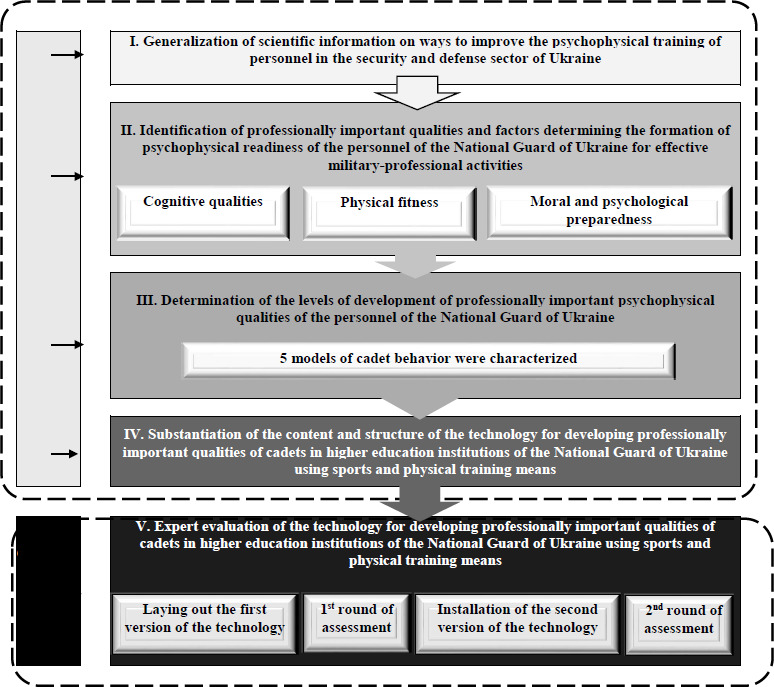
To justify the technology for developing professionally important qualities of cadets of higher education institutions of the National Guard of Ukraine through sports and physical training, the following research methods were applied: testing the physical fitness of cadets (n=168); surveys (questionnaires n=168); psychodiagnostic research methods (n=282). Statistical research methods were applied at all stages.
Testing of the physical fitness of cadets was conducted in order to determine the level of development of individual physical qualities. 8 test exercises were used. They were selected in such a way as to obtain information about all physical qualities and the level of development of all major muscle groups: 1) pull-ups on the crossbar (times); 2) pull-up with a twist on the bar (repetitions); 3) shooting a pistol from a place at a specified size of the target (by feet) during a limited time during the day (number of hits); 4) complex strength exercise (number of times); the exercise consists of two parts: the first one is bending and extending the trunk, the second one is bending and extending the arms while lying down; 5) general control exercise on a single obstacle course; this is performed without weapons, with the distance being 200 m (min, s); 6) shuttle run 10×10 (m, s); 7) throwing an F-1 grenade at a distance; the weight of the grenade was 600 g (m); 8) running for 3,000 m (min, s).
To determine the degree of importance of professionally significant physical qualities and psychophysical indicators of moral-psychological qualities, a survey (questionnaire) was conducted. Respondents assessed the importance of qualities on a 5-point scale. The questionnaire was developed by the authors of the article and consisted of 3 parts. The internal consistency of the questionnaire was assessed using Cronbach’s alpha. The result was considered satisfactory if its value was ≥0.7. The Cronbach’s alpha value of the questionnaire was 0.980, specifically for the part related to physical fitness: 0.952, and for the part related to professionally significant psycho-physical qualities, social, and personal aspects: 0.973. The alpha coefficient of each scale was at an acceptable level and did not significantly improve upon excluding individual questions.
Psychodiagnostics included the use of standard techniques to assess the level of life satisfaction (SWLS) [11], emotional control [12], anxiety [13], and coping strategies [14].
Main stage of the research (June 2022 – May 2023)
During the main stage of the research, the prognostic effectiveness of the technology for developing professionally important qualities of cadets of higher education institutions of the National Guard of Ukraine through sports and physical training was evaluated. The Delphi Method of expert assessments was applied for this purpose. Initially, the working group compiled the first version of the technology. The components of the technology were systematized into blocks reflecting the requirements for cadets of higher education institutions of the National Guard of Ukraine: future officers, goals, content and organization of physical training, and the results of this process.
After the initial evaluation of the technology (June 1st, 2022), experts recognized all the proposed blocks by the working group as important and necessary. Only one component of the second block –tasks related to the formation of military discipline and responsibility, general culture, and ethics – was assessed by experts with a small number of points.
Based on the information obtained from the experts, the working group compiled a second improved version of the technology, taking into account all aspects raised by the experts. The break between two separate surveys lasted less than a month.
After the re-survey by the experts (June 15th, 2022), the indicators of the standard deviation and coefficient of variation of the mean arithmetic value of their ratings were not significant, serving as the criterion for completing the expert survey. The working group compiled all the proposals, comments, and recommendations of the experts into a single document, which was sent to all the experts for final approval. The experts highly rated the second version of the technology. Thus, the final version of the technology for developing professionally important qualities of cadets of higher education institutions of the National Guard of Ukraine through sports and physical training was compiled.
Participants
15 individuals were involved in the expert assessment. The requirements for experts included: academic degree (PhD or Doctor of Philosophy, Doctor of Science), and/or academic title (associate professor, professor); military rank (officer rank); publications in the field of knowledge; practical experience in the armed forces and security and defense sector structures of Ukraine in physical training and sports for at least 7 years; and exclusion criteria included conflicts of interest with organizers and unwillingness to participate in the survey. The average age of the experts was 43.80±14.34 years, experience: 21.92±16.65.
In order to quantitatively describe empirical data, descriptive statistical methods were employed, such as calculating statistical indicators. The empirical data was described through basic statistical indicators: mean, median, mode, standard deviation, coefficient of variation, and minimum and maximum values of the variable.
To determine the significance of the relationship between the level of physical, psychophysical readiness, and moral-psychological qualities of the personnel of the National Guard of Ukraine, correlation analysis was conducted. The Spearman rank correlation coefficient was calculated.
For comparing whether the mean values of the results of psychodiagnostics of two samples differed significantly, a one-way analysis of variance (One-Way ANOVA) was conducted.
To test the null hypothesis that the sample comes from a normally distributed population, the Shapiro-Wilk test was performed.
Cluster analysis was carried out to identify groups of cadets with similar characteristics, needs, or behavior, and to divide them into groups, allowing for a better understanding of the target audience of cadets and the development of more effective training strategies for them.
IBM SPSS Statistics V. 23 (SPSS Inc., Chicago, Illinois, USA) was used for statistical analysis of the questionnaire data.
The Delphi Method was used for the expert assessment to evaluate the structure and content of the technology for developing professionally important qualities of cadets of higher education institutions of the National Guard of Ukraine through sports and physical training. All the experts had a high level of professionalism and significant work experience. The experts rated the components of the technology for developing professionally important qualities of cadets of higher education institutions of the National Guard of Ukraine through sports and physical training, as well as the technology as a whole, on a 9-point scale, according to 7 criteria developed by us. The arithmetic mean values of the expert assessments of the components of the technology and their standard deviations were calculated. The reliability of differences between the mean values of technology assessments of two rounds was determined using the Student’s t-test for paired samples.
Results
Preliminary stage of the research
At the preliminary stage of the research (through the synthesis of scientific information on ways to improve the psychophysical training of personnel in the security and defense sector of Ukraine), we found that the level of physical fitness of a significant portion of cadets was low, and the development of professionally important physical qualities was heterogeneous; the moral-psychological indicators of participants in combat actions were often unsatisfactory. Despite numerous scientific studies dedicated to finding ways to improve professionally important psychophysical qualities, the psychophysical training of personnel in the security and defense sector of Ukraine requires improvement. One possible way to enhance the psychophysical training of personnel in the security and defense sector of Ukraine may be the application of sports and physical training means.
A correlation between physical fitness and psychomotional indicators was established. Dexterity (primarily such manifestations as coordination of movements, a sense of rhythm, the ability to differentiate efforts and movements in space, the ability to maintain static and dynamic balance), as well as speed strength and speed, are important professional and important physical qualities for the personnel of the National Guard of Ukraine. The improvement of dexterity is accompanied by an increase in the level of development of a whole range of competencies of the defenders of the country’s interests. Cognitive indicators included: stability of attention (r=0.640) and the ability to concentrate it (r=0.691), correlate reliably (p<0.05) with dexterity indicators, volume (r=0.610) and attention switching (r=0.612), logical thinking (r=0.650), as well as moral and psychological qualities (p<0.05), such as: the ability to manage personnel, elements of strategic thinking, the ability to learn new knowledge and skills, switching attention, motivation, leadership qualities, prudence, receptiveness to innovation, the ability to take the initiative, skills in planning daily activities, self-confidence, perseverance, the ability to work in a group, knowledge of one’s own strengths and weaknesses, the ability to listen and communicate, mental abilities, the ability to care for the professional growth of subordinates, communicative skills, ability to make necessary decisions, etc.
However, there is occasional and conflicting data on the characteristics of motor activity that contribute to the formation of leading professionally important qualities of personnel in the security and defense sector of Ukraine [3,7,15]. Technologies that meet modern requirements were not identified.
As a result of a series of conducted studies, we identified professionally important qualities and factors that determine the formation of psychophysical readiness of the personnel of the National Guard of Ukraine for effective military-professional activities [1,15-17]. The factors that we consider to determine the formation of psychophysical readiness of the personnel of the National Guard of Ukraine include: 1) cognitive qualities: attention (persistence, concentration, switching ability, distribution, and volume), thinking (strategic and logical); leadership qualities: the ability to manage personnel and achieve common goals; 2) courage (fearlessness, confidence in one’s abilities, perseverance) and emotional intelligence (ability to understand others’ feelings and influence them, ability to work in a group); 3) physical qualities (agility: ability to maintain dynamic balance, ability to differentiate movements in space, sense of rhythm), strength: maximum strength, speed strength.
We determined the levels of development of professionally important psychophysical qualities of the personnel of the National Guard of Ukraine [12]. Using the obtained data, we created psychophysical “profiles” for five models of cadet behavior [18]. Model A: physically enduring, passive, risk-averse, stress-sensitive, unwilling to make decisions in stressful situations, do not rely on societal support. Model B: life-satisfied, possess well-developed strength and muscular endurance, critically low levels of specialized endurance and agility development, stress-resistant, responsible, perceive stressful situations as challenges, take risks, assert their own interests. Model C: least satisfied with life, below-average physical fitness, particularly low scores in specialized endurance and muscular endurance, resilient, capable of exerting aggressive efforts, able to find opportunities for using informational, emotional and physical support. Model D: lowest indicators of physical fitness, adaptive level of psychological preparedness. With these profiles, it is possible to predict the psychological characteristics of cadets based on the results of their physical training and propose an intervention program to address the “weak” aspects of psychophysical preparedness.
Analysis, synthesis, and generalization of the results of three periods of the preliminary research stage allowed us to substantiate the content and structure of the technology for developing professionally important qualities of cadets in higher education institutions of the National Guard of Ukraine using sports and physical training means and to develop the technology [19] (Figure 2).
Figure 2
Scheme of the technology for developing professionally important qualities of cadets of higher education institutions of the National Guard of Ukraine using sports and physical training means
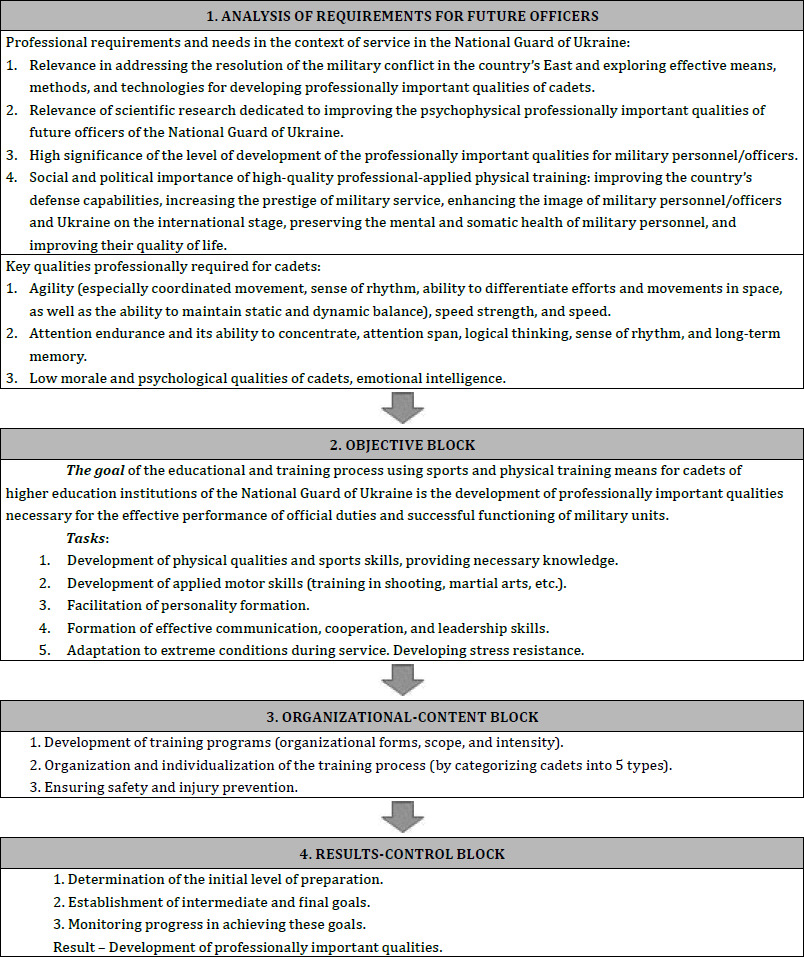
After the first round of expert assessment, our developed technology for fostering professionally important qualities among cadets of higher education institutions of the National Guard of Ukraine through sports and physical training had an average effectiveness score of 7.73±0.34 out of 9 possible points. According to the recommendations of the experts, we refined the formulation of the first three tasks of the technology and added the formulation of its final result.
After considering the experts’ suggestions, in the second evaluation, the average effectiveness score of the technology was 8.11±0.14 points. Changes in the ratings were statistically confirmed (p<0.001), indicating an increase in the prognostic efficiency of the technology.
The coefficient of variation of expert opinions between iterations decreased from 15.97% to 9.57% (from moderate to low variability), indicating an increase in the uniformity of their assessments. The final version of the technology developed by us was highly appreciated by the experts (Table 1). The average rating of the technology by criteria was 8.41±0.13 points (on a 9-point scale). The experts gave the highest scores to the practical significance of the technology (8.60±0.74 points), its novelty (8.53±0.64 points), and the relevance of the development to its title (8.73±0.59 points).
Table 1
Evaluation results of the technology for developing professionally important qualities of cadets of higher education institutions of the National Guard of Ukraine through sports and physical training means
Discussion
We have justified the structure and content of the technology for developing professionally important qualities of cadets of higher education institutions of the National Guard of Ukraine using sports and physical training means.
In contrast to existing models [2], our proposed technology includes, in addition to the target, organizational-content, result-control blocks, and a block for analyzing the requirements for future officers. This block consists of two components: professional requirements and needs in the context of service in the National Guard of Ukraine and the essential qualities professionally required for cadets (physical, cognitive, and moral-psychological).
Our data indicates that coordination indicators are relatively the most critical in the professional training of cadets of higher education institutions of the National Guard of Ukraine, placing them at the forefront of the list. This contrasts with the views of some experts [20-22] who consider overall endurance and strength as the main physical qualities. However, this aligns with results [23-26] highlighting the importance of coordination qualities in the psychophysical preparation of military personnel and extends the opinion [27,28] on the feasibility of incorporating coordination improvement into cadet training programs.
Our organizational-content block consists of three components: the creation of training programs (organizational forms, direction, means, volume, and intensity), organization and individualization of the training process (by dividing cadets into five clusters), and ensuring safety and injury prevention. According to the third block component, our proprietary technology involves considering individual and group features of cadets during the preparation process. To achieve this, we recommend applying the recommendations we have developed.
Using the data obtained in the previous stage, we compiled psychophysical characteristics of 5 groups of cadets [18] with similar characteristics, needs, or behaviors within the group, significantly differing them from representatives of other groups. The application of our compiled psychological portraits will allow for the selection of appropriate physical loads for cadets representing each group, predicting their psychological characteristics, and proposing a training program to address the “weak” aspects of psychophysical preparation. This will contribute to enhancing the individualization of the development process of professionally important qualities of cadets of higher education institutions of the National Guard of Ukraine using sports and physical training means. Thus, we have refined the content-functional model of forming the psychophysical readiness of officers of the National Guard of Ukraine for performing tasks, with an emphasis on the use of specialized physical training means, as developed by experts [2].
To minimize the impact of stress factors inherent in working in extreme situations, scientists [3] recommend applying individually beneficial sports aimed at developing professionally important physical qualities. For this purpose, they developed and tested training programs for specific physical qualities through personalized sports activities, including swimming, bodybuilding, karate, and general physical training. The research findings [3] confirmed the effectiveness of the program in shaping specific physical qualities through individual sports. However, during the study, they could not identify a specific sport to unequivocally recommend for inclusion in the physical training program for professionals working in extreme conditions [3]. This underscores the importance of using a combination of different sports in the training of cadets.
According to the technology we propose, the training program consists of elements from various sports, unlike existing single-modal programs of special physical training developed by experts based on hand-to-hand combat [5], military sports pentathlon [6], military pentathlon [7], CrossFit [8], Horting [9], and kettlebell sports [10].
Based on the analysis of scientific results obtained in the previous stage of research, we recommend using the following means of physical training and sports to accomplish the tasks of our technology (Table 2).
Table 2
Recommended means of physical activity to address technology tasks
The high evaluation by the experts (8.41±0.13 points out of 9) of the technology for developing professionally important qualities of cadets in higher education institutions of the National Guard of Ukraine using sports and physical training means attests to its prognostic effectiveness. The synthesis of the expert survey results indicates that the technology we developed is a new, original creation distinguished by conciseness, high practical significance, has scientific value for the field, and its content aligns with its name and objectives. The application of this technology for developing professionally important qualities of cadets in higher education institutions of the National Guard of Ukraine through sports and physical training will contribute to raising the prestige of military personnel in the country, strengthening the authority of military service and enhancing the defense capabilities of Ukraine, thus contributing to the growth of its reputation. For officers, this means that the use of this technology will help improve their physical and mental health, positively impacting their quality of life.
Conclusions
We have created a technology for the development of professionally important qualities of cadets in higher education institutions of the National Guard of Ukraine through sports and physical training. It is a new, original development characterized by conciseness, high practical significance, has scientific value for the field, and its content aligns with its name and objectives, possessing high prognostic effectiveness (8.41±0.13 points out of 9).
Its structure differs from existing structures through the initial block “Analysis of Requirements for Future Officers”, consisting of two components: professional requirements and needs in the context of service in the National Guard of Ukraine and basic qualities professionally necessary for cadets: physical, cognitive, and moral-psychological. The content of the authors’ technology stood out with the authors’ elaborations on the division of cadets into groups, allowing for a better understanding of the target audience and the development of more effective preparation strategies.